51
The Broadrick Occlusal Plane Analyzer
is used for analyzing the Curve of Spee
and developing an acceptable curve of
occlusion, and is recommended for lab-
oratory procedures employing the
Functionally Generated Path Technique.
Note: This text describes the
mechanical function of the Broadrick
Occlusal Plane Analyzer. The reader
is urged to refer to other textual
material as well as classes devoted
to the clinical application of this pro-
cedure in occlusal correction.
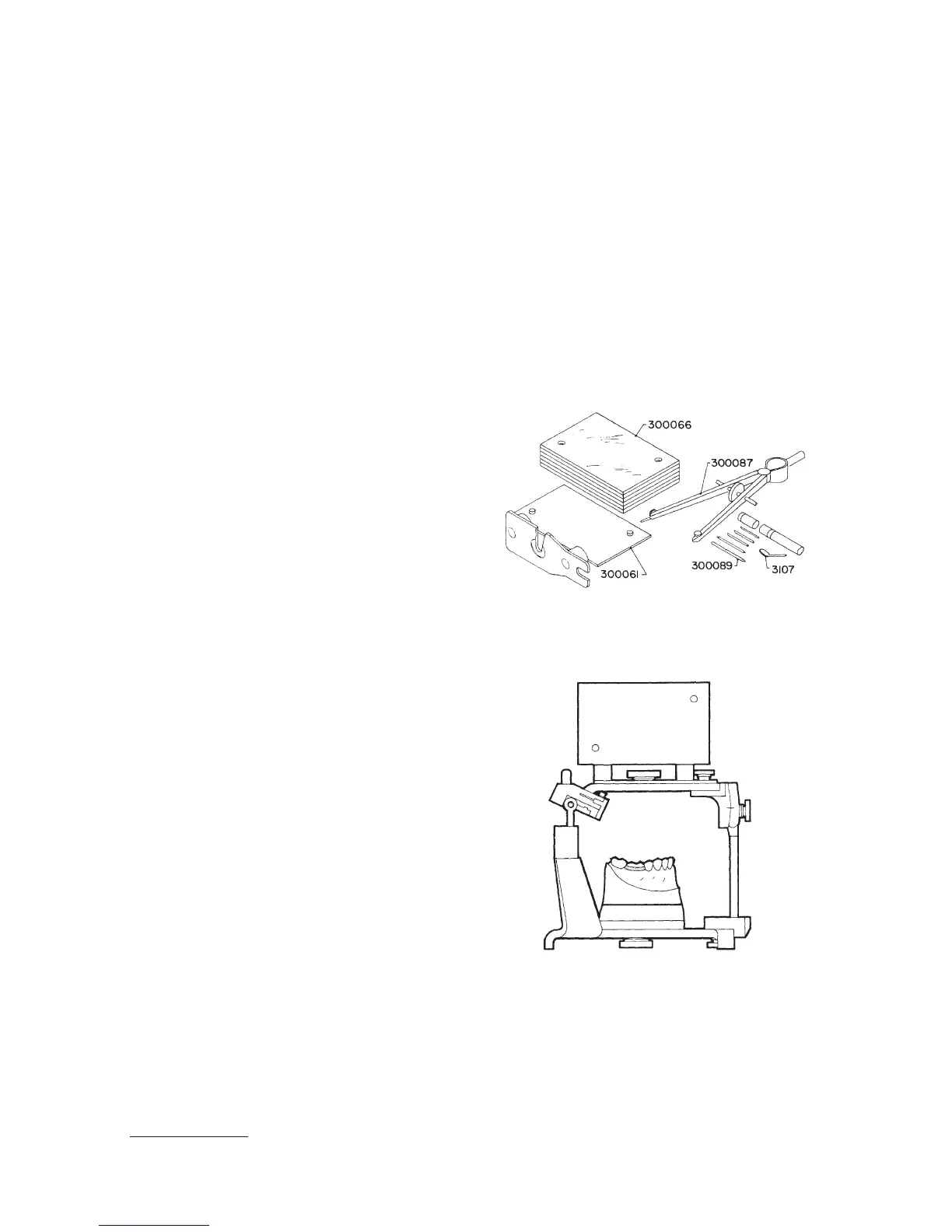
A Broadrick Occlusal Plane Analyzer, fig.
95, consists of (1) Card Index #300061,
(1) Bow Compass #300087 with
graphite leads of varying hardness,
1
(1)
extra center points #300088, (`1)
Scribing Knife #3017, (1) Needle Point
#300089, and (2) Plastic Record Cards
#300066.
To use the Occlusal Plane Analyzer the
casts are mounted in the articulator and
the articulator condyles and incisal con-
trols are adjusted in the conventional
manner. The Occlusal Plane Analyzer is
attached to the upper bow of the articu-
lator as illustrated in fig. 96 by securing
it beneath the screws which hold the
maxillary mounting plate and incisal pin
assembly in place.
It is pointed out that during the ensuing
procedure, the maxillary cast must be
removed from the articulator during the
survey.
Secure a plastic record card on the right
side of the flag. The plastic record cards
are matte finished on both sides and
readily accept pencil or ink markings.
The relatively small divergence between
arcs of 3 3/4”, 4”, and 5” radii over the
functional occlusal surfaces on the
lower posterior teeth is shown in fig. 97.
An average of 4” radius may be used in
the majority of surveyed cases.Variation
is only necessary when a pronounced
Curve of Spee may require a selection of
up to a 5” radius.
APPENDIX D
OCCLUSAL PLANE ANALYZER
1. Graphite leads of preferred hardness may be obtained locally from drafting supply houses.
fig. 95
fig. 96


 To Next Page