55
Articulators and other occlusal instru-
mentation exists to facilitate both the
diagnostic and treatment procedures for
the fabrication of restorations from the
single tooth to the complete dentition.
The question often arises regarding the
selection of the instrument of choice for
treating a particular prosthondontic
problem. To answer this question it is of
value to first briefly review the progress
that has taken place with the develop-
ment of instruments for occlusal treat-
ment and its impact on prosthodontic
techniques. This will also shed light on
why there are so many different instru-
ments being used.
The earliest articulators, which were of
the hinge type, were developed primari-
ly for full denture construction; i.e., to fill
the need for a mechanical device to
relate casts in an anatomically correct
position for the arrangement of artificial
teeth.
The next breakthrough resulted from the
desire to duplicate nature’s scheme and
provide patients with improved appear-
ance and speech. This led to improved
denture teeth of anatomical form. Also,
understanding the anatomy and func-
tions of the temporomandibular joints
and their relation to the occlusal scheme
brought about the development of artic-
ulators of anatomical dimensions with
some adjustment capability to simulate
the more pronounced condylar move-
ments of a given patient. These articula-
tors were adjusted primarily to interoc-
clusal records.
Since the articulators were still not com-
pletely adequate, the mouth was found
to be the best articulator to fabricate
wax patterns and casting that would be
attached to the natural teeth and be
compatible with the excursive move-
ments of the jaw. These early articula-
tors and occlusal schemes, that were
used to construct dentures resting on
mobile tissues, had to be supplemented
with more “in the mouth” procedures to
produce satisfactory results for fixed
restorations.
A great advance came in the late 1940s
and early fifties with the popularization
of the “indirect technique” i.e., the use
of impressions, casts and dies to dupli-
cate the dentition so that most of the
work could be done in the laboratory at
a bench rather than “in the mouth.” The
introduction of improved dental materi-
als to conveniently develop accurate
impressions and full arch working casts
coupled with the advent of high speed
cutting tools in dentistry popularized
restorative procedures for the general
public which heralded in a new era in
the development of instruments for
occlusal diagnosis and treatment.
Dentists sought more practical means to
accuratelly record and simulate the
movements of the jaw in order to deliver
better restorations in less time through
both improved laboratory work and
operating efficiency. The goal was to
produce better dentistry faster. It was
this effort and series of events that
resulted in the development of the
Dénar
®
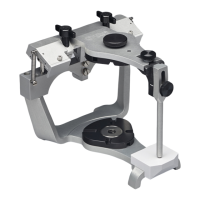
Pantograph and Fully Adjustable
Articulator and subsequently the
Dénar
®
Mark II System and the Dénar
®
Two Instrument System.
Questions often asked are: “Should a
pantograph and fully adjustable articula-
tor be used to fabricate a single gold
crown?” and “How extensive must the
restoration be before the use of a panto-
graph is indicated?” The simplest
response to these questions is as fol-
lows. If after tooth preparation, there
APPENDIX E
SELECTING INSTRUMENTS FOR OCCLUSAL TREATMENT


 To Next Page