56
a
re sufficient unprepared teeth to pro-
vide positive stops and guidelines to
which to construct the restoration, the
restoration can be constructed in har-
mony with the existing occlusion and
the use of a pantograph is not neces-
sarily indicated. On the other hand, if
after tooth preparation, there are insuffi-
cient guidelines in the remaining occlu-
sion to which to construct the restora-
tion, the restoration should be con-
structed in harmony with the patient’s
temporomandibular joint characteris-
tics. These characteristics can be diag-
nosed most efficiently with a panto-
graph and fully adjustable articulator
although other treatment methods are
available.
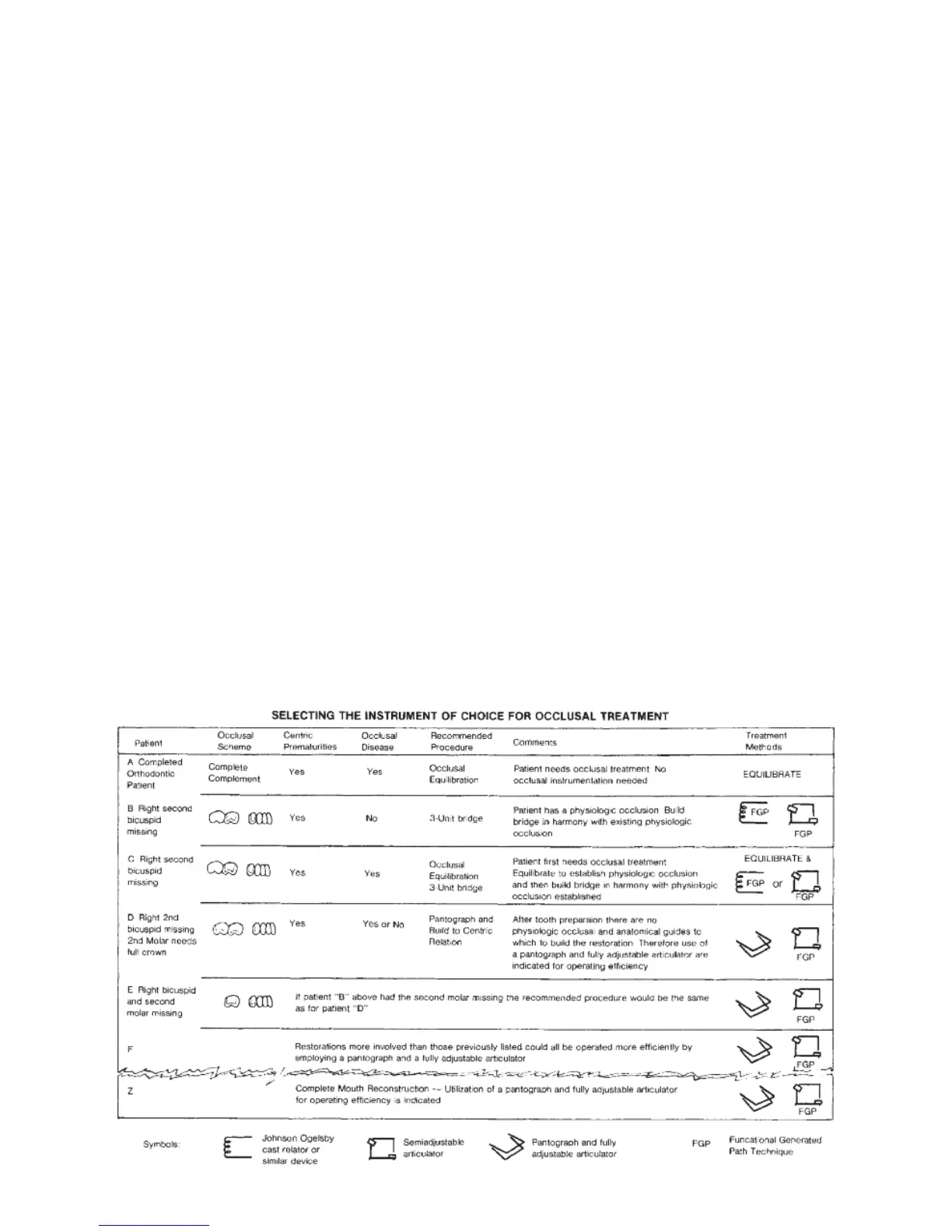
In order to better understand the criteria
for selecting the instrument of choice for
occlusal treatment a discussion of the
examples on the chart below is helpful.
In this discussion reference is made pri-
marily to the pantograph and fully
adjustable articulator; however the Mark
II System utilizing checkbites and sup-
plemented with occlusal equilibration
and the functional generated path tech-
n
ique, when indicated, can be used to
produce excellent results.
To keep the discussion pertinent, it is
assumed that none of the patients in the
following examples have temporo-
mandibular joint disease.
PATIENT A is a finished orthodontic
patient who has a full complement of
teeth in good alignment. The patient has
a slight occlusal prematurity which has
triggered facial pain. The patient has a
pathologic occlusion and occlusal treat-
ment is indicated. The treatment is pri-
marily occlusal equilibration. An articu-
lator can be used in diagnostic proce-
dures although it is not always needed
in treatment.
PATIENT Z on the other hand exhibits
many missing teeth. The remaining teeth
are badly broken down. There is exten-
sive drifting of teeth and the occlusion is
totally disorganized. This patient
requires a complete mouth reconstruc-
tion. This restoration could be fabricated
most efficiently by employing a panto-
graph and fully adjustable articulator.


 To Next Page