57
A
t what point between the two extremes
represented by Patient’s A and Z is the
use of a pantograph and fully adjustable
articulator indicated? The answer to this
question is presented in the following
discussion of Patient’s B through E who
exhibit increasingly complex occlusal
problems.
PATIENT B has a missing right second
bicuspid and a minor centric prematuri-
ty. There are no symptoms which can be
related to the occlusal condition. The
patient has a physiologic occlusion. The
recommended treatment is a three unit
bridge. To perform this laboratory pro-
cedure the cast can be accurately relat-
ed at the correct vertical dimension in a
nonrigid cast relating device such as a
Johnson Olgesby Articulator (which has
springs for condylar posts so that the
casts can be gnashed together) and the
bridge fabricated in harmony within the
anatomical guides provided by the pre-
vailing physiologic occlusion. This pro-
cedure could be used successfully if the
restoration were one, two or three
crowns on one, two or three of the teeth
involved in the bridge. Alternately a
method preferred by many operators is
the use of the functional generated path
technique (FGP) to fabricate this pros-
thesis.
PATIENT C has the same mouth condi-
tions and occlusal scheme as Patient B
with the exception that the occlusal
scheme has triggered bruxism and the
sequelae of bruxism (occlusal disease).
This patient first requires occlusal treat-
ment and in addition, a three unit bridge.
The recommended procedure is to first
equilibrate the natural occlusion to estab-
l
ish a physiologic occlusion and subse-
quently fabricate the three unit bridge (or
inlays) as outlined for Patient B.
PATIENT D has the right second bicus-
pid missing and in addition the right
second molar has indications for full
coverage. Slight occlusal discrepancies
exist. Whether this patient has related
symptoms or not, the procedure many
dentists would recommend when this
many teeth are involved in the prosthe-
sis is to fabricate the restoration in cen-
tric relation. Since after tooth prepara-
tions there are no more anatomical con-
trols in the occlusion on the right side of
the mouth to use as anatomical guides
to which to fabricate the restoration,
then the next most posterior anatomical
control, the temporomandibular joint, is
used as a control for the fabrication of
the prosthesis (see figures 26C and 27
and related discussion). This could be
accomplished most efficiently by utiliz-
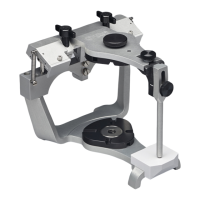
ing a pantograph and fully adjustable
articulator.
PATIENT E. If Patient B had in addition
to the missing right second bicuspid the
right second molar missing, the recom-
mended treatment would be the same
as for Patient D.
Restorations more involved than those
previously listed could all be operated
more efficiently by employing a panto-
graph and fully adjustable articulator or
alternately by means of the Mark II
System supplemented with the func-
tional generated path technique and/or
occlusal equilibration as described
above.


 To Next Page