28
W
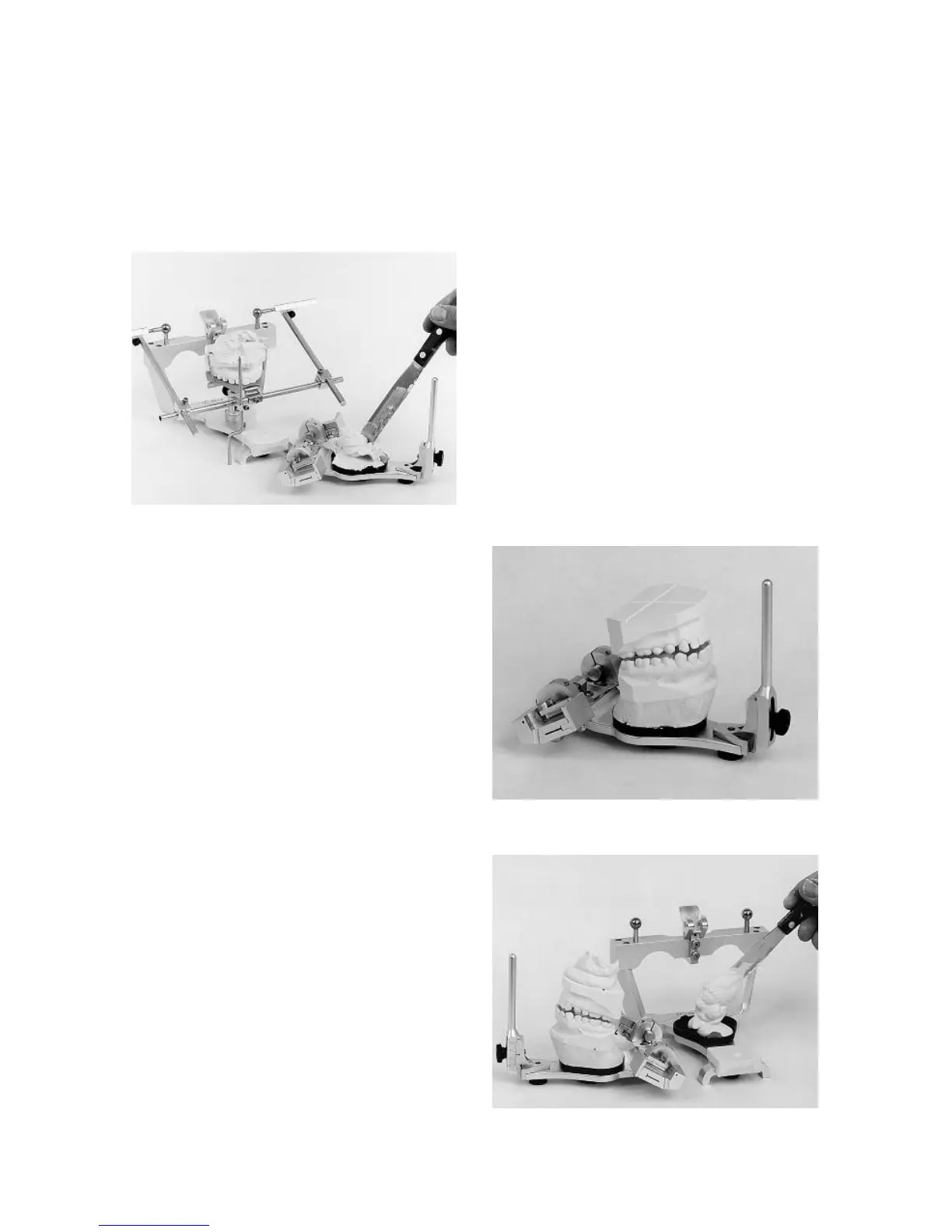
ith the facebow application (not the
earbow) it is usually easier to fill the
mounting plate with stone and stock a
pile of mounting stone on the maxillary
cast if the maxillary bow is removed and
inverted on the working surface beside
the facebow-mandibular bow assembly
(fig. 55).
THE MANDIBULAR CAST
With the maxillary cast in the articulator,
separate the upper bow from the lower
bow and turn the upper bow upside
down. Orient the mandibular cast to the
maxillary cast by accurately seating and
luting the centric relation record
between the two casts. Secure the
casts assembly with sticky wax or a light
rubber band (fig. 56).
If the centric relation record was taken
at an increased vertical dimension, esti-
mate the distance the vertical dimension
was increased by the centric relation
record and adjust the vertical dimension
of the incisal pin to this dimension.
Fill the lower bow mounting plate with
fast set stone and put an appropriate
amount of stone on the base of the
mandibular cast (fig. 57). Then invert the
lower bow and seat it on top of the
upper bow. Make sure the condyles are
seated in their fossae (fig. 58). Make
sure that the incisal table is on the
incisal pin. Lock the centric latch to its
most closed portion. Complete the
m
ounting of the mandibular cast with
the “one mix” or “two mix” procedure
previously described.
An alternate method of mounting the
mandibular cast is to first load the
mounting plate with fast set stone and
then put an appropriate amount of stone
on the base of the mandibular cast.
Next grasp the maxillary bow and sup-
port the centrically related casts with the
thumb, index and middle fingers as illus-
trated in fig. 59. Invert the maxillary
bow-casts assembly over the mandibu-
lar bow and firmly seat the condyles in
their fossae. Close the articulator until
the incisal pin contacts the incisal table.
While maintaining this hand grasp have
an assistant move the centric latch to its
most closed position. After the initial set
of the mounting stone has occurred to
fig. 55
fig. 56
fig. 57


 To Next Page