15
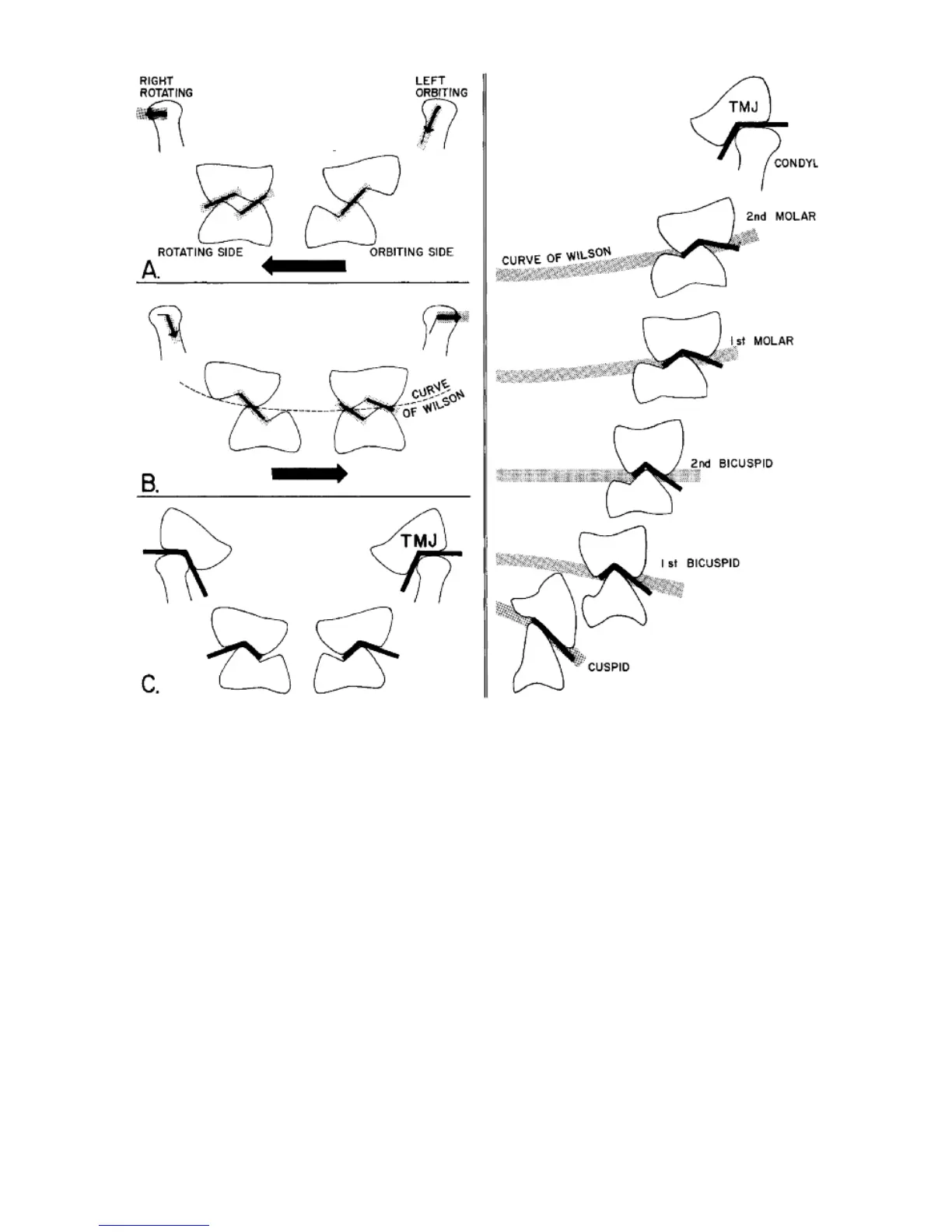
The closer the functioning tooth incline is
to the condylar path of movement the
more the tooth incline simulates that
condylar path of movement.The interrelat-
ing tooth inclines on the orbiting side in
figure 26A have steep inclines to comple-
ment the path of movement of the orbiting
condyle.
Figure 26B illustrates a left lateral move-
ment. Due to the fact that the left rotating
condyle is moving straight outward the left
maxillary buccal cusps must be kept short
to allow the left mandibular buccal cusps
to escape. It is this influence of the rotat-
ing and orbiting condylar paths on
occlusal anatomy that establishes the
Curve of Wilson. The more posteriorly we
progress in the dental arches the
mandibular teeth take on a greater lingual
inclination and the maxillary teeth take on
a greater buccal inclination to harmonize
occlusal anatomy to condylar paths of
movement (fig. 27). The condyle tracks a
path in its fossa just as a buccal cusp of a
lower molar tracks a path in its fossa on
the occlusal surface of an upper molar. For
all practical purposes in the use of articu-
lators to establish dental articulation, the
temporo-mandibular joint can just be
thought of as another tooth, the fourth
molar
__
another anatomic control of jaw
movement (figs. 26C and 27).
fig. 26 fig. 27


 To Next Page