41
retruded position and the orbiting
condyle advanced approximately seven
millimeter. This can be done with the
“thumb on chin” method with the thumb
on the anterio-inferior border of the
mandible in the area of the left cuspid.
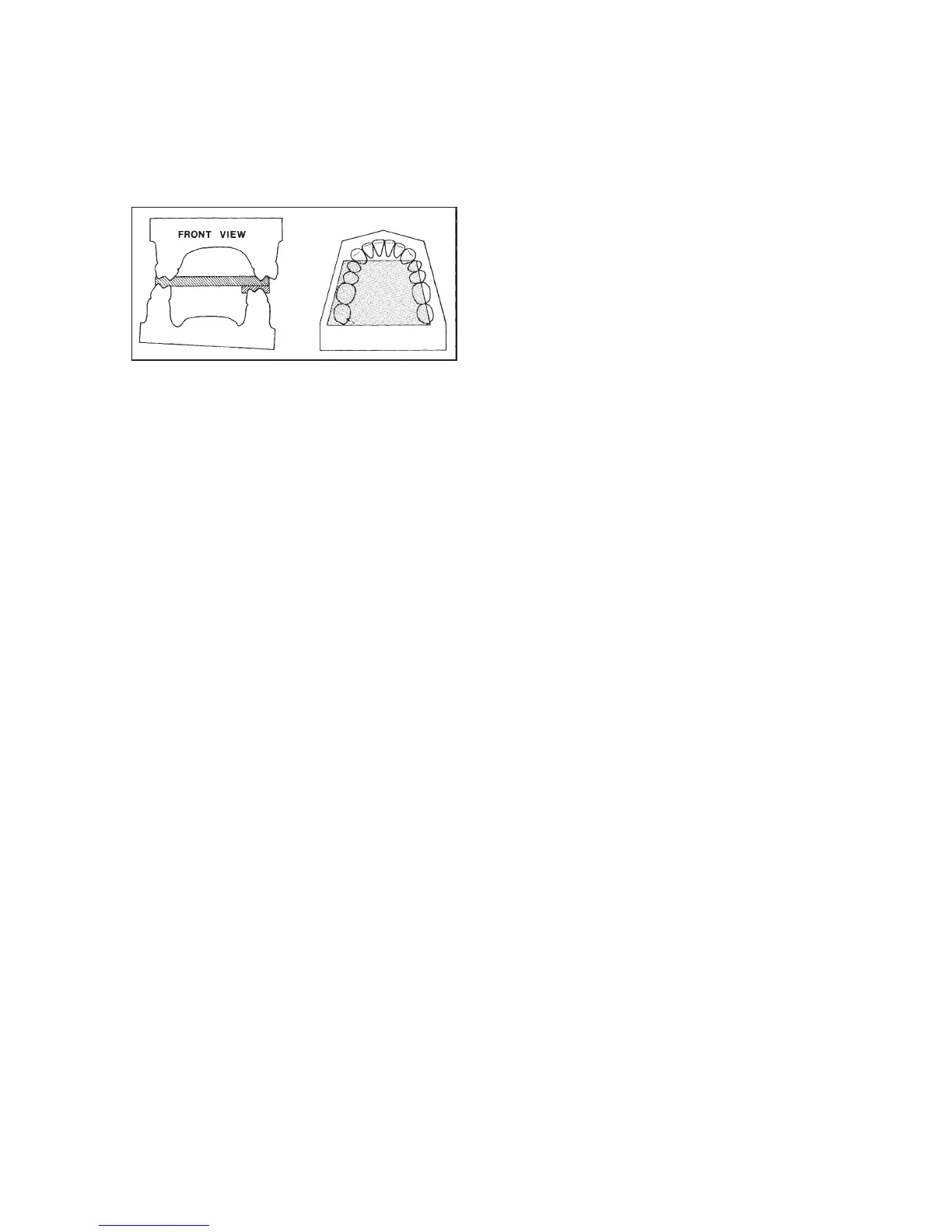
Construct a wax wafer composed of
two thicknesses of hard base plate wax
to the dimensions illustrated in fig. 81.
This is done by fabricating an oversized
wafer as previously described and
adapting it to the maxillary teeth with the
index fingers to conform the wafer to the
plane of occlusion and to obtain light
imprints of the cusp tips. Chill the wafer
with air and remove it from the mouth.
Use a warm scalpel to trim the wafer to
the desired dimensions. Return the
wafer to the mouth, and position it on
the maxillary teeth to confirm that it is
stable on the maxillary teeth and con-
forms to the plane of occlusion. Guide
the mandible in right lateral closure to
contact the wax and determine the
number of additional strips of wax which
must be added to the lateral extremities
of the mandibular side of the wafer to
establish even contact with the
mandibular teeth. Lute additional thick-
nesses of wax to the mandibular side
and then heat the lateral extremities of
the wafer in an open flame to soften the
wax. Quickly temper the wax in a wafer
bath and position the wafer on the dry
maxillary teeth. Guide the mandible in
right lateral closure to obtain light
imprints of the cusp tips in the wax. Chill
the wax with air and remove the wafer
from the mouth and place it in cool
water. The wafer can be returned to the
mouth and checked for accuracy.
fig. 81


 To Next Page