Table 2 – Circulating Pump Flow Rates
Model kW Minimal flow ∆T = 10°F ∆T = 20°F
USGPM (L/min) USGPM (L/min) USGPM (L/min)
HYDRAT15-E2401M 15 5.1 (19.3) 10.2 (38.7) 5.1 (19.3)
HYDRAT18-E2401M 18 6.1 (23.2) 12.3 (46.4) 6.1 (23.2)
HYDRAT20-E2401M 20 6.8 (25.8) 13.6 (51.6) 6.8 (25.8)
HYDRAT24-E2401M 24 8.2 (30.9) 16.3 (61.9) 8.2 (30.9)
HYDRAT27-E2401M 27 9.2 (34.8) 18.4 (69.6) 9.2 (34.8)
HYDRAT29-E2401M 29 9.9 (37.4) 19.7 (74.7) 9.9 (37.4)
2.4 DISTRIBUTION SYSTEM
The proper functioning of your heating system is directly
related to the quality of the plumbing installation.
Therefore, the entire installation must be performed by
qualified technicians.
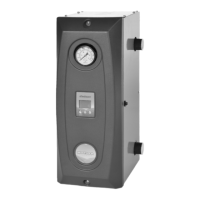
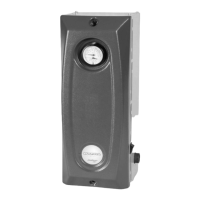
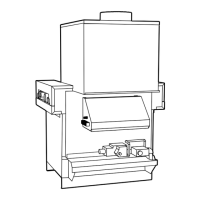
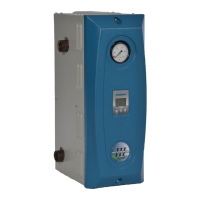
See Figure 4 for the various boiler components.
The heating system should be set-up to operate at
a pressure around 12 psi. The maximum operating
pressure is 28 psi, but such a high pressure is abnormal
and requires inspection from a service technician. The
operating temperature may range from 5°C to 88°C (41°F
to 190°F).
All installations must include the following items:
• 1 pressure regulator, adjusted to 12 psi, must be
installed between the boiler and the main water
supply in the building;
• 1 expansion tank, pre-pressurized to 12 psi and of
appropriate size;
• 1 or more circulating pumps of appropriate
capacity.
• 1 or more air purge valves;
WARNING
BURN HAZARD
To avoid water damage and/or scalding due to
relief valve operation, a discharge line must be
connected to the valve outlet and run to a drainage
area. The discharge line shall be installed in such
a way that it will allow for the complete drainage of
the valve and the discharge line.
2.4.1 Circulating Pump
The circulating pump must be selected according to
the heating distribution system and the heating capacity
of the boiler. Table 2 shows necessary water flows
according to various temperature rises. For example, a
system using baseboard heaters will usually require a
temperature rise of 20°F, wheras a radiant floor system
will use a rise around 10°F.
2.4.2 Freeze protection (when required)
WARNING
Only propylene glycol may be used in this
hydronic heating system to prevent freezing.
It is recommended to add a maximum of 50%
of propylene glycol mixture to ensure proper
operation.
Do not use automotive anti-freeze, ethylene glycol
or any undiluted anti-freeze.
If the above recommendations are not followed,
severe personal injury, death or substantial
property damage can result.
6


 To Next Page