11- INSTALLATION WARNINGS
ATTENTION : Important safety instruc!ons. Follow all instruc!ons carefully, incorrect installa!on may cause serious injury.
Before start installa!on we highly recommend reading the instruc!ons and warnings contained in this manual carefully (see the SAFETY INSTRUCTIONS
AND WARNINGS Chap) and observing the instruc!ons it contains.
11.1 - Instruc!ons and warnings for installa!ons
• Before start installa!on read the. SAFETY INSTRUCTIONS AND WARNINGS chapter carefully
• The PROFESSIONAL FITTER electromechanical operator is responsible to perform risk analysis and to regulate the automa!ons
safety devices.
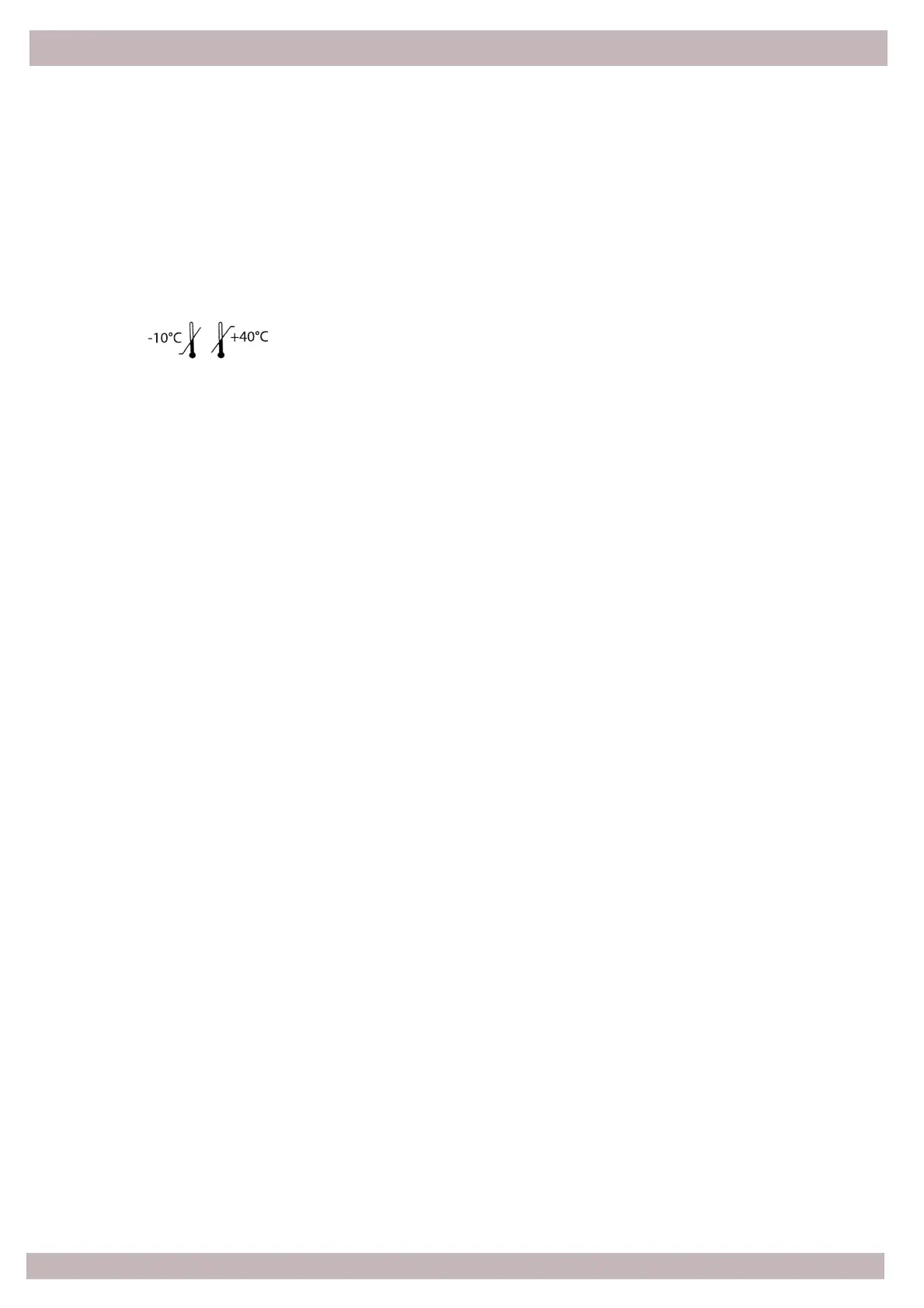
• The Fi"er must check that the temperature range declared on the electromechanical operator is in accordance to the place in when the device is
installed.
• Normally open/off bu"ons installed for the ac!va!on of the operator must be posi!oned so that they are within view of the gate but distant
from moving parts. Unless said commands operate using keys, they must be posi!oned at a minimum height of 1.5m and not accessible to to
unauthorised persons.
• During installa!on, make constant reference to harmonised standards EN 12453 and EN12445.
• Ensure that the individual devices to be installed are compa!ble with the electromechanical operator. Do not proceed if even just one device is
unsuitable for the intended use.
• Ensure that the place of installa!on of the central unit is not prone to flooding, does not contain sources of heat or naked flames, fires or hazard
situa!ons in general.
• During installa!on, protect control unit components in order to prevent liquids (e.g. rain) and/or foreign bodies (earth, gravel, etc) penetra!ng inside.
• Connect the control unit to a power supply line created in compliance with current regula!ons and earthed and fi"ed with a power supply sec!oning
switch.
• Connect the gearmotor only to an electrical power supply line carried out according to the regula!ons in force; device for complete disconnec!on of
the line in condi!ons of overvoltage category III in accordance with na!onal regula!ons in force.
• Wrapping materials must be disposed of in compliance with local regula!ons.
• Wear protec!ve goggles when making holes for clamping.
In the event of work at heights of over 2m from the ground, for example for the installa!on of the indicator lamp or aerial, fi"ers must be equipped
with with ladders, safety harnesses, protec!ve helmet, and all other equipment required by law and the standards governing this kind of work.
12 - TESTING AND TRIAL RUN
• The tes!ng and trial run must be performed by a COMPETENT PERSON supervised and aided by a PROFESSIONAL FinER.
It is the responsibility of the person who tests and sets up the automa!on (of which the control unit is a part) to perform the checks required in
accordance with the risks exis!ng and to check conformity with the relevant legisla!on and standards, in par!cular with EN standard 12445, which
governs the methods for performing trials on gate automa!ons and EN standard 12453 that specifies the performance requisites concerning safety
of use.
• The tes!ng and trial run are the most essen!al phases of installa!on for guaranteeing maximum opera!ng safety.
• The checks and procedures for tes!ng may also be used for rou!ne checks on the automa!on and its devices.
• The automa!on may only be tested if a non-hazardous force tolerance has been set. Force tolerance must be adjusted to a minimum value so as to
exclude the danger of injury during closure.
• Adjust the maximum force in line with EN standard 12445.
• Never touch the gate or moving parts when they are in mo!on.
• Remain at a safe distance when the gate is in mo!on: only pass when the gate is completely open and immobile.
• In the event of malfunc!ons (noisiness, jerky movements, etc.) suspend the use of the automa!on immediately: failure to observe this rule may
entail serious hazards, risks of accidents and/or serious damage to the gate and the automa!on .
• Always remember that the following residual risks exist when the gate is in movement:
a) impact and crushing against the main closure edge (against the single leaf or between the two leaves);
b) impact and crushing in the opening area;
c) cshearing between the moving and the fixed guides and support during movement;
d) mechanical risks caused by movement.
12.1 - Tes!ng
During tes!ng, ensure that the measurement of the gate's impact force has been performed in accordance with EN standards 12445 and 12453.
• Check that the indica!ons given in the SAFETY INSTRUCTIONS AND WARNINGS and INSTRUCTIONS AND INDICATIONS FOR INSTALLATION
chapters have been carefully observed.
• Ensure that the automa!on is correctly adjusted and that the protec!on and release systems are working correctly.
ATTENTION: once the automa!on has been tested, the parameters set must not be altered. If further adjustments (e.g. altera!ons to the voltage
value) are made, all the checks required for tes!ng and compliance with EN standard 12445 must be repeated.



 To Next Page
 Loading...