82
INSTRUCTIONS FOR USE
INSTAFOLD™ POWERCHAIR
EN
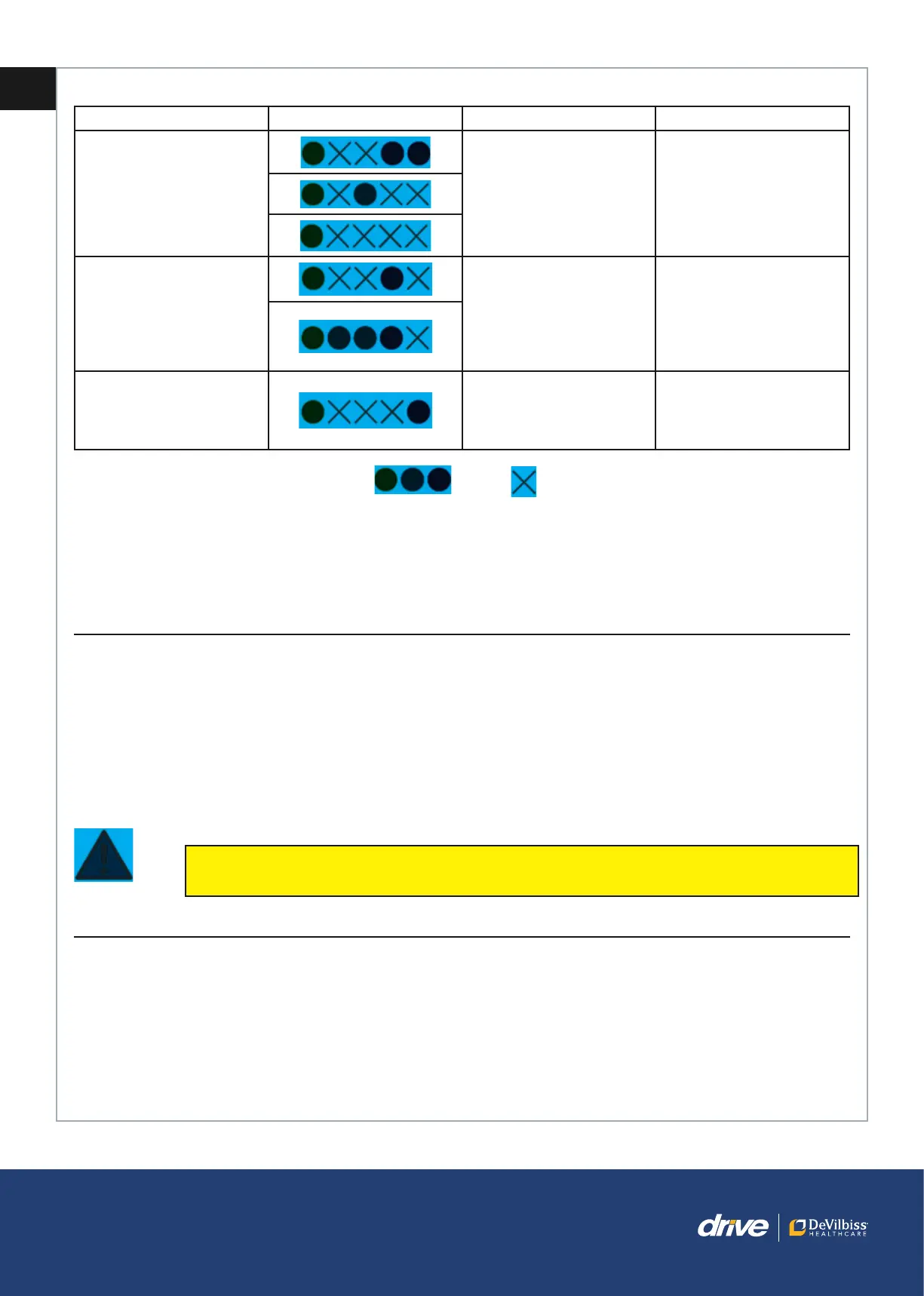
Beep Code Battery Gauge Resolution Resolution
Beep 2 + 3
RHS motor is disconnected
or in freewheel mode
Switch o powerchair.
Check right motor is in
‚Electric‘ drive mode.
Ensure motor cables are
plugged into the joystick
loom. Restart powerchair
Beep 2 + 5
LHS motor is disconnected
or in freewheel mode
Switch o powerchair.
Check right motor is in
‚Electric‘ drive mode.
Ensure motor cables
are plugged in. Restart
powerchair.
Beep 2 + 7
Joystick is out of neutral
during power
up
Switch o powerchair.
Ensure joystick is
released. Restart
powerchair.
LED:
= lit and = not lit
11.3 Repair
Contact your provider to discuss the replacement of components on the powerchair. Some spare parts may be
replaced by the user under instruction from service personnel, however other components will require installation by
a service engineer.
12. DISPOSAL OF PARTS
When the powerchair, the electrical system or any associated packaging and accessories have come to the end of
their useful life, follow W.E.E.E. (Waste Electrical and Electronic Equipment) policies, local and national regulations
for recycling and disposal. Individual parts can be separated and disposed according to the type of material. The
electrical components of the powerchair should not be disposed in municipal waste. Some of these electrical
components could be harmful to the environment and where viable, can be recovered and reused / recycled.
When the powerchair is unpacked for the first time, the cardboard box, and plastic packaging used can be recycled
at recycling centres that oer suitable cardboard and polymer recycling programmes respectively. For further
information about disposal, contact your local waste agency, recycling centre, or provider. If in doubt, contact Livewell
Today Ltd.
Warning
• The InstaFold™ Powerchair and any associated parts are to be decontaminated before disposal to
avoid the risk of crosscontamination.
13. ELECTROMAGNETIC COMPATIBILITY (EMC)
Electromagnetic interference (EMI) tests have shown to produce adverse eects on the performance and control of
electrically powered mobility devices. EMI can be produced from dierent sources, such as cellular phones, amateur
radio transmitters (HAM), microwave signals and emergency vehicle transceivers. The EMI produced from hand-held
radios are of special concern. The EMI waves can cause unintentional movement of the powerchair, or damage to
the controller. Every electrically powered mobility device has a resistance to EMI. The higher the resistance level the
greater the protection. The intensity of the interference can be measured in volts per meter, V/m. If the powerchair or
any alternative equipment is found to be operating abnormally, turn o the piece of equipment that is believed to be
causing the interference (if possible, as soon as it is safe) to identify the source of the



 To Next Page