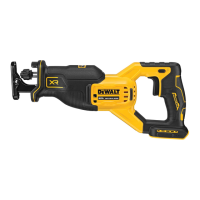
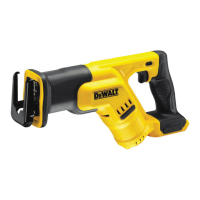
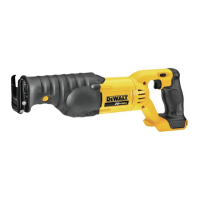
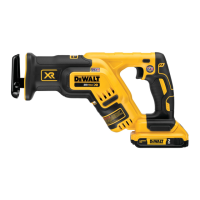
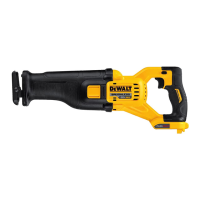
The DEWALT DCS382 is a 20V Max* reciprocating saw designed for professional sawing applications. It is a cordless power tool, meaning it operates on battery packs.
Function Description:
The DCS382 reciprocating saw is primarily used for cutting various materials. It features a variable speed trigger switch (1) that allows for precise control over the cutting speed; the further the trigger is depressed, the higher the speed. A lock-off button (2) is integrated to prevent unintentional starting, which should always be engaged when carrying or storing the tool. The saw is equipped with a blade clamp (3) for securing the blade (10) and a pivoting shoe (4) that rests against the workpiece during cutting to improve control and minimize vibration. For enhanced visibility in low-light conditions, a worklight (9) is located at the end of the tool near the shoe, activating when the trigger switch is depressed and remaining on for a short time after release. The saw is designed for flush cutting, allowing close cuts to floors, corners, and other difficult areas by inserting the blade with teeth facing up. It can be used for wood cutting, metal cutting, and pocket cutting (wood only).
Important Technical Specifications:
The saw operates with 20V Max* lithium-ion battery packs. The maximum initial battery voltage (measured without a workload) is 20 volts, with a nominal voltage of 18 volts. The tool is designed to be used with specifically designated DEWALT 20V Max* battery packs and chargers. Compatible battery packs include DCB200, DCB201, DCB203, DCB203G, DCB204, DCB204BT, DCB205, DCB205G, DCB205BT, DCB206, DCB208, DCB210, DCB230, DCB240, DCBP034, and DCBP520. Compatible chargers include DCB103, DCB104, DCB107, DCB112, DCB113, DCB115, DCB118, DCB132, DCB1102, DCB1104, DCB1106, and DCB1112. The tool is a Class II construction, indicating double insulation. It is designed for professional use and should not be exposed to wet conditions or flammable liquids/gases.
Usage Features:
- Blade Installation and Removal: Blades are installed by rotating the blade clamp collar (3) to its full open position, inserting the blade (10) fully, and then releasing the collar. For flush cutting, the blade can be installed with the teeth facing up. To remove a blade, the collar is rotated open, and the blade is pulled out. In case of a broken blade caught in the clamp, the battery should be removed, the clamp held open facing down, and the saw shaken until the blade falls out.
- Battery Pack Installation and Removal: Battery packs (6) are installed by aligning them with the rails in the tool's handle and sliding them in until firmly seated. To remove, the release button (8) is pressed, and the pack is pulled out.
- Proper Hand Position: The saw should always be held firmly with both hands during operation, one hand on the hand grip (5) and the other on the main handle (8), to maintain control and anticipate sudden reactions.
- Cutting Operations:
- General Cutting: Ensure the blade (10) extends past the pivoting shoe (4) and the workpiece thickness. The pivoting shoe should rest firmly against the workpiece to minimize vibration and blade breakage. Always allow the motor to reach maximum speed before applying pressure.
- Flush Cutting: The compact design allows for close cuts. Insert the blade with teeth up and turn the saw upside down to get as close to the work surface as possible.
- Wood Cutting: Ensure the workpiece is firmly anchored. Use sharp blades for cleaner, faster cuts and less motor strain.
- Metal Cutting: Use fine-tooth blades for ferrous metals and coarse-tooth blades for non-ferrous materials. For thin gauge sheet metals, clamping wood to the underside can ensure a clean cut. A thin film of oil or coolant can extend blade life; kerosene is preferred for aluminum. Avoid forcing the blade to prevent breakage.
- Pocket Cutting (Wood Only): Mark the cutting area clearly. Tip the saw backward until the pivoting shoe rests firmly on the surface, start the motor, and begin a slow, deliberate upward swing. Ensure the blade is completely through the material before continuing.
- Worklight: The worklight (9) illuminates the immediate work surface and is not intended as a flashlight.
- Battery Fuel Gauge: Some battery packs feature a fuel gauge (Fig. B) with LED lights to indicate the approximate charge level when the button is pressed.
Maintenance Features:
- Cleaning: The tool should be kept clean and well-lit. Air vents should be blown clear of dirt and dust with clean, dry air at least once a week. Non-metallic parts can be cleaned with a cloth dampened with water and mild soap. Solvents or harsh chemicals should not be used. The exterior of battery packs can be cleaned with a cloth or soft non-metallic brush; water or cleaning solutions should not be used.
- Blade Maintenance: Keep cutting tools sharp and clean. Dull blades can cause the saw to swerve or stall. Cracked or bent blades should be discarded and replaced immediately.
- Storage: Store idle power tools out of reach of children. Battery packs should be stored in a cool, dry location, away from direct sunlight and excessive heat or cold, and fully charged, out of the charger. Do not store battery packs in a tool with the trigger switch locked on.
- Charger Care: Chargers should be kept clean and free of conductive foreign materials. Do not operate damaged chargers or cords. Chargers should not be disassembled; service should be performed by authorized personnel.
- Battery Pack Service: Damaged battery packs should never be serviced by the user but returned to a service center for recycling.
- General Tool Maintenance: Regularly check for misalignment or binding of moving parts, breakage, and any other condition affecting the tool's operation. Damaged tools should be repaired before use.
- Always wear eye protection (ANSI Z87.1 certified) and, if dusty, a dust mask. Hearing protection (ANSI S12.6) is also recommended.
- Hold the tool by insulated gripping surfaces when cutting where hidden wiring may be present.
- Use clamps or other practical means to secure workpieces.
- Avoid prolonged operation to prevent vibration-induced injuries; use gloves and take frequent rest periods.
- Inspect the work area for hidden electrical wiring, gas, or water pipes before making blind or plunge cuts.
- Keep hands away from the cutting area and never reach underneath the material.
- Do not modify the power tool or any part of it.
- Charge batteries only with specified DEWALT chargers within the recommended temperature range (40°F–104°F / 4.5°C–40°C).
- Do not expose battery packs or tools to fire or excessive temperatures (above 265°F / 130°C).
- In case of battery liquid contact with skin, wash with soap and water; for eye contact, flush with water for 15 minutes and seek medical help.
- Do not incinerate battery packs.
- Ensure proper ventilation when working with materials that produce dust, and use appropriate dust extraction.

 Need help?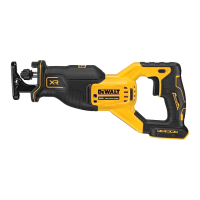

 To Next Page
 General