12. STANDARDS OF USE
BEFORE EVERY USE:
Before every use, perform the following checking procedures in order to assure regular operation.
CHECK THE OIL LEVEL:
See the specic chapter for the oil to be used.
a) Place the engine level.
b) Clean around oil ll.
c) Unscrew the cap, clean the end of the dipstick and insert it, as illustrated, without screwing it down.
d) Remove the cap with the dipstick and check the oil level that must be between “MIN” and “MAX” marks.
e) If oil is required, add oil of the same kind up to the “MAX” mark, being careful not to spill any outside the oil ll.
f) Fully tighten the ller cap and wipe o any spilled oil.
CHECK THE AIR CLEANER:
The eciency of the air lter is fundamental for the engine to work properly. Do not start the engine if the ltering element is missing or broken.
a) Clean around the lter cover.
b) Open the clips of the two sides of the air lter cover.
c) Check the condition of the ltering element. It must be intact, clean and in perfect working order; if not, either carry out maintenance or replace it.
d) Put the cover back.
LONG STORAGE (OVER 30 DAYS):
In case the engine has to be stored for a long time (for example at the end of the season), a few precautions are needed to help the future start-up.
a) To prevent the formation of deposits inside the tank, empty it of fuel by unscrewing the carburettor oat chamber plug and collecting all the fuel in a
suitable container. At the end of the operation remember to screw the plug back on and fully tighten it.
b) Remove the spark plug and pour about 3 cl of clean engine oil into the spark plug hole, then, having blocked the hole with a rag, run the starter motor
briey to turn the engine for a few revs and distribute the oil over the inner surface of the cylinder. Finally replace the spark plug without connecting
the cable cap.
These troubleshooting steps are specic for propane fuel system issues. For other engine issues, refer to the Engine Operator Manual and/or OEM Equipment Manual.
13. TROUBLESHOOTING
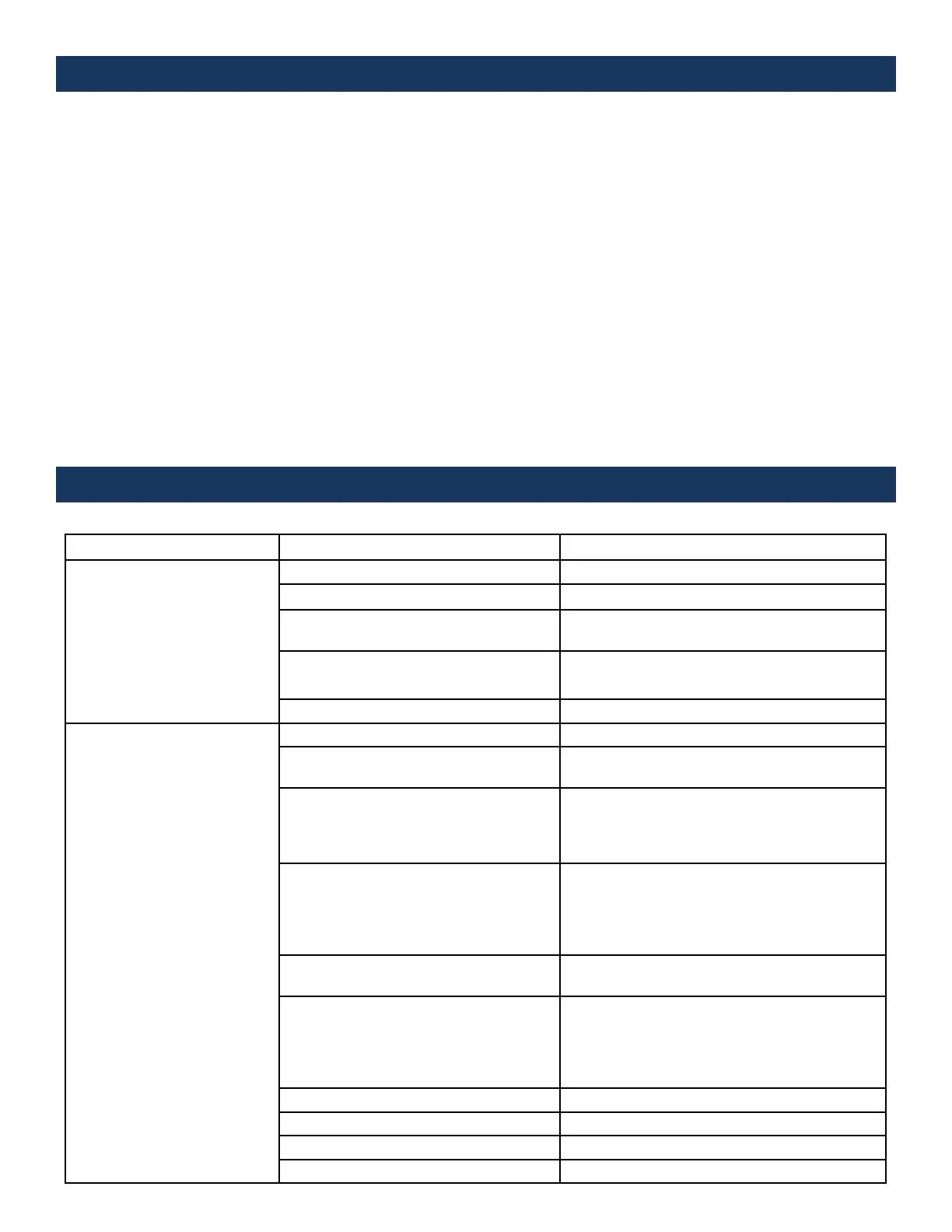
PROBLEM REASON SOLUTION
Engine does not turn over
Weak or dead battery. Recharge or replace battery.
Ignition switch faulty.
Check or replace switch.
Faulty safety interlock switch (operator
presence control).
Engage safety interlock switch (operator
presence control) prior to engaging starter.
Safety interlock switch (operator
presence control) not engaged.
Check or replace safety interlock switch
(operator presence control).
Numerous other causes. See engine manual or dealer.
Engine turns over, but
does not start or run
Propane cylinder is empty Rell cylinder or replace with full cylinder.
Main fuel service valve on propane
cylinder is closed
Manually open main fuel service valve on
propane cylinder.
REGO tting (fuel hose to cylinder
connector) is not fully seated
Manually close main fuel service valve. Dis-
connect REGO tting. Reconnect and hand
tighten to ensure secure connector is fully
seated. Slowly open main fuel service valve.
Propane cylinder OPD (overow pro-
tection device) has been triggered.
Manually close main fuel service valve.
Disconnect REGO tting. Wait 5 seconds.
Reconnect and hand tighten to ensure
secure connector is fully seated. Slowly open
main fuel service valve.
Propane regulator out of adjustment or
faulty
Have certied dealer inspect regulator and
adjust or replace.
Poor quality propane causes deposits
of particles in regulator or valves
Have certied dealer inspect regulator
and clean or replace. Service engine valves
according to engine manual instructions.
Contact propane supplier to provide clean
HD5 propane.
Spark plug not ring Replace spark plug.
Faulty vacuum switch Check or replace vacuum switch.
Faulty oil pressure switch Check or replace oil pressure switch.
Numerous other causes See engine manual or dealer.


 To Next Page
 Loading...