• 12 •
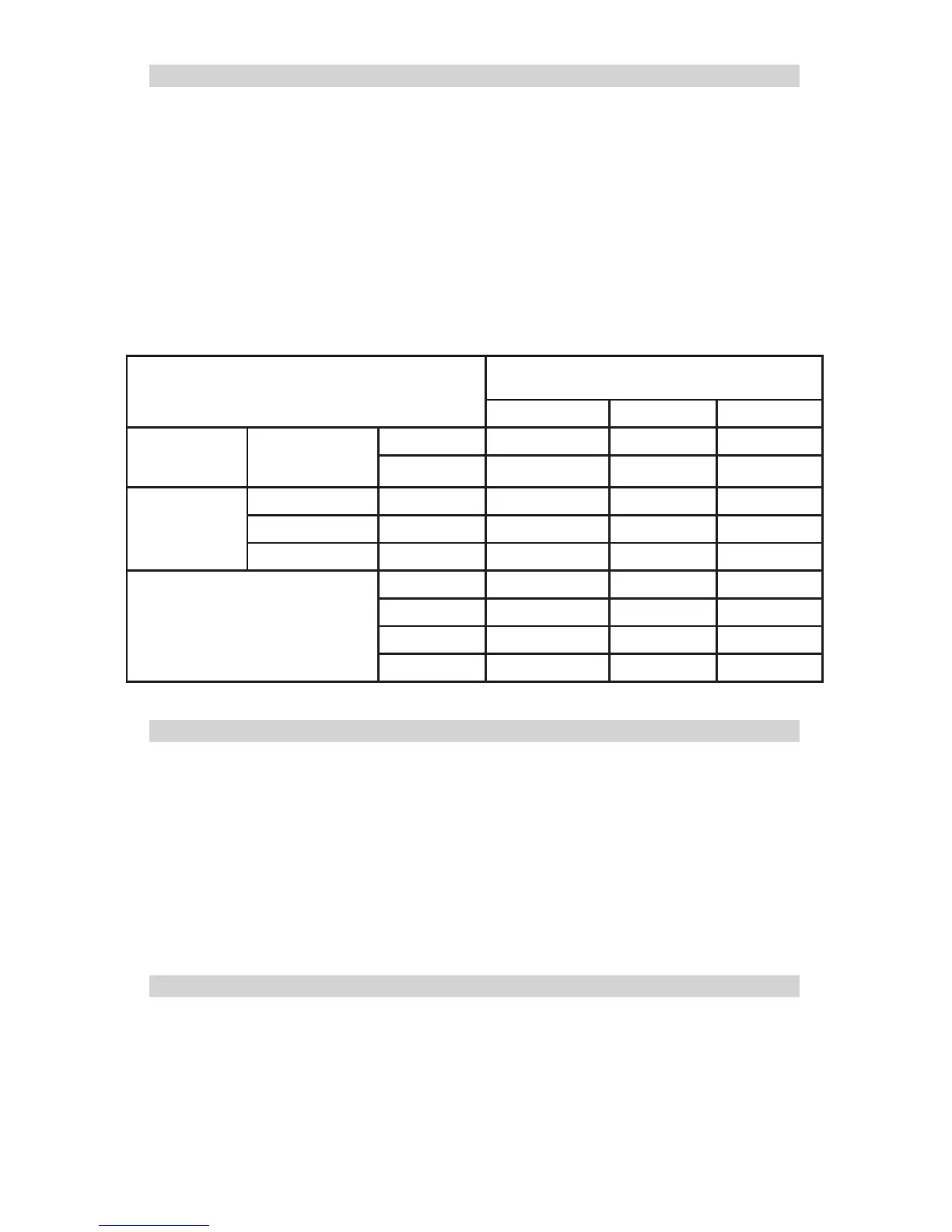
Use the following table to more accurately determine the time it will take to
bring a battery to full charge. First, identify where your battery ts into
the chart.
CCA = Cold Cranking Amps
RC = Reserve Capacity
Ah = Amp Hour
NR means that the charger setting is NOT RECOMMENDED.
Find your battery’s rating on the chart below, and note the charge time given
for each charger setting. The times given are for batteries with a 50% charge
prior to recharging. Add more time for severely discharged batteries.
SMALL
BATTERIES
Motorcycle,
garden,
tractor, etc.
6 - 12 Ah 2 – 3¾ hrs. NR NR
12 - 32 Ah 3¾ – 10 hrs. NR NR
CAR/TRUCK
200 - 315 CCA 40 - 60 RC 11¼ – 14½ hrs . 2¼ – 3 hrs. ½ - ¾ hrs.
315 - 550 CCA 60 - 85 RC 14½ – 18¼ hrs. 3 – 3¾ hrs. ¾ – 1 hr.
550 - 1000 CCA 85 - 190 RC 18¼ – 34¾ hrs. 3¾ – 7 hrs. 1 – 1¾ hrs.
MARINE/DEEP CYCLE
80 RC 17½ hrs 3½ hrs. NR
140 RC 27 hrs. 5½ hrs. NR
160 RC 30 hrs. 6 hrs. NR
180 RC 33 hrs. 6½ hrs. NR
After use and before performing maintenance, unplug and disconnect the
battery charger (see sections 6, 7 and 8).
Use a dry cloth to wipe all battery corrosion and other dirt or oil from the
terminals, cords, and the charger case.
Ensure that all of the charger components are in place and in good working
condition.
Servicing does not require opening the unit, as there are no user-
serviceable parts.
All other servicing should be performed by qualied service personal.
Store charger unplugged, in an upright position. Cord will still conduct
electricity until it is unplugged from outlet.
Store inside, in a dry, cool place.
Do not store clips on the handle, clipped together, on or around metal, or
clipped to the cables.
If the charger is moved around the shop or transported to another location,
take care to avoid/prevent damage to the cords, clips and charger. Failure to
do so could result in personal injury or property damage.


 To Next Page