3.1.3 Cable Selection
In certain instances it is desirable to match a guitar cord to a specific instrument. One can use the
otherwise undesirable qualities of a cord to one’s advantage, if one has the time and patience to
experiment with different cords and guitars. You should do this when playing with a band or when
you are recording. Sometimes it is difficult to tell a component’s true advantages until it is used in
the right context. A guitar that has very piercing highs could theoretically be tamed down
somewhat by the use of a long guitar cord that offers some high-end attenuation. The loops of
your Diezel Hagen send signals at higher levels and impedances, which makes this section of
wiring less sensitive. You should still use reliable and good quality wiring for all loops and inserts.
3.2 Rear Panel Connections
3.2.1 Send/Return Loop
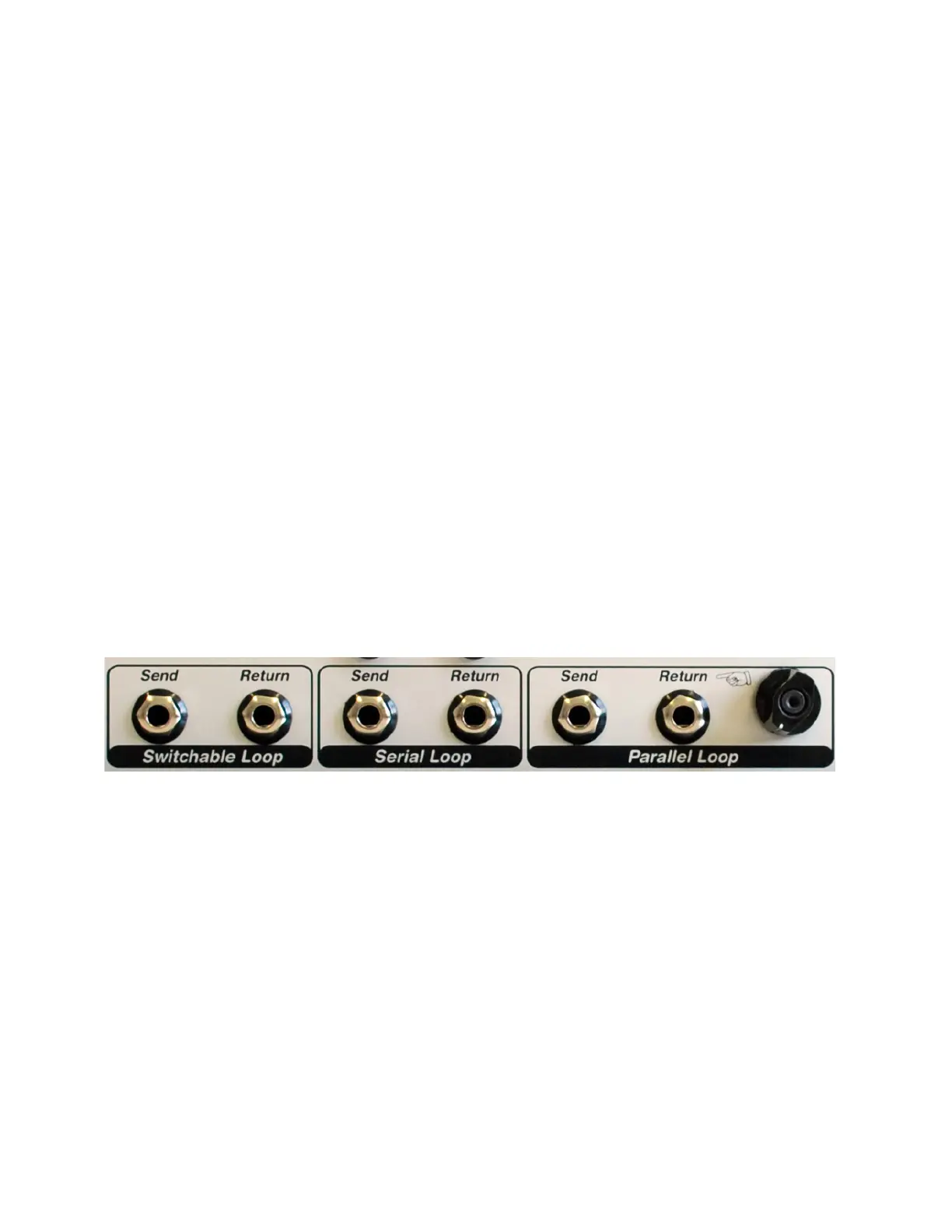
The System consists of 3 separate Loops. It allows creation of effects path in either serial, parallel,
or switched configurations. The individual channel volume controls determine the signal strength at
the send jacks. The range is - ... to +10dB. The output impedance is 4.7 kOhm. If you want to use
the loops, then connect the “Send” to the input of the Effects unit. Be sure and adjust the input
level of the effects unit to the amplifiers level. Most effects units have led bar or other level control
devices. The Output of the effects unit must be connected to one of the return jacks, parallel,
switched, or serial. If you use the parallel return, then the signal can be mixed to the original
signal via the rear panel mounted “Volume” control.


 To Next Page