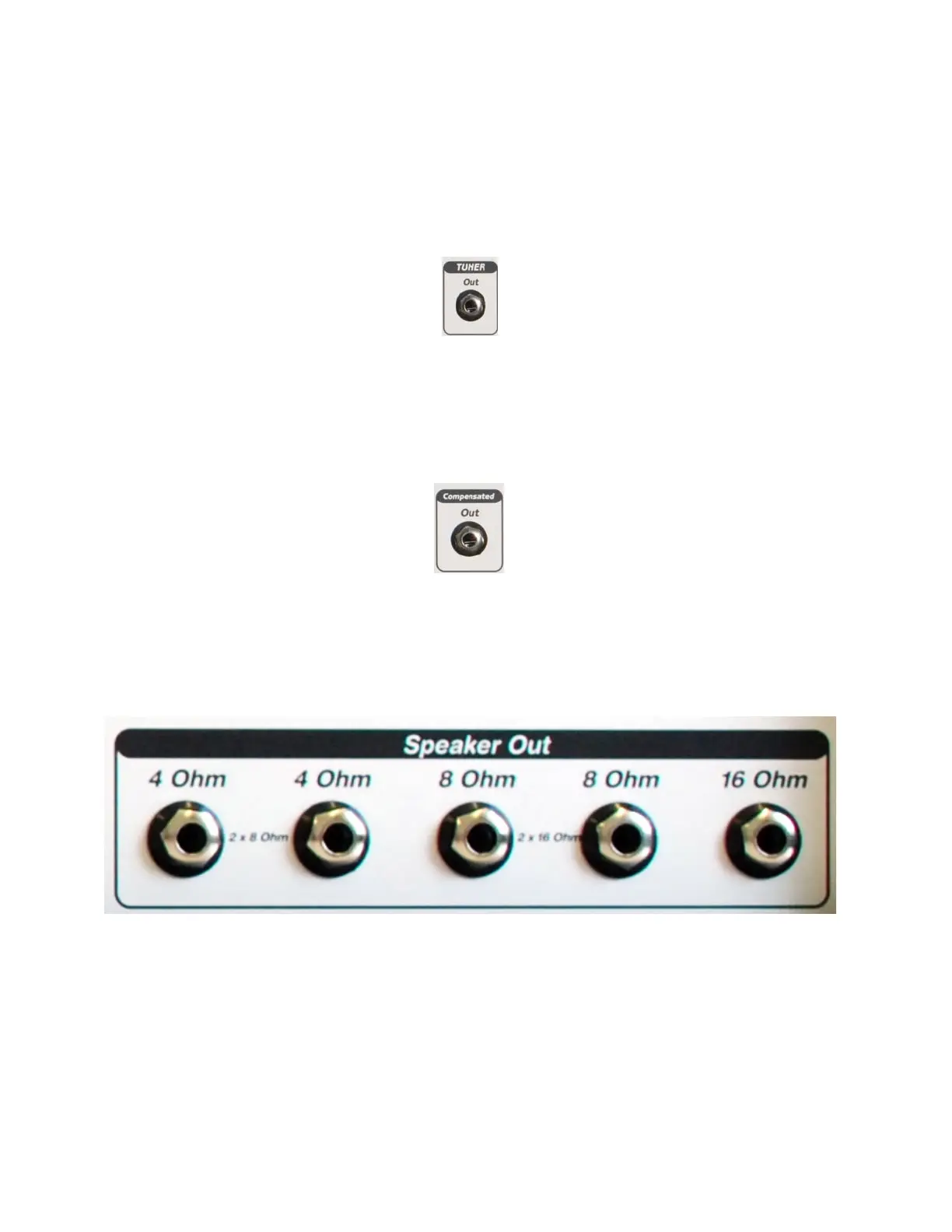
3.2.6 Tuner Out
You guessed it – it’s for a guitar tuner. Stays lit while mute is activated. So you can tune without
annoying your band members, or the audience.
3.2.7 Compensated Out
A frequency corrected signal will leave this jack if you connect it to a mixer or recording device.
Use it to quietly compose or send an auxiliary signal to a console etc. Always make sure that your
amp is connected to either a loudspeaker or a load.
3.2.8 Speaker Connections
Hagen has 5 speaker jacks: 1 for a 16-Ohm load, 2 for 2 16-Ohm loads or 1 8Ohm load, and 2 for
2 8-Ohm loads or 1 4-Ohm load. Confusing? Oh, yes! Just do what it says on the jacks, and you’ll
be fine
3.2.9 Top 5 Reasons for dynamic losses in the effects loop
Many different factors can be responsible for loss of dynamics, aside from those mentioned in 3.2.2
(ADA conversion). A vital point that often leads to frustration is a maladjusted output level of an
effects unit. If the output level is too high, then unwanted distortion is caused in the power amp. If
it is too low, then the rig will not sound punchy and might get lost easily in the band sound. When
used in the serial loop, the output of the effects unit determines the ultimate drive signal strength
of the power amp. The output level should be matched to give the best possible sound with all 3
channels without over driving the power amp section. Headroom adjustments of 10% are usually
sufficient.


 To Next Page