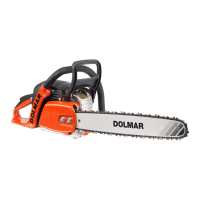
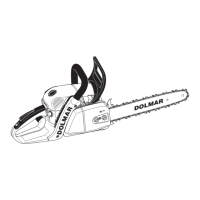
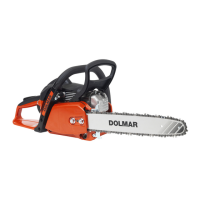
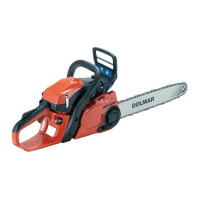
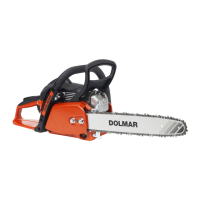
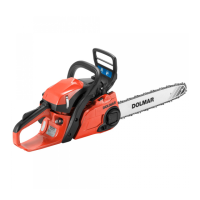
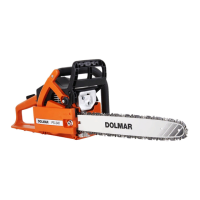
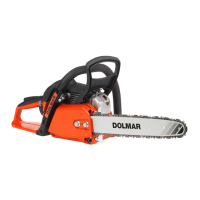
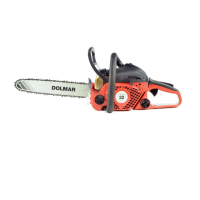
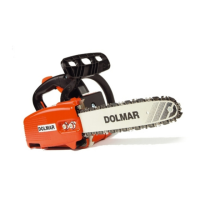
This document is an instruction manual for the Dolmar PS-350 S, 350 SC, PS-420 S, and 420 SC chain saws. It provides detailed information on the function, technical specifications, usage, and maintenance of these devices.
Function Description
The Dolmar PS-350 S, 350 SC, PS-420 S, and 420 SC are modern, handy, and robust chain saws designed for sawing wood outdoors. They are equipped with several features to ensure efficient, safe, and comfortable operation.
Key functions include:
- Automatic Chain Lubrication: A variable-flow oil pump ensures continuous lubrication of the chain, extending its lifespan and maintaining smooth operation.
- Maintenance-Free Electronic Ignition: This system provides reliable starting and consistent engine performance.
- Anti-Vibration System: Designed to reduce hand fatigue and improve user comfort during prolonged use.
- Ergonomic Grips and Controls: These enhance ease of use, safety, and reduce strain on the operator.
- Featherlight-Start System: A spring-loaded starting assist allows for effortless engine starts.
- Catalytic Converter (for some models): Reduces pollutant emissions, complying with European Guideline 2002/88/EG.
- Safety Features: Includes hand guards on both handles, a grip throttle lever lock, chain catch, safety saw chain, and a chain brake. The chain brake can be actuated manually or automatically via inertia in case of kickback.
The chain saws are suitable for various tasks depending on their class:
- Professional and Mid-Class: For felling, limb removal, cutting to length, and thinning in small, medium, and large trees.
- Hobbyklasse: For occasional use in small trees, fruit-tree care, felling, and limb removal.
Important Technical Specifications
The manual provides detailed technical data for both PS-350 S/SC and PS-420 S/SC models:
| Specification |
PS-350 S, 350 SC |
PS-420 S, 420 SC |
| Stroke volume |
34.7 cm³ |
42.4 cm³ |
| Bore |
38 mm |
42 mm |
| Stroke |
30.6 mm |
30.6 mm |
| Max. power at speed |
1.7 kW / 9,500 rpm |
2.2 kW / 9,500 rpm |
| Max. torque at speed |
2.1 Nm / 6,500 rpm |
2.6 Nm / 6,500 rpm |
| Idling speed / max. engine speed |
2,800 / 13,500 rpm |
2,800 / 13,500 rpm |
| Clutch engagement speed |
5,100 rpm |
5,100 rpm |
| Sound pressure level (LpA, eq) |
100.8 dB(A) |
100.8 dB(A) |
| Sound power level (LWA, eq) |
110 dB(A) |
110 dB(A) |
| Vibration acceleration (Tubular handle) |
4.3 m/s² |
3.6 m/s² |
| Vibration acceleration (Rear handle) |
3.6 m/s² |
3.2 m/s² |
| Carburetor type |
Membranecarburetor |
Membranecarburetor |
| Ignition system |
electronic |
electronic |
| Spark plug |
NGK CMR7A-5 |
NGK CMR7A-5 |
| Electrode gap |
0.5 mm |
0.5 mm |
| Fuel consumption at max. load |
0.79 kg/h |
0.96 kg/h |
| Specific consumption at max. load |
526 g/kWh |
480 g/kWh |
| Fuel tank capacity |
0.48 l |
0.48 l |
| Chain oil tank capacity |
0.28 l |
0.28 l |
| Mixture ratio (fuel/two-stroke oil) |
50:1/100:1 (HP-100) or 50:1 (2%) |
50:1/100:1 (HP-100) or 50:1 (2%) |
| Chain speed (at max. power) |
18.1 m/s |
18.3 m/s |
| Sprocket pitch |
3/8 inch |
.325 inch |
| Number of teeth |
6 |
7 |
| Guide bar length of cut |
30, 35, 40 cm |
33, 38, 45 cm |
| Weight (fuel tank empty, without chain, guide bar and accessories) |
4.8/4.9 kg |
4.8/4.9 kg |
Usage Features
The manual emphasizes safe and correct operation, providing detailed instructions for various tasks:
Putting into Operation:
- Safety First: Always read the manual, wear protective equipment (helmet, eye and ear protection, gloves, safety shoes/boots, protective clothing), and ensure a safe working environment free of obstacles and other people.
- Refuelling: Stop the engine, let it cool, and refuel in a well-ventilated area away from open flames. Use the specified fuel mixture (gasoline and two-stroke oil) and chain oil.
- Mounting Guide Bar and Saw Chain: Detailed steps are provided for models with fastening nuts, QuickSet guide bars, and quick tensioners. This includes releasing the chain brake, unscrewing retaining nuts, positioning the guide bar and chain, and tightening the chain tension.
- Chain Tension Check: The chain tension is correct if the chain rests against the bottom side of the guide bar and can be easily turned by hand. New chains tend to stretch and require frequent re-tensioning.
- Chain Lubrication Check and Adjustment: Ensure sufficient chain oil in the tank. The oil pump feed rate can be adjusted using a screw on the bottom of the housing to suit different guide bar lengths.
- Starting the Engine: Instructions for both cold and warm starts, including priming the fuel pump, setting the combination switch (choke/ON), and pulling the starter handle. The chain brake must be engaged during starting.
- Stopping the Engine: Depress the combination switch to turn off the engine. For complete ignition current cut-off, push the switch all the way down to the safety position.
- Working in Winter: Special instructions for preventing carburetor icing and faster warm-up by adjusting the air intake for heated air from the cylinder.
- Adjusting the Carburetor: Only a specialist DOLMAR service center should adjust the carburetor, using a tachometer to prevent engine damage from incorrect settings. The idle speed (S screw) can be adjusted by the user.
Working Behavior/Method of Working:
- Kickback Prevention: Be aware of kickback, which occurs when the guide bar tip touches wood or hard objects. Follow rules like never applying the end of the bar when starting a cut, ensuring the chain is sharpened correctly, and avoiding cutting multiple branches simultaneously.
- Safe Handling: Always hold the chain saw with both hands, maintain a safe footing, and avoid working above shoulder height or on unstable surfaces.
- Cutting Techniques: Instructions for using the spike bar for felling and crosscuts, and precautions for longitudinal cuts.
- Tree Felling: Detailed steps for judging the tree, cutting roots, notching the trunk (to determine fall direction), and performing the felling cut, emphasizing safety distances and the use of felling wedges.
Transport and Storage:
- Switch off the chain saw and actuate the chain brake before transport.
- Never transport the saw with the chain running.
- Allow the saw to cool down before storing, especially models with catalytic converters.
- Use the guide bar protection cover during transport.
- Store the chain saw safely in a dry place, away from children, and with empty fuel and oil tanks for long-term storage.
Maintenance Features
Regular maintenance is crucial for the chain saw's long life, safety, and optimal performance.
Key maintenance tasks include:
- Before Each Start: Inspect the saw chain for damage and sharpness, check chain tension, chain brake function, and fuel/oil tank cap tightness.
- Every Day: Clean the air filter, check the guide bar for damage and clean its oil intake bore, clean the guide bar support and oil guide groove, and check idle speed.
- Every Week: Clean the fan housing, air filter compartment, fan compartment, and cylinder fins to maintain good cooling air flow. Check and replace the spark plug if necessary. Check muffler mounting tightness, chain guide, screws, and nuts.
- Every 3 Months: Replace the suction head. Empty and clean fuel and oil tanks.
- Annually: Have the chain saw checked at an authorized service center.
- Storage: Clean the exterior, demount, clean, and oil the guide bar/chain, clean the guide groove, and empty and clean fuel/oil tanks. Run the carburetor empty.
Detailed maintenance instructions:
- Sharpening the Saw Chain: Instructions on when to sharpen (sawdust looks like wood flour, chain penetrates with pressure, visible damage, saw pulls to one side). Use special saw chain round files and file holders for correct sharpening angles (30° for type 092, 484; 80° for type 092, 484). Check and correct the depth limiter height with a chain gauge and flat file.
- Cleaning Sprocket Guard and Guide Bar: Remove the sprocket guard, chain, and guide bar. Clean the interior of the sprocket guard, oil guide groove, and chain tensioner. Inspect the guide bar bearing surfaces and clean the oiling holes.
- Replacing the Saw Chain: Use only specified chains and guide bars. Check the sprocket for wear and replace if necessary. Instructions for removing and installing the chain, circlip, thrust washer, and clutch drum.
- Cleaning the Air Filter: Unscrew the hood lock, remove the hood, push up the combination switch, and pull out the air filter. Clean fleece filters by tapping or blowing with compressed air (do not brush). Nylon filters can be cleaned with a soft brush or compressed air. Wash dirty filters in lukewarm water with dishwashing detergent. Replace damaged filters immediately.
- Replacing the Spark Plug: Remove the filter cover and pull off the plug cap. Use the combination wrench to remove the spark plug. Check for damage, dirt, or oil. Ensure an electrode gap of 0.5 mm. Use only NGK CMR7A-5 spark plugs.
- Checking the Ignition Spark: Use the combination tool to make contact between the hood and cylinder, press the unscrewed spark plug against the tool, set the combination switch to ON, and pull the starter cable. A visible spark indicates correct function.
- Checking Muffler Screws: Unscrew and remove the upper half of the muffler (and catalytic converter for SC models). Check and tighten the screws on the bottom muffler half.
- Replacing Starter Cable/Return Spring Pack/Starter Spring: Detailed instructions for disassembling the fan housing, de-tensioning the return spring, replacing the cable, and reassembling. Emphasizes safety precautions due to spring tension.
- Cleaning Air Filter Compartment/Fan Compartment: Remove the cover and fan housing. Brush or clean the entire area with compressed air.
- Cleaning Cylinder Fins: Use a bottle brush to clean the cylinder fins.
- Replacing Suction Head: Replace the felt filter of the suction head every three months. Use a hooked wire to pull it out through the tank filler neck.
The manual also includes information on service, spare parts, and guarantee conditions, emphasizing the use of original DOLMAR parts and authorized service centers for repairs. It also provides a troubleshooting guide for common issues.

 Need help?

 To Next Page
 General