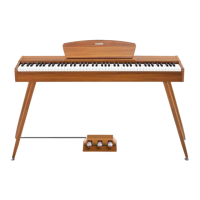
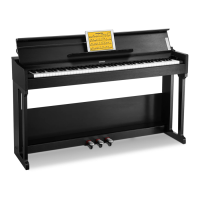
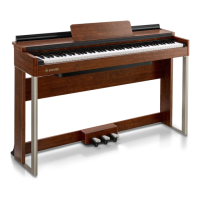
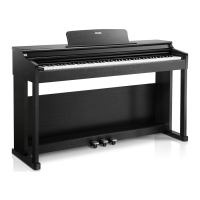
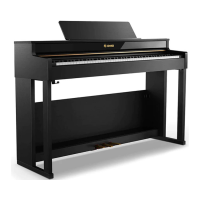
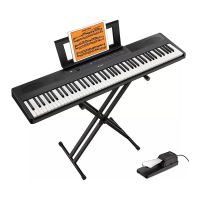
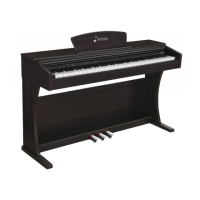
The Donner DDP-300 is a digital piano designed for home use, offering a comprehensive set of features for learning, practice, and performance. This owner's manual provides detailed instructions for assembly, operation, external connections, function introduction, product specifications, maintenance, and safety considerations.
Function Description
The DDP-300 functions as a digital piano with 88 full-weighted keys, designed to simulate the feel of an acoustic piano. It offers 10 pre-set authentic tones, including Grand Piano, Electric Piano, Rock Organ, Strings, Bass, Brite Piano, Harpsichord, Church Organ, Guitar, and Pad. The piano includes a metronome with adjustable tempo (30-280 BPM) and 9 types, as well as 5 built-in piano demos and 10 timbre demo songs for practice and inspiration. It supports various playing modes such as Double Keyboard (duet mode) for one-to-one teaching, and Split Timbre, which divides the keyboard into two sections with different tones. The DDP-300 also features a MIDI record function, allowing users to record and store one song in the piano's internal memory. For connectivity, it includes a USB-MIDI jack for computer connection, AUX OUT for audio devices, and headphone sockets for private practice. A notable feature is its built-in Bluetooth MIDI, enabling wireless connection to compatible apps on iOS and Android devices for enhanced learning and creative possibilities.
Important Technical Specifications
- Product Name: DDP-300
- Size/Weight:
- Product Size: 136x42x81.5 cm
- Product Weight: 39 KG
- Package Size: 143x53.5x35 cm
- Package Weight: 43.8 KG
- Keyboard: 88 key full-weighted keyboard
- Performance Control:
- Touch Response: Hard/Medium/Soft/Fixed
- Pedal: 3 (Sustain/Sostenuto/Soft)
- Body:
- Key Cover Type: Sliding Cover Type
- Music Stand: YES
- Polyphony: 128 (Max)
- Sound Resource: Donner D1-DSP DAC-3817B
- Pre-setting:
- Timbre: 10
- Timbre Demo Song: 10
- Piano Demo Song: 5
- Metronome:
- Type: 9
- Beat Speed: 30 ~ 280
- Function:
- Double Keyboard: Support
- Transposition: -12 ~ 0 ~ +12 semitones
- Tone: 415.3Hz ~ 466.2Hz (Default: 440Hz)
- Split Timbre: Support
- Effects: Reverb (4 types, switchable & adjustable)
- Automatic Shutdown: 30 minutes (after no operation)
- Record Function: Non-tracking function
- Wireless: Built-in Bluetooth MIDI
- Connecting Sockets:
- Power Socket: DC 12V 3A
- Headphone Socket: 2 x headphone sockets
- AUX OUT Socket: YES
- USB-MIDI Socket: YES
- Pedal Socket: Single sustain pedal sockets
- Sound System:
- Amplifier: 20W x 2
- Low-pitch Speaker: 20W x 2
- High-pitch Speaker: 10W x 2
Usage Features
The DDP-300 is designed for user-friendly operation. Assembly involves fixing the pedal box to the stand boards, attaching the back plate, and then placing the piano body onto the assembled stand. The key cover slides open and closed, and the music stand can be easily erected or put down.
- Power On/Off: Connect the power cord, ensure volume is at minimum, then press the power button. Turn off by lowering volume and pressing the button again.
- Volume Control: A knob on the control panel adjusts the master volume.
- Auto Power Off: The piano automatically shuts down after 30 minutes of inactivity, a feature that can be enabled or disabled.
- Key Sound Setting: The default key sound is on and can be toggled using the [FUNCTION] and [#A2] keys.
- Double Keyboard Setting: Activates a duet mode, splitting the keyboard at e¹ into two identical sections for teaching or collaborative play. Activated/deactivated via [FUNCTION] and [B2].
- Timbre Selection: Choose from 10 pre-set tones using direct selection buttons (PIANO, E.PIANO, ROCK ORGAN, STRINGS, BASS) or by pressing [FUNCTION] and specific keys (C₁-E₁).
- Timbre Demo: Play previous, next, or stop timbre demos using [FUNCTION] and F₁, #F₁, or G₁ keys.
- Split Timbre: Divides the keyboard into two sections with different tones, with #f as the default split point. Can be turned on/off with [FUNCTION] and [METRONOME]. The split point can be changed by pressing [METRONOME] and any key.
- Piano Demo: Play 5 built-in piano demos. Loop all demos with the DEMO play/stop button, or cyclically switch demos. Play specific demos by pressing [FUNCTION] and corresponding keys (#G₁-C).
- Reverb Effect: Offers 4 reverb types (Hall 1, Hall 2, Stage 1, Stage 2) with adjustable depth (0-127). Control reverb on/off with [FUNCTION] and #C, and select types with [FUNCTION] and D-F. Reverb depth is adjusted with [FUNCTION] and #F (-1), #G (+1), or G (reset to default).
- Tone Setting: Adjust the overall pitch (415.3Hz~466.2Hz) to match other instruments. Decrease pitch with [FUNCTION] and A (-), increase with [FUNCTION] and B (+), and reset to default with [FUNCTION] and #A.
- Transposition Setting: Adjust the overall pitch up or down by ±12 semitones. Decrease with [FUNCTION] and c (-), increase with [FUNCTION] and d (+), and reset to default with [FUNCTION] and #c.
- Metronome: Turn on/off with the [METRONOME] key. Adjust type (1-9) with [FUNCTION] and #d (-1), f (+1), or e (reset to default). Adjust speed (30-280 BPM) with [FUNCTION] and #f (-1), #g (+1), or g (reset to default).
- Touch Curve: Adjust keyboard sensitivity (Fixed, Medium, Soft, Hard) with [FUNCTION] and a~c¹.
- MIDI Record: Record performances by pressing the record button. Stop recording to save. Play back recorded songs.
- Bluetooth MIDI: Connect wirelessly to compatible apps (e.g., Garageband, Piano Diary, Flowkey) for interactive learning and control. The piano's Bluetooth name is BTMIDI.
Maintenance Features
Proper maintenance is crucial for prolonging the DDP-300's service life and preventing faults.
- Environmental Care:
- Avoid Heat, Dampness, or Direct Sunlight: Do not expose the piano to excessive direct sunlight, place it near air conditioners, or in extremely hot or dusty places. Avoid kitchens or areas with oil fumes.
- No Use Near TV or Radio: To prevent video or audio interference, keep the piano away from TVs and radios.
- Cleaning:
- Do Not Use Paint, Diluent, or Similar Chemicals: Clean the piano with a soft towel dampened with a weak solution of detergent, wrung out until dry. Always unplug the power cord before cleaning.
- Handling:
- No Shaking and Collision: Move the product carefully to avoid violent shakes and collisions, which can damage the shell or internal electronic components.
- Product Movement: Before moving, unplug the power cord and all other cables to prevent damage and electric shock.
- Key Cover Care: When opening or closing the key cover, be careful to avoid pinching fingers. Do not place metal plates or paper on the key cover, as small items may slip into the piano and cause damage or electric shock.
- Headphone Use: Avoid wearing headphones at high volume for extended periods to prevent hearing damage.
- Power Cord Safety:
- Use only the specified power cord and ensure it's unplugged when not in use for a long time or during thunderstorms.
- Do not use wet hands to touch the power cord or plug.
- Ensure the power cord is not overloaded, placed near heat sources, or subjected to excessive bending or twisting.
- Clean dust around the plug at least once a year.
- General Safety:
- Don't Burn This Product: Disposal by burning can cause fire and explosion of electronic components.
- Water and Foreign Matter: If water or metal enters the product, immediately turn off the power, unplug the cord, and contact your dealer.
- Dismantling and Rebuilding: Do not disassemble or modify the product; all internal repairs should be handled by an authorized dealer.
- Drop or Impact: If the product falls or is subjected to a strong impact, turn off the power, unplug, and contact your dealer.
- Plastic Bag Safety: Keep plastic bags away from children to prevent suffocation.
- Stability: Avoid placing the piano on uneven or unstable surfaces to prevent it from falling and causing injury.
- Support Assembly: Ensure correct assembly of the stand to prevent tipping and injury.
- Fuse Replacement: If the fuse breaks, professionals are required for replacement to avoid short circuits or voltage instability.


 To Next Page
 General