Operation Section
180
Towing Information
WARNING
Personal injury or death could result when
towing a disabled lift truck incorrectly.
Block the lift truck wheels to prevent movement
before releasing the brakes. The lift truck can
roll free if it is not blocked.
Follow the recommendations below, to properly
perform the towing procedure.
These towing instructions are for moving a disabled
lift truck a short distance, at low speed, no faster
than 2 km/h (1.2 mph), to a convenient location for
repair. These instructions are for emergencies only.
Always transport the lift truck if long distance moving
is required.
Shield must be provided on the towing lift truck to
protect the operator if the tow line or bar should
break.
Do not allow riders on the lift truck being towed
unless the operator can control the steering and/or
braking.
Before towing, make sure the tow line or bar is in
good condition and has enough strength for the
towing situation involved. Use a towing line or bar
with a strength of at least 1.5 times the gross weight
of the towing lift truck for a disabled lift truck stuck in
the mud or when towing on a grade.
Keep the tow line angle to a minimum. Do not
exceed a 30° angle from the straight ahead position.
Connect the tow line as low as possible on the lift
truck that is being towed.
Quick lift truck movement could overload the tow
line or bar and cause it to break. Gradual and
smooth lift truck movement will work better.
Normally, the towing lift truck should be as large as
the disabled lift truck. Satisfy yourself that the towing
lift truck has enough brake capacity, weight and
power, to control both lift trucks for the grade and
the distance involved.
To provide sufficient control and braking when
moving a disabled lift truck downhill, a larger towing
lift truck or additional lift trucks connected to the rear
could be required. This will prevent uncontrolled
rolling. The different situation requirements cannot
be given, as minimal towing lift truck capacity is
required on smooth level surfaces to maximum on
inclines or poor surface conditions.
Consult your DOOSAN Lift Truck dealer for towing a
disabled lift truck.
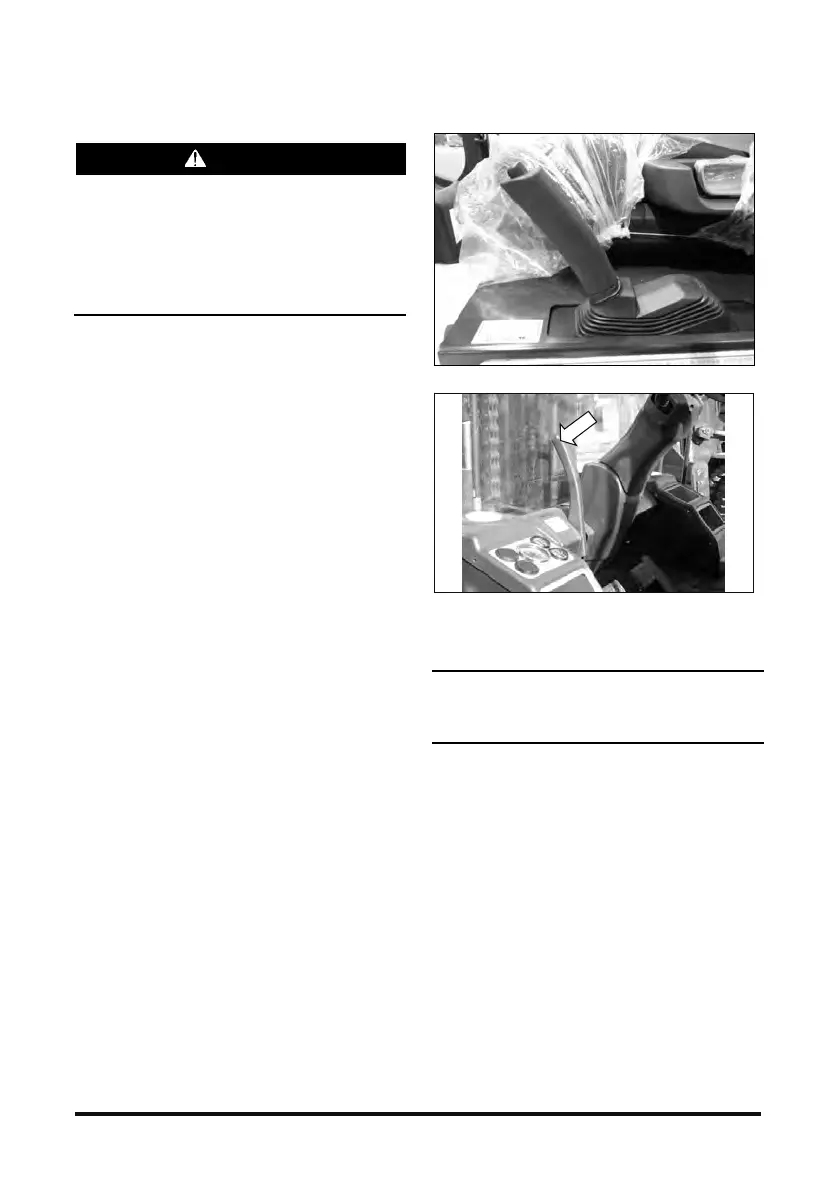
Mechanical Parking Brake (If Installed)
Typical Example
1. Release the parking brake.
NOTICE
Release the parking brake to prevent excessive
wear and damage to the parking foot brake system.
2. Secure the wheels with blocks.
3. Direction control lever is in neutral.
4. Release the parking brake.
5. Release the service brake pedal.
6. Key switch is in the OFF position.
7. Direction control lever is in neutral.
8. Fasten the tow bar to the lift truck.
9. Remove the wheel blocks. Tow the lift truck
slowly. Do not tow any faster than 2 km/h (1.2
mph).



 To Next Page