
 Need help?
Do you have a question about the Dormakaba RCI 6 Series and is the answer not in the manual?
Setting the strike for fail-safe operation, requiring power to lock.
Setting the strike for fail-secure operation, requiring power to unlock.
Details on wiring for the latch monitor switch.
Details on wiring for the keeper monitor switch.
The provided manual details the installation, operation, and troubleshooting of the RCI 6 Series Electric Strikes, designed for various door and frame types. These electric strikes are integral components of access control systems, allowing for controlled entry and exit through doors.
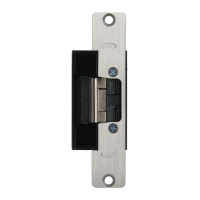
The RCI 6 Series Electric Strikes are electromechanical devices installed in doorframes to secure a door's latch bolt. When activated by an access control system (e.g., card reader, keypad), the strike's keeper pivots, releasing the latch bolt and allowing the door to open without needing to turn the door handle. This provides a convenient and secure method of access control. The series includes models like the RCI L65 (Low Profile) and RCI S65 (Standard), catering to different latch projection requirements. The L65 is suitable for 1/2" or 5/8" latch projections, often found in narrow stile aluminum frames, while the S65 accommodates 3/4" latch projections.
The strikes are designed with flexibility in mind, offering both "Fail Safe" and "Fail Secure" operating modes. In "Fail Safe" mode, the strike unlocks when power is removed, ensuring egress during power outages, which is crucial for life safety applications. Conversely, in "Fail Secure" mode, the strike remains locked when power is removed, maintaining security during power failures. The mode can be easily adjusted by rotating a screw on the strike, allowing installers to configure the device according to specific security and safety requirements.
Many models within the RCI 6 Series are modular, meaning they consist of an insert (e.g., AS65 or AL65) and a faceplate (e.g., B604, B605, B607, B608, B614). This modular design allows for greater versatility, as different faceplates can be combined with the core strike mechanism to fit various frame types, including aluminum, wood, and hollow metal.
The strikes can also incorporate optional monitoring features, such as a Latch Monitor and a Keeper Monitor. The Latch Monitor detects the presence of the door's latch bolt in the strike cavity, providing feedback to the access control system about the door's status (e.g., latched or unlatched). The Keeper Monitor, on the other hand, senses the position of the strike's keeper, indicating whether the strike is locked or unlocked. These monitoring capabilities enhance the security system by providing real-time door status information, which can be used for logging events, triggering alarms, or integrating with other security functions.
The RCI 6 Series Electric Strikes are designed for straightforward installation and integration into various door and frame configurations. The installation process involves determining the vertical and horizontal centerlines of the door lock and latch, transferring these to the doorframe, and then preparing the doorframe for cutting according to the provided diagrams. The modular nature of the strikes, with interchangeable faceplates, simplifies the selection process, ensuring compatibility with a wide range of frame materials and aesthetics.
For frames without factory-installed mounting tabs, a mounting tab kit is available. This kit facilitates secure installation in aluminum and steel frames by providing tabs that are fastened to the faceplate and then installed into the frame using machine screws. This ensures a robust and stable mounting, critical for the long-term performance and security of the strike.
The strikes also feature a lip bracket adjustment mechanism. If the door or latch is out of alignment, the insert can be adjusted forward or backward within the faceplate. This fine-tuning capability is essential for ensuring proper engagement of the latch bolt with the strike, preventing binding, and ensuring smooth operation. The adjustment is made by loosening two screws, repositioning the insert, and then tightening the screws.
Wiring instructions are clearly provided for different power supply configurations (12VDC, 12-24VAC, 24VDC). The manual emphasizes the importance of correct wiring to prevent damage to the coils and ensure proper functionality. For AC power applications, the manual notes that polarity is not observed, and for BHMA A156.31 compliance, a MOV (Metal Oxide Varistor) is provided to be installed across the power wires for surge suppression.
The UL 294 Performance Ratings indicate the strike's capabilities in terms of access control line security, destructive attack resistance, endurance, and standby power. These ratings provide valuable information for system designers and end-users regarding the strike's suitability for different security applications.
The RCI 6 Series Electric Strikes are designed for durability and minimal maintenance, but the manual provides guidance for troubleshooting common issues. The troubleshooting section is comprehensive, addressing problems such as the strike not locking or unlocking properly, releasing but not buzzing, making a buzzing sound, having a burnt smell, mortise lock not dead latching, cylindrical deadlatching not working, door not latching, and monitor switch not functioning.
For each problem, possible causes are identified, along with corresponding solutions. For instance, if the strike is not locking or unlocking, potential causes include no power to the insert, incorrect voltage, or strike binding. Solutions involve checking voltage with a multimeter, confirming tight connections, ensuring proper voltage, and adjusting the strike or door to eliminate backpressure.
The lip bracket adjustment feature, while primarily for installation, also serves as a maintenance feature, allowing for realignment if the door or latch shifts over time due to wear or environmental factors. This adjustability helps prolong the life of the strike and ensures continued smooth operation.
The manual also highlights the importance of proper installation to prevent future issues. For example, ensuring the strike cavity depth is compatible with the lock set and that the deadlocking pin (if present) operates correctly are critical steps during installation that prevent common problems. For wood frame installations, specific screw types are recommended, indicating attention to detail for long-term stability.
Overall, the RCI 6 Series Electric Strikes are robust, versatile, and user-friendly devices, designed for a wide range of access control applications with clear installation and maintenance guidelines to ensure reliable performance.
 General
| Operating Voltage | 12/24 VDC |
|---|---|
| Strike Plate | Adjustable |
| Static Strength | 5000 N |
| Monitoring | Yes |
| Certifications | UL1034 burglary resistant |
| Holding Force | 5000 N |



 To Next Page