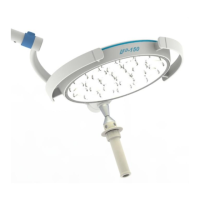
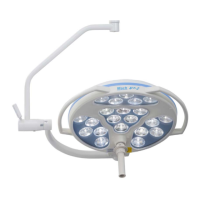
The Dr. Mach LED 150F / 150 / 150FP is a medical lighting system designed for illuminating examination areas in hospitals and doctors' practices. It provides high-intensity, shadow-free, and "cold" light, making it suitable for surgical fields and patient bodies. The system is classified as a Class I medical device according to the Medical Device Regulation and is intended to support therapy and diagnosis in medical rooms (groups 0, 1, and 2 according to DIN VDE 0100-710 / HD 60364-7-710).
Function Description
The Mach LED 150F / 150 / 150FP lighting system is an examination light that can be integrated into ceiling-mounted suspension systems, supporting horizontal and spring arms, or used as a wall light or mobile light. It is important to note that it is not fail-safe when used as a single light.
Important Technical Specifications
The device features LED technology with a long lifespan of at least 50,000 hours and produces minimal heat in the surgeon's head area and the wound field.
- Light Intensity:
- Central light intensity at 1 meter: 110,000 Lux (150F, 150), 130,000 Lux (150FP).
- Light field diameter d10: 187 mm (150F), 200 mm (150), 172 mm (150FP).
- Light field diameter d50: 96 mm (150F), 113 mm (150), 90 mm (150FP).
- Light intensity with one shadower: 0%.
- Light intensity with two shadowers: 55% (150F), 50% (150), 54% (150FP).
- Light intensity on the ground of a normed tube: 100%.
- Light intensity on the ground of a normed tube with one shadower: 0%.
- Light intensity on the ground of a normed tube with two shadowers: 55% (150F), 50% (150), 54% (150FP).
- Illumination depth 20%: 1800 mm (150F, 150FP), 1780 mm (150).
- Illumination depth 60%: 900 mm (150F), 800 mm (150), 840 mm (150FP).
- Color Rendering:
- Color rendering index Ra: 96.
- Color rendering index R9: 94.
- Radiation:
- Max. radiation in field at 1 meter: 379 W/m² (150F), 376 W/m² (150), 459 W/m² (150FP).
- Max. radiation in field at 0.85 meters: 454 W/m² (150F), 460 W/m² (150), 541 W/m² (150FP).
- Light Field:
- Focusable light field size: 18-25 cm (150F), 19 cm (fixed focus for 150), 17-24 cm (150FP).
- Color temperature (Kelvin): 4300 K* (4500 Kelvin optional).
- Electronic light intensity control at the light head (standard): 50-100%.
- Temperature:
- Temperature increase in head area: 0.5 °C.
- LEDs:
- Number of LEDs: 26.
- Lifespan of LEDs: 50,000 hours.
- Physical Dimensions:
- Working distance: 70-140 cm.
- Diameter of the light head: 40 cm.
- Height adjustment: 118 cm.
- Electrical Data:
- Power consumption: 35 W.
- Operating voltage DC: 24 V DC.
- Current: 1.45 A.
- The light is delivered with a Dr. Mach power supply (electronic, wide-range input 100-240V AC, 50-60Hz, output 24V DC).
- If a customer-provided power supply is used, it must provide 24V DC with a maximum undulation of 5%.
- Weights (without handle):
- Mach LED 150F: 3.5 kg.
- Mach LED 150: 3.5 kg.
- Mach LED 150FP: 3.5 kg.
- Environmental Conditions (Operation):
- Temperature: +10°C to +30°C*.
- Relative atmospheric humidity: 30% to 75%.
- Air pressure: 700 hPa to 1060 hPa.
- Environmental Conditions (Transport/Storage):
- Temperature: -10°C to +50°C.
- Relative atmospheric humidity: 20% to 90%.
- Air pressure: 700 hPa to 1060 hPa.
Usage Features
- ON/OFF Switch: The push button on the control panel turns the light ON and OFF.
- Light Intensity Control: The light intensity can be adjusted from 50% to 100% using push buttons to increase or decrease brightness. The set intensity is shown on a display.
- Endo – Light (Mach LED 150/150F/150FP with 4500 Kelvin only): For endoscopic interventions, the light can be dimmed. The Endo mode is activated by repeatedly pressing a specific key until only one LED is on. Deactivation is done by pressing the '+' key.
- Focusing (Mach LED 150F / 150FP only): These models have a focusing function, allowing the user to enlarge or bundle the light field diameter by turning the handle.
- Positioning: The lamp can be positioned using the handle or the handle rail. The handle rail is used for initial positioning before operation, while the handle is used for fine adjustments during operation. It is crucial to position the light only with the handle or specially designed parts on the light housing to avoid damage.
- Safety during Positioning: Collisions between lights, spring arms, and other devices must be avoided during positioning to prevent parts from loosening and falling. When the spring arm and extension arm are in a 180° position, the lamp head cannot be moved in the direction of the suspension axis. Applying force greater than 25 N at this angle can cause damage. To move the lamp in the direction of its suspension axis, the angle between the extension arm and spring arm must be less than 180°.
Maintenance Features
- Sterilisable Handle: The light can be equipped with a removable and sterilisable handle. Before first use and every subsequent use, the handle sleeve must be cleaned, disinfected, and sterilised. To remove, press the lock V and pull off the sleeve. To attach, push and twist until the lock V engages securely. Additional handles should be kept available for exchange as they can become unsterile during an operation.
- Handle Durability: The sterilisable handle sleeve must be disposed of after 1000 sterilisation cycles or at the latest after 2 years and replaced with a new one. The year of manufacture is stamped on the inner side of the handle sleeve.
- Cleaning / Disinfection: Cleaning and disinfection must be carried out immediately after use. A mechanised process (disinfector) is recommended. The process efficiency must be validated. Manual procedures require proof of suitability and effectiveness. It is not allowed to use agents containing high-concentration organic/inorganic acids, chlorinated hydrocarbons, or 2-ethoxyethanol, as these may damage the material.
- Sterilisation Procedure: Only previously cleaned and disinfected handles may be sterilised. Handles should be placed in a suitable sterilisation pack (e.g., foil/paper sterilisation bags) according to DIN EN 868 / ISO 11607 for steam sterilisation. Only steam sterilisation (validated according to DIN EN 554/ISO 11134, maximum 134°C) is permissible. Other sterilisation procedures (e.g., ethylene oxide, formaldehyde, low-temperature plasma) are not allowed.
- Lamp Housing, Protective Disk, and Support System: The Dr. Mach light system has a high-quality surface that can be cleaned with conventional cleaning agents. The protective disk is made of high-quality plastic. It should never be wiped with a dry cloth; always clean with a wet cloth and then wipe with an antistatic, non-fluffy cloth.
- Preventive Maintenance: Preventive maintenance, including a technical and mechanical check-up, must take place every two years. This includes checking for defects in paintwork, fissures in plastic parts, deformation of the suspension, loosened parts, connections between light and carrying system, securing segment (check and grease), faultless function of the light, and electrical safety tests.
- Troubleshooting: The manual provides guidance for common issues such as the light not switching on (checking mains connection, securing segment, and power cycle) and the spring arm not adjusting as required (checking installation and adjusting spring force).
- Electrical Installation: The light is Class I equipment and must be connected to a mains supply with protective earth to avoid electric shock.
- Electromagnetic Compatibility: The lights are subject to special preventive measures and must be installed according to EMC instructions. Portable and mobile HF-communication or other HF-devices can affect the function. Maintenance must be performed within defined intervals using specified spare parts to ensure basic safety and essential performance regarding electromagnetic disturbances. Portable RF communications equipment should be used no closer than 30 cm (12 inches) to any part of the light.
- Disposal: The light does not contain dangerous goods. Components should be properly disposed of at the end of their lifespan, with materials carefully separated. Electrical conducting boards should be recycled, and other components disposed of according to contained materials.

 Need help?
 General

 To Next Page