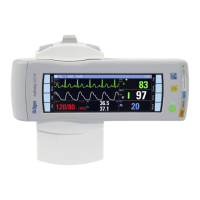
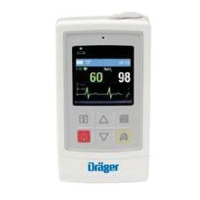
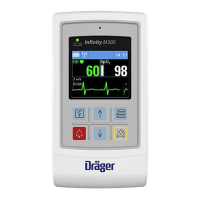
Infinity M300+
34 Supplement – Infinity M300 and M300+ Series – VG2.4
M300/M300+ Performance data
The following disclosures related to algorithm performance using certain waveforms are added or updated
to the monitoring specifications:
M300/M300+ ECG/Arrhythmia/ST Supplemental information
Time to alarm for
tachycardia
Ventricular tachycardia 1mVpp, 206 bpm
Gain 0.5, range 3.0 to 3.5 seconds, average 3.3 seconds
Gain 1.0, range 2.9 to 3.3 seconds, average 3.2 seconds
Gain 2.0, range 2.8 to 3.5 seconds, average 3.0 seconds
Ventricular tachycardia 2 mVpp, 195 bpm
Gain 0.5, range 2.2 to 4.0 seconds, average 3.0 seconds
Gain 1.0, range 1.9 to 2.5 seconds, average 2.3 seconds
Gain 2.0, range 2.0 to 2.9 seconds, average 2.5 seconds
Tall T wave rejection capability 1.20 mV T wave amplitude
Heart rate averaging method Heart Rate is normally based on the average R-R interval calculated
over the last 10 seconds.
Response time of heart rate
meter to change in heart rate
HR change from 80 to 120 bpm:
Range: [3.9 to 5.38 seconds] Average: 4.5 seconds
HR change from 80 to 40 bpm:
Range: [5.31 to 6.73 s] Average: 5.89 seconds
Heart rate meter accuracy and
response to irregular rhythm
Ventricular bigeminy: 80 bpm
Slow alternating ventricular bigeminy: 60 bpm
Rapid alternating ventricular bigeminy: 120 bpm
Bidirectional systoles: 90 bpm
Accuracy of input signal Methods A, B, C, and D from IEC 60601-2-27 were used to establish
overall system error and frequency response.
Lead-off sensing applied current Lead-off sensing applied current < 0.1 µ ampere
M300/M300+ User Interface
Time from alarm condition to
representation
System alarm delay: < 1/s


 To Next Page
 Loading...