

J
John PorterAug 28, 2025
How to fix error 105 on Dräger X-am 5100?
- BBrian FernandezAug 28, 2025
Error code 105 indicates that the bump test interval has elapsed. To resolve this, carry out the bump test.


 To Next PageTo Next Page
How to fix error 105 on Dräger X-am 5100?
Error code 105 indicates that the bump test interval has elapsed. To resolve this, carry out the bump test.
What to do if Dräger X-am 5100 bump test interval has elapsed?
If error code 155 appears, it indicates that the interval for the bump test has elapsed. Perform the bump test.
Why Dräger X-am 5100 display '– –'?
The display showing '– –' on your Dräger Security Sensors indicates that the measuring range may be calibrated incorrectly. Recalibrate the measuring range. If the issue persists, the electronics or sensors could be defective, requiring repair by DrägerService.
What to do if Dräger X-am 5100 Security Sensors database is 90% full?
If error code 153 appears, it indicates that the database is 90% full. To resolve this, read the database soon and then clear the memory.
What to do if Dräger X-am 5100 database is full?
If error code 154 appears, it indicates that the database is full. To resolve this, read the database and clear the memory.
 General
| Measurement Range (H2S) | 0 - 100 ppm |
|---|---|
| Measurement Range (Ex) | 0 - 100 % LEL |
| Measurement Principle | Electrochemical (O2, CO, H2S), Catalytic (Ex) |
| Display | LCD |
| Resolution (O2) | 0.1 % vol |
| Resolution (CO) | 1 ppm |
| Resolution (H2S) | 0.1 ppm |
| Resolution (Ex) | 1 % LEL |
| Accuracy (Ex) | ± 5 % LEL |
| Gas Detection | O2, CO, H2S, Ex (combustible gases) |
| Operating Temperature | -20 to +50 °C |
| Operating Humidity | 10 - 95% RH (non-condensing) |
| Power Supply | Rechargeable Li-ion battery |
| Alarm | Visual, audible, and vibration alarms |
| Data Logger | Yes |
| Accuracy (CO) | ± 5 ppm |
| Certifications | ATEX, IECEx, UL |
| Measurement Range (O2) | 0 to 25 vol.% |
Explains the meaning of warning, caution, and notice icons used in the document.
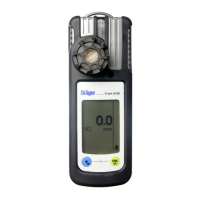
Identifies and describes the components of the Dräger X-am 5100 device.
Specifies the portable gas detection instrument's intended application and monitoring capabilities.
Details the intended operating environments and conditions, including hazardous area classifications.
Provides instructions and warnings for charging the instrument's rechargeable batteries.
Details the procedure and precautions for replacing batteries in the instrument.
Explains the steps to power on the Dräger X-am 5100 device.
Outlines the procedure for powering down the Dräger X-am 5100 device.
Lists essential checks and warnings before using the instrument in a work environment.
Describes how to connect the instrument to a PC for configuration using Dräger CC-Vision software.
Step-by-step guide on how to perform a bump test on the instrument.
Explains how to perform a bump test and document the results within the instrument's memory.
Provides operational guidance and notes on how to use the instrument correctly.
Explains how different alarms are indicated and acknowledged on the instrument.
Describes the indications and acknowledgment of a concentration pre-alarm (A1).
Details the indications and acknowledgment of a concentration main alarm (A2).
Explains the STEL/TWA exposure alarms and their handling.
Describes the battery pre-alarm indication and its implications.
Describes the indications and automatic shutdown for the battery main alarm.
Explains the 'Instrument alarm' indication and the need for maintenance.
Describes how to access the Info Mode to view warning/fault messages and exposure values.
Explains how to view gas, unit, and range limit values in Info-Off Mode.
Lists functions accessible via the Quick Menu, such as bump test and fresh air adjustment.
Describes how to access the Info Mode to view warning/fault messages and exposure values.
Explains how to view gas, unit, and range limit values in Info-Off Mode.
Lists functions accessible via the Quick Menu, such as bump test and fresh air adjustment.
Guides on calibrating the instrument to fresh air to set the sensor's zero point.
Explains how to perform a standard sensitivity calibration using test gas.
Specifies the recommended annual inspection and maintenance intervals for the instrument.
Provides instructions and warnings regarding the cleaning of the instrument.
Details the various markings and certifications applied to the instrument.