EasyManua.ls Logo

Dual 504 - Connection to Amplifier

Dual 504
13 pages
Print Icon
To Next Page IconTo Next Page
To Previous Page IconTo Previous Page
Loading...
Denken
Sie
bitte
daran,
daß
der
Nadelträger
mit
dem
Abtast-Diamanten
aus
physikali-
schen
Gründen
sehr
grazil
ist
und
deshalb
zwangsläufig
empfindlich
gegen
Stoß,
Schlag
oder
unkontrollierte
Berührung
sein
muß,
Nehmen
Sie
zur
Prüfung
der
Abtastnadel
den
kompletten
Tonabnehmerkopf
(das
Abneh-
men
vom
Tonarm
ist
vorstehend
beschrieben)
zum
Fachhändler
mit.
Ausbalancieren
des
Tonarmes
Eine
präzise
Tonarmbalance
ist
Voraussetzung
für
die
Einhaltung
der
Auflagekraft
des
Ton-
abnehmersystems.
Der
Tonarm
ist
nur
einmal
auszubalancieren.
Es
empfiehlt
sich
jedoch,
die
Tonarmbalance
von
Zeit
zu
Zeit
zu
über
prüfen.
Der
Tonarm
ist
ausbalanciert,
wenn
er
frei-
schwebend
in
horizontaler
Lage
verbleibt,
d.
h.
weder
unten
noch
oben
anliegt
und
sich
nach
Antippen
in
vertikaler
Richtung
wieder
von
selbst
in
die
horizontale
Lage
einpendelt
Der
Tonarm
wird
durch
Verschieben
des
Ba-
lancegewichtes
mit
dem
Dorn
im
Tonarmrohr
zunàchst
annáhernd
und
durch
Drehen
des
Balancegewichtes
(8)
exakt
ausbalanciert
1.
Auflagekraft
(7)
und
Antiskating
(10)
auf
"0"
stellen.
2.
Tonarm
entriegeln
und
über
die
Tonarm-
ablage
nach
innen
schwenken.
Tonarmlift
(13)
in
Stellung
X
bringen.
3.
Tonarmbalance
prüfen.
Wenn
der
Tonarm
sich
nicht
von
selbst
horizontal
einpendelt,
Feststellschraube
(9)
lösen
und
das
Balancegewicht
mit
dem
Dorn
so
lange
verschieben,
bis
sich
eine
ungefähre
Balance
ergibt.
Der
Dorn
des
Balancegewichtes
ist
dann
durch
Anziehen
der
Feststell-
schraube
zu
arretieren.
4.
Die
exakte
Balance
des
Tonarmes
an-
schließend
durch
Drehen
des
Balance-
gewichtes
herstellen.
5.
Auflagekraft
und
Antiskating
einstellen
Einstellen
der
Auflagekraft
Jedes
Tonabnehmersystem
erfordert
eine
be-
stimmte
Auflagekraft,
bei
der
optimale
Wie-
dergabe
erzielt
wird.
Für das
eingebaute
Ton-
16
N'oubliez
pas
que
le
porte-pointe
avec
le
diamant
est,
pour
des
raisons
physiques,
très
fin
et
par
suite
trés
sensible
aux
coups,
aux
chocs
et
à
tout
contact
incontrólé.
Pour
le
contróle
de
la
pointe,
emportez
la
téte
com-
plète
chez
le
revendeur
(l'enlèvement
de
la
téte
du
bras
de
lecture
est
décrit
plus
haut)
Equilibrage
du
bras
de
lecture
Un
équilibrage
précis
du
bras
de
lecture
est
la
condition
du
maintien
de
la
force
d'appui
de
la
cellule.
Le
bras
ne
doit
étre
équilibré
qu'une
seule
fois.
Cependant,
il
est
conseillé
de
con-
tróler
l'équilibre
du
bras
de
temps
à
autre.
Le
bras
est
équilibré,
lorsqu'il
reste
librement
en
position
horizontale,
c-à-d
qu'il
n'est
pas
incliné
vers
le
bas
ou
vers
le
haut
et
qu'il
re-
vient
de
lui-méme
en
position
horizontale
aprés
une
légère
pression
verticale
du
doigt.
Le
bras
est
tout
d'abord
équilibré
approxima-
tivement
par
déplacement
du
contrepoids
avec
la
tige
dans
le
tube,
puis
avec
précision
en
tournant
le
contrepoids
(8).
1.
Amener
la
force
d'appui
(7)
et
le
dispositif
antiskating
(10)
sur
"0"
2.
Deverrouiller
le
bras
de
lecture
et
le
faire
pivoter
sur
l'appui
vers
l'intérieur.
Amener
le
léve-bras
(13)
dans
la
position
Y
3.
Contróler
l'équilibre
du
bras.
Si
le
bras
ne
se
stabilise
pas
horizontalement
de
lui
méme,
desserrer
la
vis
de
blocage
(9)
et
déplacer
le
contrepoids
avec
la
tige
jusqu'à
obtenir
un
équilibre
approximatif.
La
tige
du
contrepoids
doit
ensuite
étre
fixée
par
serrage
de
la
vis
de
blocage.
4.
Enfin,
équilibrer
le
bras
avec
précision
en
tournant
le
contrepoids.
5,
Réglez
la
force
d'appui
et
l'antiskating
Réglage
de
la
force
d'appui
Chaque
cellule
nécessite
une
certaine
force
d'appui
permettant
d'obtenir
une
reproduc-
tion
optimale.
Cette
valeur
est
indiquée
sur
Please
keep
in
mind
that
the
stylus
holder
with
the
diamond
tip
is
necessarily
quite
delicate
in
order
to
provide
quality
perform-
ance.
It
is,
therefore,
extremely
sensitive
to
harsh
handling,
accidental
touch,
blows,
etc
Take
the
cartridge
in
the
holder
to
your
Dual
dealer
for
inspection
of
the
stylus.
(Removal
of
cartridge
holder
is
described
above)
.
Balancing
the
pickup
arm
Precise
balancing
of
the
pickup
arm
is
a
prerequisite
for
maintenance
of
the
tracking
force
of
the
pickup
system.
The
pickup
arm
needs
to
be
balanced
only
once.
It
is,
however,
recommended
to
check
the
balance
of
the
tone
arm
from
time
to
time.
The
pickup
arm
is
correctly
balanced
if
it
remains
in
a
horizontal
position
when
released,
ie.
if
it
does
not
rest
against
the
lower
or
upper
end
stops
and
if
it
returns
to
a
horizon-
tal
position
if
deflected
vertically
by
a
small
distance.
The
pickup
arm
is
first
balanced
approxima-
tely
by
sliding
the
shaft
of
the
balance
weight
in
the
pickup
arm
tube.
After
this,
it
is
balanced
precisely
by
turning
the
balance
weight
(8)
1.
Set
the
tracking
force
(7)
and
anti-skating
(10)
controls
to
"0"
2.
Unlock
the
tonearm
and
move
it
over
the
tonearm
rest.
Place
the
cue-control
lever
(13)
in
X
position
3.
Check
the
balance
of
the
pickup
arm.
If
the
pickup
arm
does
not
balance
in
à
hori
zontal
position
at
this
time,
loosen
the
locking
screw
(9)
and
shift
the
balance
weight
complete
with
its
shaft
until
an
approximate
balance
is
achieved.
Now
tighten
the
shaft
of
the
balance
weight
by
tightening
the
locking
screw
4.
Exact
balancing
of
the
pickup
arm
is
then
carried
out
by
turning
the
balance
weight
5.
Set
up
the
tracking
force
and
antiskating
adjustment
Setting
the
Stylus
Pressure
Each
cartridge
has
an
optimum
stylus
pres-
sure.
See
instructions
supplied
with
your
cartridge
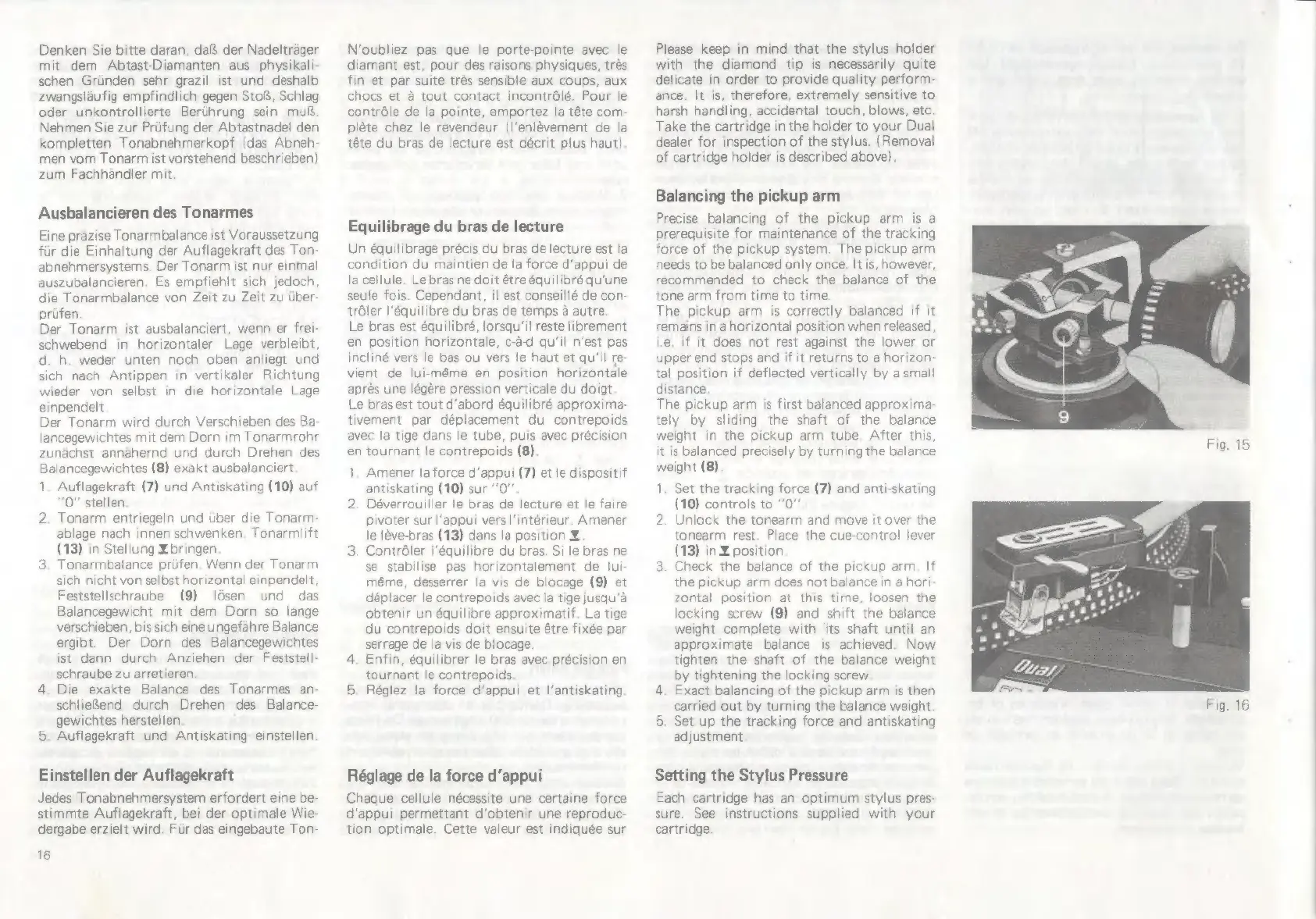
Fig.
15
Fig.
16

Other manuals for Dual 504

Related product manuals