EasyManua.ls Logo

Dual 621 - Pitch Control and Speed Setting; Pitch Control Operation and Adjustment; Stroboscope Speed Verification

Dual 621
18 pages
Print Icon
To Next Page IconTo Next Page
To Previous Page IconTo Previous Page
Loading...
3.
Unsolder
connecting
leads
to
rotary
switch
(5)
and
the
gene-
rator.
Open
twists
of
holding
angle
(150)
with
flat
pliers.
Lift
off
motor
electronic
(152).
Remove
machine
screw
(151)
and
holding
angle
(150).
4.
Loosen
threaded
pins
(15)
and
remove
platter
cone
(14).
Remove
the
three
screws
(148).
Lift
off
motor
mechanics
(149).
5.
Put
platter
cone
(14)
on
new
motor
mechanics
and
fix
it.
Fix
new
motor
mechanics
with
the
three
screws
(148).
Fix
holding
angle
(150)
with
screws
(151).
Insert
motor
electronics
(152)
and
twist
holding
pieces.
Solder
on
resp.
plug
connecting
leads
(Fig.
4).
Push
cover
on
power
part
and
fix
it
with
screws
(112).
6.
With
the
unit
in
normal
position
connect
it
to
the
power
line
Switch
on
unit
and
check
power
consumption
when
opera-
ting:
220
V/50
Hz
approx.
15
mA
110
V/60
Hz
approx.
25
mA
Check
nominal
speeds.
If
necessary,
readjust
as
described
below.
Setting
nominal
speeds
With
knob
(7)
bring
the
fine
speed
control
(129/R
19)
into
center
position.
With
controls
(R
8)
and
(19
9)
on
the
motor
elec-
tronic
system
adjust
nominal
speeds.
Control
(13
8)
is
used
for
33
1/3
rpm,
R
9
for
45
rpm.
Check
with
strobe
disk.
Changeover
to
78
rpm
nominal
speed
Instead
of
45
rpm
the
Dual
621
can
be
changed
to
a
nominal
speed
of
78
rpm.
To
change
the
speed
bring
the
fine
speed
control
(129/R
19)
in
center
position
using
knob
(7).
Using
control
R
9
on
the
motor
electronics
board
(172)
adjust
for
78
rpm.
Check
with
strobe
disk.
Stroboscope
Accurate
setting
of
the
platter
speeds
33
1/3
and
45
rpm
can
be
checked
during
play
with
the
aid
of
the
stroboscope.
When
the
platter
(4)
is
rotating
at
exactly
33
1/3
or
45
rpm
the
lines
of
the
stroboscope
appear
to
stand
still.
If
the
lines
move
in
the
direction
of
rotation
of
the
platter,
the
platter
speed
is
too
high.
If
the
lines
move
backwards,
the
platter
is
rotating
more
slowly
than
the
nominal
speed.
Adjustment
of
platter
speeds
33
1/3
and
45
rpm
can
make
with
the
"pitch"
control
(7).
Strobe
markings
are
provided
on
the
outer
edge
of
the
platter
for
50
and
60
Hz
line
frequencies.
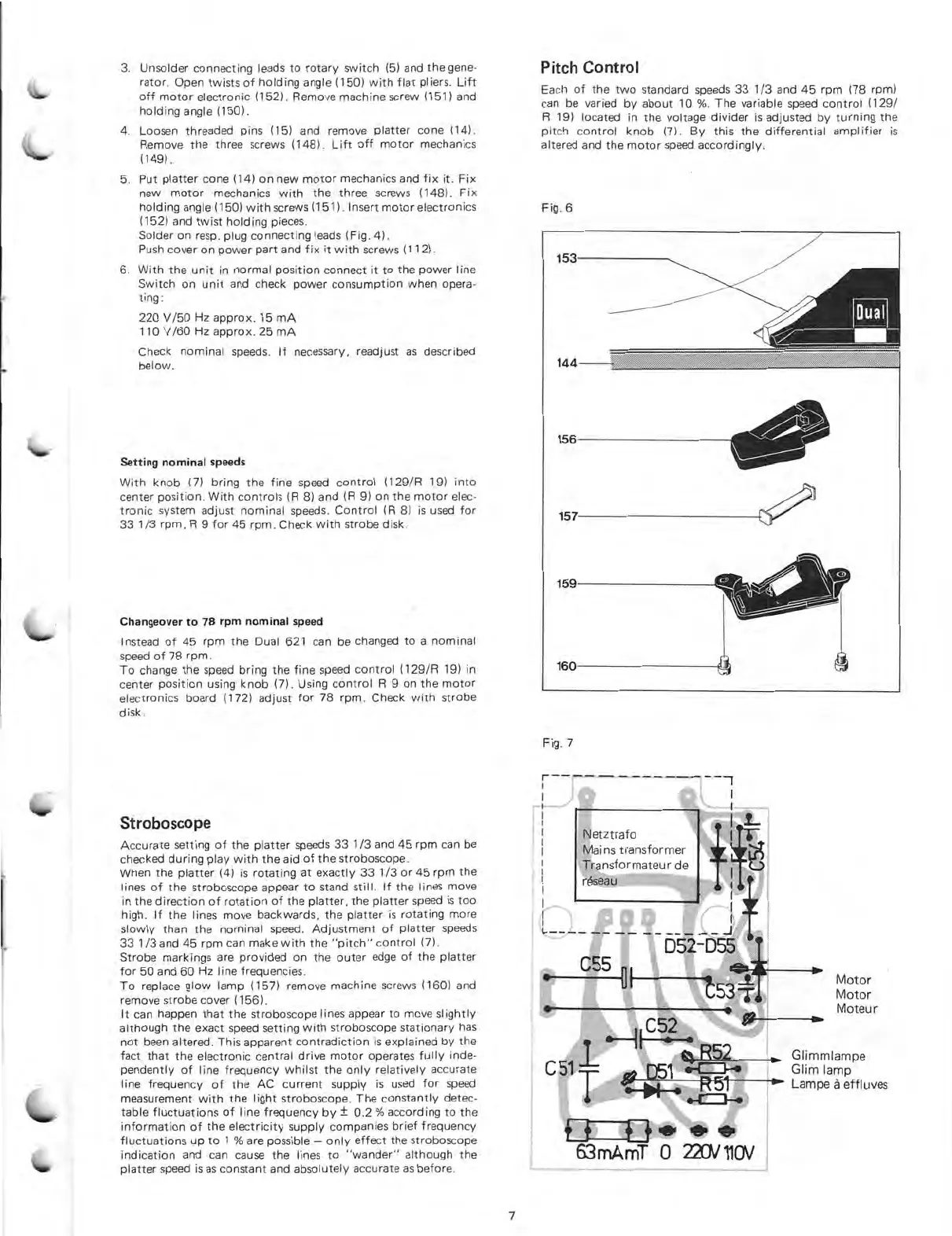
To
replace
glow
lamp
(157)
remove
machine
screws
(160)
and
remove
strobe
cover
(156).
lt
can
happen
that
the
stroboscope
lines
appear
to
move
slightly
although
the
exact
speed
setting
with
stroboscope
stationary
has
not
been
altered.
This
apparent
contradiction
is
explained
by
the
fact
that
the
electronic
central
drive
motor
operates
fully
inde-
pendently
of
line
frequency
whilst
the
only
relatively
accurate
line
frequency
of
the
AC
current
supply
is
used
for
speed
measurement
with
the
light
stroboscope.
The
constantly
detec-
table
fluctuations
of
line
frequency
by
±
0.2
%
according
to
the
information
of
the
electricity
supply
companies
brief
frequency
fluctuations
up
to
1
%
are
possible
only
effect
the
stroboscope
indication
and
can
cause
the
lines
to
"wander"
although
the
platter
speed
is
as
constant
and
absolutely
accurate
as
before.
P
itch
Control
Each
of
the
two
standard
speeds
33
1/3
and
45
rpm
(78
rpm)
can
be
varied
by
about
10
%.
The
variable
speed
control
1129/
R
19)
located
in
the
voltage
divider
is
adjusted
by
turning
the
pitch
control
knob
(7).
By
this
the
differential
amplifier
is
altered
and
the
motor
speed
accordingly.
Fig.
6
153
144
156
157
159
160
Fig.
7
Netztrafo
Mains
transformer
Transformateur
de
ffi
seaLi
C52
fIJ
e
63
mA
mT
0
220V
110V
Motor
Motor
Moteur
Glimmlampe
Glim
lamp
Lampe
ä
effluves

Other manuals for Dual 621

Related product manuals