Precise
balance
is
especially
important
with cartridges
that
require a
low
stylus
force. The balancing
operation
needs
to be
done only once,
unless
you
install
a dif-
ferent cartridge.
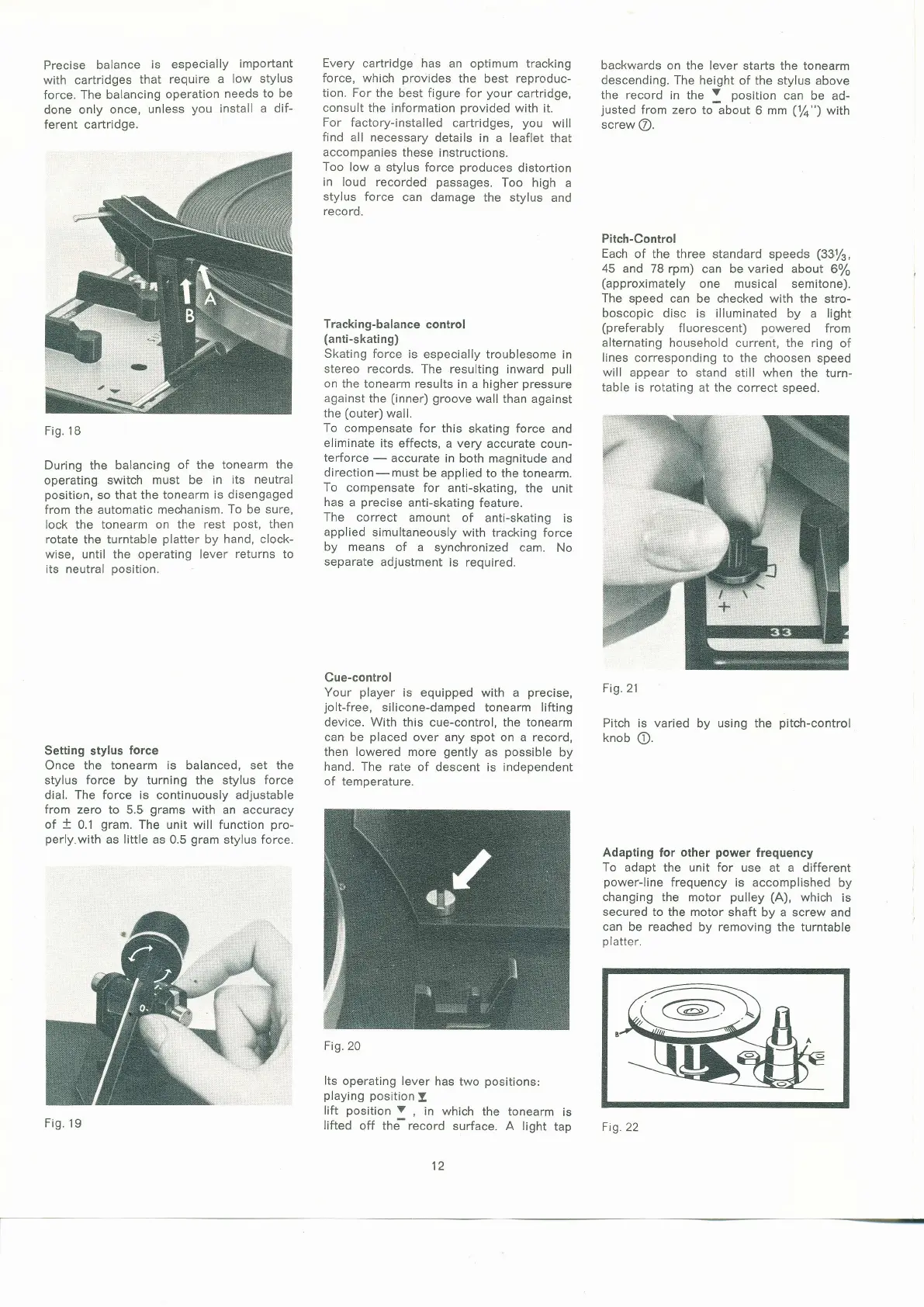
Fig. 18
During the
balancing
of
the
tonearm
the
operating switch
must be
in its
neutral
position,
so that the tonearm
is disengaged
from the automatic
mechanism. To be
sure,
lock the tonearm on
the rest
post,
then
rotate
the
turntable
platter
by
hand,
clock-
wise,
until
the operating lever
returns
to
its neutral
position.
Setting
stylus
force
Once the tonearm is balanced, set the
stylus
force
by turning the stylus
force
dial. The force is
continuously
adjustable
from
zero to 5.5
grams
with an accuracy
of
+
0.1
gram.
The unit will function
pro-
perly.with
as little as 0.5
gram
stylus force.
Every
cartridge has an optimum tracking
force, which
provides
the best reproduc-
tion. For the
best
figure
for
your
cartridge,
consult the information
provided
with it.
For factory-installed
cartridges,
you
will
find all necessary
details
in a leaflet that
accompanies
these instructions.
Too
low
a stylus force
produces
distortion
in
Ioud recorded
passages.
Too high
a
stylus
force can
damage
the stylus and
record.
Tracking-balance
control
(anti-skating)
Skating force
is especially troublesome
in
stereo records.
The resulting inward
pull
on the tonearm results
in a higher
pressure
against the
(inner) groove
wall than against
the
(outer)
wall.
To
com.pensate for this
skating force
and
eliminate
its effects,
a
very
accurate coun-
terforce
-
accurate in
both magnitude
and
direction-must
be applied
to the tonearm.
To compensate
for anti-skating,
the
unit
has
a
precise
anti-skating
feature.
The
correct
amount of
anti-skating is
applied
simultaneously
with tracking force
by means
of a synchronized cam.
No
separate
adjustment
is required.
Cue-control
Your
player
is equipped
with a
precise,
jolt-free,
silicone-damped
tonearm
lifting
device. With this cue-control, the tonearm
can be
placed
over any
spot
on a record,
then lowered more
gently
as
possible
by
hand.
The rate of descent is independent
of temperature.
Fig. 20
Its
operating lever
has
two
positions:
playing position
t
lift
position
v
,
in which
the tonearm
is
Iifted
off the-record
surface. A light
tap
backwards on the lever
starts the tonearm
descending.
The height
of the stylus above
the record
in the
v
position
can be
ad-
justed
from
zero to
about 6 mm
(t/a")
with
screw
@.
Pitch-Control
Each
of the three
standard speeds
(33'll3,
45
and 78 rpm) can be varied about
60/s
(approximately
one musical semitone).
The
speed can be checked with the
stro-
boscopic disc
is illuminated by a light
(preferably
f luorescent)
powered
from
alternating household current, the ring
of
lines
corresponding to the choosen
speed
will appear
to stand still when the
turn-
table is rotating
at
the
correct speed.
Fig. 2l
Pitch is varied
by using the
pitch-control
knob
O.
Adapting
for other
power
frequency
To
adapt the unit for
use
at a different
power-line
frequency is
accomplished by
changing the
motor
pulley
(A),
which
is
secured
to
the
motor shaft
by
a screw
and
can be reached
by
removing
the turntable
p
I atter.
Fig.
19
12
Fi9.22


 To Next Page
 Loading...