8
TUNING
GUIDE
When tuning the Evader EXB make sure that you have equal
length shocks, camber rods and steering rods on both sides
(left and right). They do not have to be the same front to rear.
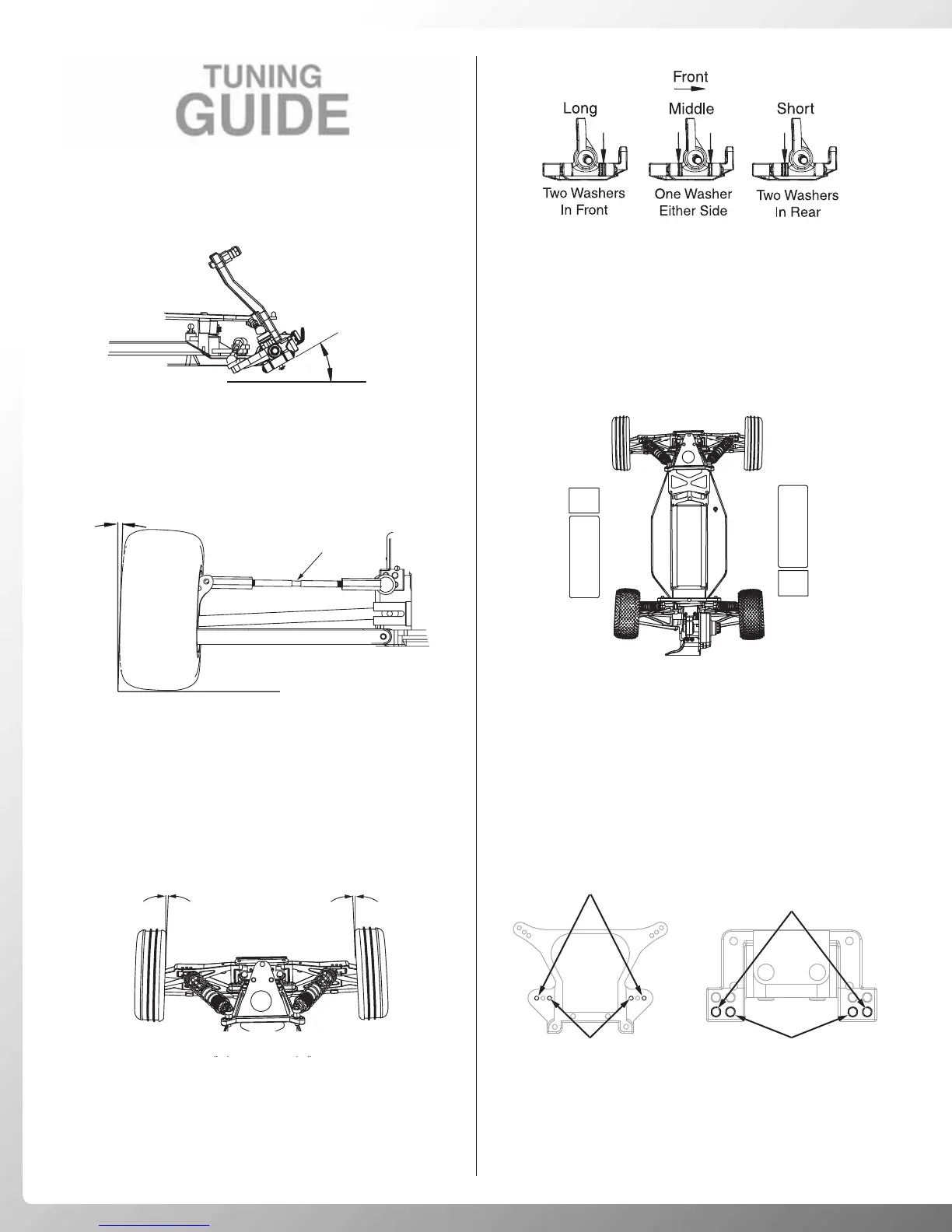
CASTER
30° Caster
Caster refers to the angle formed by the kingpin and the
surface when viewed from the side. 0° of caster means that
the kingpin is straight up and down. The Evader EXB comes
stock with 30° of caster and is not adjustable.
CAMBER
2° Negative Camber
Adjust
Camber refers to the angle at which the tire and wheel ride
in relation to the ground when viewed from the front or rear.
Negative camber is when the top of the tire and wheel lean
inward and positive camber is when the tire and wheel lean
outward. Typically you want 0° to 2° of negative camber.
Never put in positive camber. Make sure that both sides have
equal amounts of camber by keeping the camber turnbuckles
equal in length.
FRONT TOE-IN AND TOE-OUT
Front wheels
ointed towards each other.
1° 1°
Toe-in and toe-out refer to the angle which the tire is at
when viewed from above. Toe-in increases stability under
acceleration, but also decreases steering when entering a
corner. Toe-out will increase steering into corners, but will
decrease the overall stability during acceleration. The front
typically is setup with 0° to -2° of toe-in.
WHEELBASE
Wheelbase is the distance from the center of the front wheel
to the center of the rear wheel. Lengthening the wheelbase
of the Evader increases steering, but decreases rear traction
because it puts more weight on the front wheels. Decreasing
the wheelbase of the Evader will increase rear traction, but
decrease steering.
BATTERY PLACEMENT
Foam
Spacer
Foam
Spacer
Battery
Battery
More Rear
Traction
More Front
Traction
The battery placement of the Evader can be adjusted with
the foam spacers which will affect the buggy’s rear traction.
Forward position will reduce rear traction, but enhance
steering. A rear position will create more rear traction with
less steering.
CAMBER LINK PLACEMENT
FRONT
Short Camber Link Position:
More Stable, Less Traction
REAR
Short Camber Link Position:
More Stable, Less Traction
Long Camber Link Position:
Less Stable, More Traction
Long Camber Link Position:
Less Stable, More Traction
The camber link placement affects the traction and handling
on rough tracks. Using a long mounting position will increase
traction but decrease stability. Shortening the link will increase
stability, but decrease traction.


 To Next Page