Need help?
Do you have a question about the DWK WHEATON Standard and is the answer not in the manual?
This document describes the WHEATON® Standard Top Drive Roller Apparatus, a device designed for controlled bottle rotation in laboratory settings.
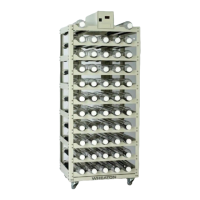
The WHEATON® Standard Top Drive Roller Apparatus is a microprocessor-controlled, digital display and powerful brushless DC motor system. It provides smooth and precise control of bottle rotation speed, featuring true bottle speed indication, programmable ramping, and an optional 8-hour battery backup and rotation alarm. This apparatus is designed to roll partially filled roller bottles at specified speeds, making it suitable for various cell culture applications.
Operating Voltage: Nominal 100-240 VAC 50/60 Hz Power Consumption: 35 watts Fuse(s): (1) 1.0 A 5x20 mm 250 V – (110-120 V) (2) 0.63 A 5x20 mm 250 V – (220-240 V) Bottle Size Range: 110 – 121 mm diameter and up to 550 mm in length Bottle Speed: 0.25 to 8.00 rotations per minute (RPM) using 110 mm diameter bottles Diameter Bottles: 0.22 to 7.54 RPM using 117 mm diameter bottles Installation Category: Class II IP Code (Control Head Only): 42 Environmental: Operating temperature: 5° C to 40°C Humidity: 80% up to 31°C / 50% at 40°C Altitude limit: 2000 meters Motor: 24 VDC – Brushless Gear motor Battery Backup (option): Two sealed lead acid batteries for approximately 8 hours full operation. Alarms:
Dimensions and Capacities:
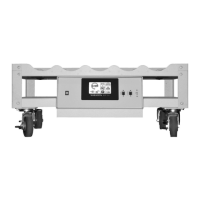
The apparatus offers a user-friendly interface with a front panel navigation system. The display screen and power switch are clearly visible, and an optional alarm output jack is available. Navigation between the three main screens (Operation Mode, Setup Mode, and Factory Mode) is done through four push buttons: Select, Enter, Up Arrow, and Down Arrow.
Operation Mode: This is the default mode where all operational parameters are set. True bottle speed is displayed along with any alarm conditions. Setting Bottle Speed: Users can change the bottle speed using the Up and Down buttons. The speed can be incremented by 0.01 rpm with each press, or by holding the button down for about 5 seconds for a larger numerical change. The standard bottle speed range is 0.23 rpm to 8.02 rpm. Setup Mode: This mode allows users to set the bottle diameter and direction of rotation. Parameters are usually not changed unless different size bottles are used. Values set in the Setup Mode are not erased when power is removed. Factory Mode: Five additional parameters are accessible in Factory Mode, which are typically for advanced users or service personnel. These parameters control change motor gear, ramp up time, bottle speed tolerance, rotation alarm, and battery backup alarm. Bottle Speed Tolerance: This parameter sets the speed deviation point at which a unit will generate a speed deviation alarm. Rotation Alarm: This parameter determines if the optional rotational alarm is activated or off. Battery Backup Alarm: This parameter indicates if the battery voltage falls below 21.7 volts.
Calibration: The motor can be calibrated in two steps. The calibration process takes 20 seconds for each step, during which the system will automatically go to the next step. Once all steps are complete, the calibration constants are saved, and the apparatus returns to normal operation.
Regular maintenance is crucial for optimal performance and longevity of the WHEATON® Standard Top Drive Roller Apparatus.
Instrument Inspection Schedule:
Troubleshooting Checklist: The manual provides a comprehensive troubleshooting guide for common issues:
Motor Replacement: Detailed instructions are provided for replacing the motor, including steps to disconnect power, remove screws, locate and unplug the motor lead cable, and re-assemble the unit.
Fuse Replacement: Instructions for replacing fuses are provided, including how to remove the fuse drawer and insert new fuses with the correct rating. The unit uses 110-120 VAC unit uses (1) 5x20 mm, 250 V, 1.0 A fuse and 220-240 VAC unit uses (2) 5x20 mm, 250 V, 0.63 A fuses.
Optional Battery Backup Technical Information: The battery backup system is a factory-installed or field-installed option that provides approximately 8 hours of auxiliary power. This integrated system consists of two sealed lead acid batteries and an automatic charging system. The battery backup utilizes two sealed lead acid batteries which must be maintained in a fully charged state to ensure proper auxiliary operation. The charging circuitry charges the batteries whenever the roller apparatus is plugged in and operating. If primary mains power is lost while a roller apparatus is in normal operation, the battery backup system will automatically and seamlessly switch the roller apparatus to operate and function normally on its internal batteries. Once primary power is restored, the charger will automatically switch the apparatus back to normal operation. Replacement batteries are Power Sonic Model PS-1230. Typical battery service life is 2.5 to 3 years. Assuming battery storage and operation in a 37 °C incubator.
 General
| Brand | DWK |
|---|---|
| Model | WHEATON Standard |
| Category | Industrial Equipment |
| Language | English |

 To Next Page