
 Need help?
Do you have a question about the Eaton Xpert Meter 2000 Series and is the answer not in the manual?
Identifies the physical location of the Power Xpert Meter 2000 Gateway Card.
Steps to make the meter's gateway card accessible on the network.
Procedure to check the IP address from the meter's front panel.
Accessing meter functions and configuration via the network.
Instructions on how to restart the gateway card using the reset switch.
The Eaton Power Xpert Meter 2000 Series is a sophisticated power monitoring device designed for comprehensive electrical system analysis and management. This quick start guide, IM02601002E, provides essential information for the mechanical installation, electrical wiring, network planning, and initial configuration of the meter, ensuring it can be quickly integrated into an existing power infrastructure. The meter is available in several models, including PXM 2250, PXM 2260, PXM 2270, PXM 2280, and PXM 2290, each offering a range of capabilities to suit various application needs.
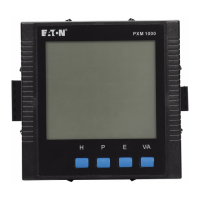
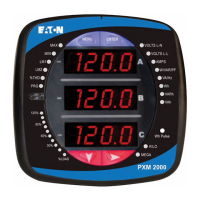
The primary function of the Power Xpert Meter 2000 Series is to provide accurate and real-time measurement of electrical parameters within a power system. It is capable of monitoring a wide array of electrical values, including voltage (L-N and L-L), current (amps), active power (W), reactive power (VAR), apparent power (VA), power factor (PF), frequency (Hz), active energy (Wh), reactive energy (VARh), and apparent energy (VAh). The meter's front panel features a clear digital display that shows these measurements, along with indicators for load percentage (120%, 90%, 60%, 30%), and status lights for various functions like limits (LMT), minimum (MIN), maximum (MAX), and programming (PRG).
A key feature of the PXM 2000 Series is its integrated, multi-function Ethernet network gateway card. This card transforms the meter into a networked device, enabling remote access and advanced communication capabilities. The gateway card provides a local web server, allowing users to access and configure the meter through a standard web browser. It supports various communication protocols, including Modbus/TCP, SNMP, Power Xpert Software (PXS) communications, and BACnet/IP communications, making it highly versatile for integration into different building management and industrial control systems.
The meter is designed to facilitate network accessibility, allowing for remote configuration and data retrieval. This is crucial for modern power management systems where centralized monitoring and control are essential. Users can configure the meter's gateway card for network accessibility, either by assigning a fixed (static) IP address or by utilizing a DHCP server to assign an IP address. Eaton strongly recommends using a fixed IP address, especially when integrating with an Eaton PXS system, to prevent data access issues that could arise from IP address changes after power outages.
The device also includes a pulse output for active energy (Wh Pulse), which can be used for external energy counting or billing systems. The front panel controls, including MENU and ENTER buttons, allow for direct navigation through the meter's settings and displayed parameters. The presence of "KILO" and "MEGA" indicators suggests the meter can handle and display large energy values, suitable for significant industrial or commercial applications.
The Power Xpert Meter 2000 Series is designed for ease of use, from installation to daily operation. Mechanical installation options include 4-inch diameter round mounting (using ANSI studs) and 92 mm square form mounting. For DIN rail installations, the ANSI studs can be unscrewed. The guide provides clear diagrams for both round and square form installations, ensuring proper physical integration into electrical panels. A critical caution during mechanical installation is to avoid overtightening nuts, with a maximum installation torque of 0.4 Newton-Meter specified to prevent damage to the meter.
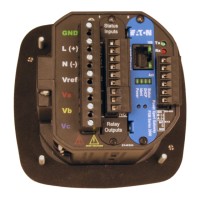
Electrical wiring instructions are provided for various configurations, including WYE Direct 3 Phase, 4-wire; WYE with PTs 3 Phase, 4-wire; DELTA Direct 3 Phase, 3-wire; and DELTA with PTs 3 Phase, 3-wire. These diagrams illustrate the connections for power supply, current transformers (CTs), and voltage references, ensuring correct and safe electrical integration. Users are directed to the Power Xpert Meter 2000 User and Installation Guide for additional wiring configurations, highlighting the meter's adaptability to diverse electrical systems.
Network planning is a significant aspect of using the PXM 2000 Series. The guide emphasizes the importance of consulting with a network administrator to determine the appropriate IP addressing scheme (fixed or DHCP) and to obtain necessary network information such as IP address, subnet mask, default gateway, and DNS server IP addresses. The MAC address of the meter's gateway card is crucial for DHCP server configurations and is located on a small label on the device.
Configuring the meter's gateway card for network accessibility involves using a local PC with an Ethernet port, an Ethernet cable (straight-through or cross-over), a web browser (Internet Explorer 7 or 8 recommended), and Java J2SE JRE (version 6 or later). The process involves setting the PC's IP address to be on the same subnet as the meter's default IP address (192.168.1.1) and then accessing the meter's web server through the browser. The Java Control Panel is used to manage temporary internet files, ensuring smooth loading of the meter's Java applet. Once connected, users can log in using default credentials (admin/admin) and configure network settings, location information, and other optional parameters.
The meter's front panel also serves as a direct interface for verifying the IP address. By navigating through the MENU button and selecting the "IP" option, users can confirm that the assigned IP address matches the network administrator's specifications. This direct verification method is useful for quick checks without needing a networked PC.
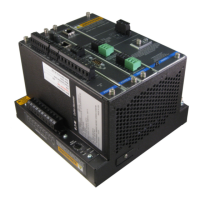
The Power Xpert Meter 2000 Series incorporates features that simplify maintenance and troubleshooting. The gateway card, a blue card installed in the right-most option slot (slot 2) on the rear of the meter, includes four indicator LEDs: Status, DHCP, Ident, and Power. These LEDs provide visual feedback on the card's operational status. When power is first applied, all lights should briefly be off before the Power light illuminates, indicating that the card has power and is running. This visual diagnostic helps in quickly assessing the basic functionality of the gateway card.
A crucial maintenance feature is the ability to restart and reset the gateway card to factory defaults. A momentary push-button switch, accessible through a small hole in the faceplate of the gateway card (closest to the DHCP LED), allows users to restart just the gateway card. This is particularly useful for recovering from abnormal conditions without affecting the entire meter. The guide notes that it may take approximately five minutes for the meter pages to display values after a gateway card restart. While not used in normal operations, this switch provides a vital troubleshooting mechanism.
For more detailed information on applications and options, users are directed to the PXM 2000 Meter User's Guide (IM02601001E), which is typically shipped with the meter on a CD and is also available online. This comprehensive guide serves as a valuable resource for advanced configurations, troubleshooting, and understanding the full capabilities of the device. The availability of such detailed documentation ensures that users have access to the necessary information for ongoing maintenance and optimal utilization of the meter.
The design of the PXM 2000 Series, with its robust communication capabilities and diagnostic indicators, aims to minimize downtime and simplify the management of power systems. The ability to remotely access and configure the meter through a web browser significantly reduces the need for on-site interventions, streamlining maintenance efforts and enhancing operational efficiency.
 General
| Mounting | Panel mount |
|---|---|
| Power Consumption | < 5 VA |
| Operating Temperature | -10°C to +55°C |
| Current Input | 5 A nominal |
| Frequency Range | 45 Hz to 65 Hz |
| Display | LCD with backlight |
| Communication | RS485, Ethernet |
| Storage Temperature | -40°C to +70°C |
| Humidity | Up to 95% non-condensing |
| Dimensions | 96 mm x 96 mm x 80 mm |
| Weight | 0.5kg |
| Protection Class | IP20 |
| Standards | IEC 61010-1 |



 To Next Page