
 Need help?
Do you have a question about the ebm-papst VBH0310CTRLS and is the answer not in the manual?
Describes different hazard levels (DANGER, WARNING, CAUTION, NOTE) used in the manual.
Specifies the required qualifications and training for personnel handling the device.
General safety principles and precautions to be observed when working with the device.
Warns about electrical hazards, including shock risks associated with voltage.
Mentions integrated safety mechanisms and protective features of the device.
Discusses potential electromagnetic interference and EMC compliance requirements.
Highlights risks associated with the device's moving parts, such as rotating impellers.
Addresses potential emissions from the device, such as noise levels.
Warns about burn risks due to hot components of the device during operation.
Provides instructions and precautions for safely transporting the device.
Recommends proper conditions and procedures for storing the device.
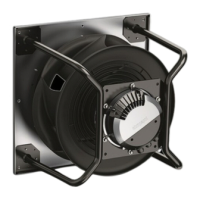
Visual representation of the device with key dimensions and labels.
Lists essential technical specifications and performance characteristics.
Provides energy efficiency data and compliance information as per EU regulation.
Detailed overview of the device's components, materials, and features.
Information and specifications related to the mounting of the device.
Guidelines for handling, transporting, and storing the device.
Information regarding the device's behavior concerning EMC standards.
Procedures and precautions for physically installing and connecting the device.
Detailed instructions for wiring the device, including safety precautions.
Prerequisites, standards, and cable specifications for electrical connections.
Details on connecting the power supply, including fuse recommendations.
Explanation of reactive currents and their implications for the supply line.
Guidance on selecting and using residual current devices with the device.
Information regarding potential leakage currents and their behavior.
Explanation of the device's built-in protection against rotor blockage.
Instructions for making connections within the device's terminal box.
Steps for preparing cables, including stripping and ensuring proper fit.
Detailed procedure for connecting wires to the device terminals.
Best practices for routing cables to prevent damage and moisture ingress.
Schematic illustration of electrical connections and terminal assignments.
Details on how to configure device functions, parameters, and IO modes.
Diagrams illustrating the electrical behavior of inputs and outputs.
Procedures for verifying the correctness and security of electrical connections.
Step-by-step instructions for safely powering up the device after installation.
Methods to manage and avoid excessive vibration at specific speed ranges.
Procedures for safely powering down the device during operation or for maintenance.
Guide to interpreting LED indicators and status codes for device monitoring.
Specific warning codes displayed by the device, their causes, and remedies.
Detailed error codes, their possible causes, and recommended actions.
Procedure for performing manual vibration tests to ensure smooth operation.
Instructions for cleaning the device to maintain performance and longevity.
Recommended intervals and procedures for performing safety checks.
Guidelines for environmentally sound disposal of the product and its components.
Legal regulations and standards applicable to product disposal in different countries.
Steps for safely disassembling the product for disposal, requiring qualified personnel.
Instructions for separating and recycling individual product components.
This document outlines the operating instructions for the VBH0310CTRLS device, a built-in fan designed for conveying air according to its technical specifications. It emphasizes safety, proper usage, and maintenance procedures to ensure optimal performance and longevity.
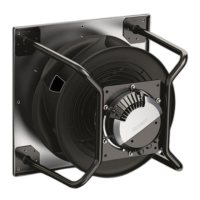
The VBH0310CTRLS is an EC fan primarily designed for air conveyance within stationary systems. It operates by drawing in air and moving it through a system, with its performance controlled by various input signals. The device is equipped with integrated protective features that automatically switch off the motor in case of faults such as rotor position detection errors, blocked rotor, line undervoltage, or phase failure, ensuring operational safety and preventing damage. The motor status is indicated by an LED on the electronics housing, which displays different colors and flash codes to signal warnings or errors. The fan is designed for use in power systems with grounded neutral (TN/TT), phase conductor grounding, or IT power systems, and in networks with quality characteristics as per EN 50160.
The device is intended for conveying air at ambient air pressures between 800 mbar and 1050 mbar, within a permitted ambient temperature range. It is crucial to operate the device with all protective devices in place and to follow the operating instructions diligently. The fan's speed can be controlled via various input signals, including analog inputs (0-10V/PWM or 4-20mA) or digital inputs, allowing for flexible integration into different control systems. The device also features an RS485 interface for MODBUS, RSA, and SELV communication, enabling remote monitoring and control. Output signals provide feedback on fan operation, such as speed and status. The fan is designed to be robust, with an IP55 degree of protection, making it suitable for various industrial environments. It is important to avoid improper use, such as operating the device in an unbalanced state, with severe vibration, conveying solids or highly corrosive air, or in explosive atmospheres, as these can lead to hazards and device damage.
Regular maintenance is crucial for the VBH0310CTRLS to ensure a long service life and proper operation. This includes periodic checks for soiling and proper functioning. The preferred cleaning method is dry cleaning, such as using compressed air, and aggressive cleaning agents, pointed, or sharp-edged objects should be avoided. If severe corrosion is observed on load-bearing or rotating parts, the device should be replaced immediately. The fan is equipped with maintenance-free ball bearings with lifetime lubrication designed for 40,000 hours of service.
A key maintenance feature is vibration testing, which should be performed every six months. This involves measuring vibration severity at the motor fastening diameter to identify and avoid speed ranges with excessively high vibration levels caused by resonances or imbalances. The integrated vibration sensor in the motor can be used for this purpose, or a manual vibration test can be performed. If cleaning does not eliminate vibrations, the fan may need rebalancing.
The device also includes a safety inspection checklist, which involves checking the electrical equipment at regular intervals, replacing loose connections and defective cables, and ensuring that all protective features are functional. For devices not operated for a lengthy period, especially in damp environments, it is recommended to start and operate them at full speed for a specified duration to move the bearings and evaporate any condensate. In case of malfunctions, the LED warning/status codes provide diagnostic information, guiding troubleshooting efforts. For repairs or replacements, the device should be sent to ebm-papst.
 General
| Manufacturer | ebm-papst |
|---|---|
| Model | VBH0310CTRLS |
| Category | Fan |
| Type | Axial Fan |
| Voltage | 24 VDC |
| Airflow | 1900 m³/h |
| Bearing Type | Ball Bearing |


 To Next Page