
 Need help?
Do you have a question about the ebm-papst W2D250-CI14-09 and is the answer not in the manual?
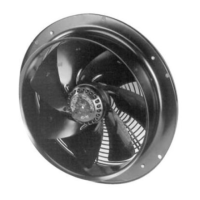
This document describes the W2D250-CI14-09 device, an ebm-papst fan designed for conveying air. It is intended as a built-in component and must be operated according to its technical data and within specified environmental conditions.
The W2D250-CI14-09 is a three-phase external rotor motor fan, primarily designed for air conveyance. It operates by drawing air in direction "A" (as indicated in the product drawing) and rotating counterclockwise when viewed toward the rotor. The device is a built-in component, meaning it is integrated into a larger system or machine. Its operation is contingent on proper mechanical and electrical connection, adherence to safety regulations, and appropriate maintenance. The fan is designed for continuous operation (S1 mode) and is equipped with ball bearings for long service life.
The fan's nominal data varies depending on the voltage, wiring configuration (Delta or Star), and frequency. For instance, at 230 VAC, Delta wiring, and 60 Hz, the fan operates at 2580 rpm, consumes 140 W, and draws 0.38 A, with a maximum back pressure of 100 Pa. Other configurations are detailed in the "Nominal data" table, including operations at 208 VAC, 220 VAC, 360 VAC, 380 VAC, 400 VAC, 415 VAC, 460 VAC, and 480 VAC, across 50 Hz and 60 Hz frequencies.
Key physical specifications include:
The device is designed to operate within an ambient air pressure range of 800 mbar to 1050 mbar. The maximum permitted ambient temperature for motor transport/storage is +80 °C, and the minimum is -40 °C. The strength class of screws for mounting is 8.8. The tightening torque for mounting is 1.5 ± 0.2 Nm, and for the cable gland, it is 2.5 ± 0.4 Nm, accommodating cable diameters between 4 mm and 10 mm.
The fan is designed for use in power systems with grounded neutral (TN/TT power systems). It must be operated within the permitted ambient temperature range specified in the nominal data and transport/storage conditions. All protective devices must be in place and functional during operation.
Regular maintenance is crucial for ensuring a long service life and proper operation.


 To Next Page
 General