Heat
ptmp
bme
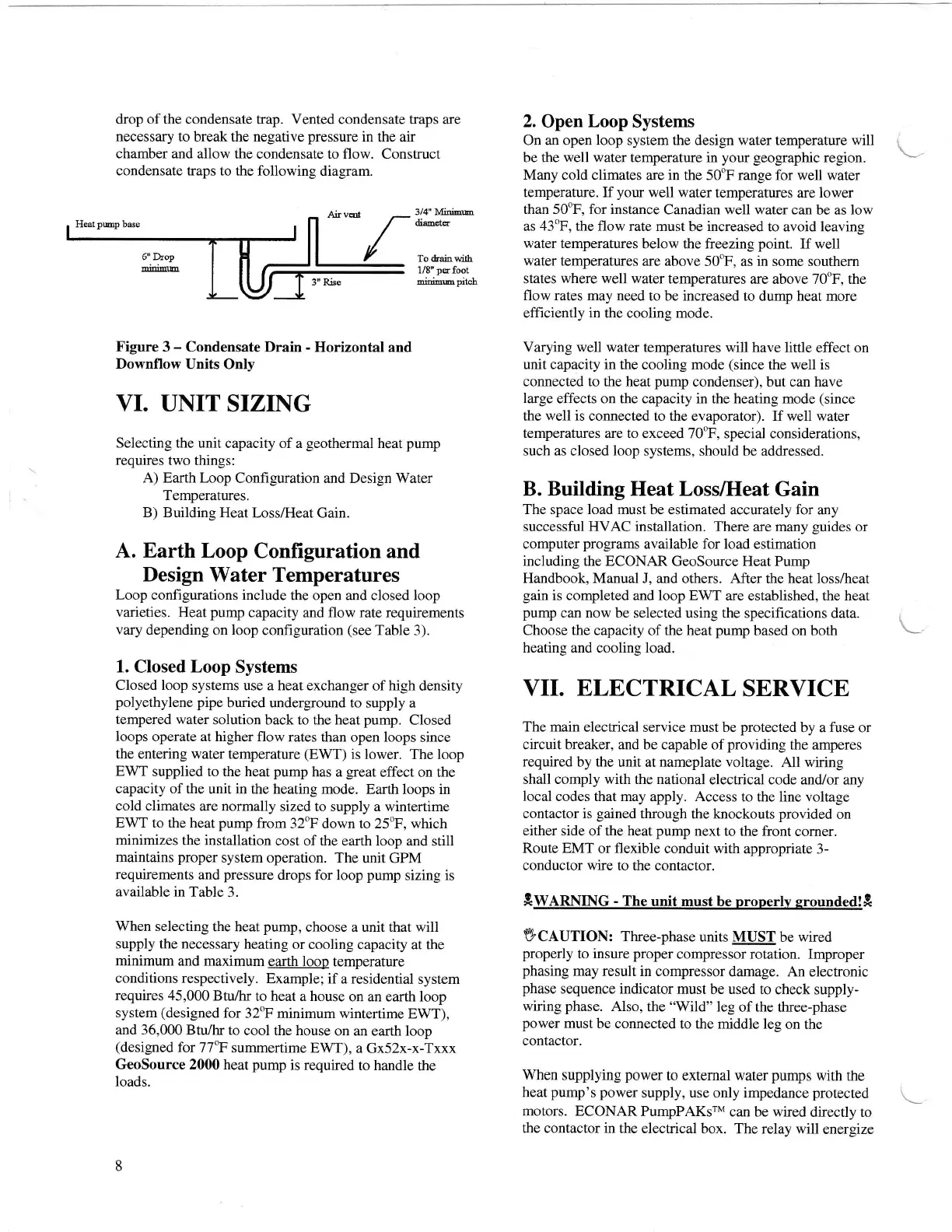
drop ofthe condensate
trap. Vented condensate traps are
necessary to break the negative
pressuro
in
the air
chamber and
allow the condensate to flow. Consffuct
condensate traps to
the following diagram.
Air v@t
3/4"Minim
di@til
2.
Open
Loop
Systems
On an open loop system the design water temperature will
be the well water temperature in
your geographic
region.
Many
cold climates are in the 50oF range for
well
water
temperature. If
your
well
water temperafures
are
lower
than 50oF, for instance
Canadian well water
can be as low
as
43nF,
the flow rate must
be
increased
to avoid leaving
water temperatures
below the freezing
point.
If well
water
temperatures are above
50oF, as in some southern
states
where
well water temperatures
are above 70oF, the
flow rates
may need to be increased
to dump heat more
efficiently
in
the cooling mode.
Varying well water temperatures
will have little effect on
unit capacity in
the cooling mode
(since
the well is
connected to the
heat
purp
condonser), but can have
large effects on the capacity in
the
heating
mode
(since
the well is connected to the
evaporator). If
well
water
temperafues are
to exceed 70oF, special considerations,
such as closed loop systems,
should be addressed.
B. Building Heat Loss/fleat
Gain
The space load must
be estimated accurately for any
successful
HVAC installation.
There are many
guides
or
computer
programs
available for load
estimation
including the ECONAR
GeoSource
Heat
Pump
Handbook, Manual
J, and others. After the heat loss/heat
gain
is completed
and
loop EWT
are established, the heat
pump
can now be selected
using the specifications data.
Choose the capacity of the heat
pump
based on both
heating
and cooling
load.
VII.
ELECTRICAL
SERVICE
The main
electrical service must be
protected
by a
fuse
or
circuitbreaker, and
be capable ofproviding the
amperes
required
by the unit at nameplate voltage.
All wiring
shall comply with the national
electrical code
and/or any
local codes that may
apply. Access to the line voltage
contactor is
gained
through the knockouts
provided
on
either
side of the
heat pump
next
to the front corner.
Route EMT
or flexible conduit with
appropriate 3-
conductor wire to the contactor.
9WARNING
-
The
unit must be
properlv
erounded!9
VCIUTION:
Three-phase
units
ry[WI
be wired
properly
to insure
proper
compressor rotation. Improper
phasing
may
result in compressor
damage. An
electronic
phase
sequence indicator
must be used
to check supply-
wiring
phase.
Also,
the
"Wild"
leg
of the three-phase
power
must
be connected
to the middle leg
on the
contactor.
When supplying
power
to extemal
water
pumps
with the
heat
pump's
power
supply, use
only impedance
protected
motors. ECONAR
PumpPAKsru
can be wired
directly to
the contactor in
the electrical
box. The relay will
energize
6" Drop
rinirm
To &aia wilh
1/8"
pafoot
niHffipitch
3" Rise
Figure
3
-
Condensate Drain
-
Horizontal and
Downflow
Units Only
VI. UNIT SIZING
Selecting
the unit capacity of a
geothermal
heat
pump
requires
two things:
A) Earth Loop
Configuration and Design Water
Temperafures.
B) Building
Heat Loss/Heat
Gain.
A. Earth Loop
Configuration and
Design
Water Temperatures
Loop configurations include
the open and closed loop
varieties. Heat
pump
capacity
and
flow rate
requirements
vary depending
on
loop
configuration
(see
Table
3).
1.
Closed
Loop
Systems
Closed loop
systems use a heat exchanger
of
high
density
polyethylene
pipe
buried underground to
supply a
tempered water
solution back to the heat
pump.
Closed
loops
operate at higher
flow rates than open loops
since
the entering waler
temperature
(EWT)
is lower. The loop
EWT
supplied to the heat
pump
has a
great
effect on the
capacity of
the unit in the heating mode.
Earth loops in
cold climates
are normally
sized to supply a wintertime
EWT to the heat
pump
from
32oF down to 25oF, which
minimizes
the installation
cost of the earth loop
and still
maintains
proper
system operation. The
unit GPM
requirements
and
pressure
drops
for
loop
pump
sizilg is
available
in Table
3.
When selectilg
the heat
pump,
choose a unit that
will
supply
the necessary heating
or cooling
capacity at the
minimum
and maximum
earth loop temperature
conditions
respectively.
Example; if
a
residential
system
requires 45,000
Btu/hr
to heat
a
house
on an earth loop
system
(designed
for
32oF minimum wintertime
EWT),
and 36,000
Btu/hr to
cool the house
on an earth loop
(designed
for 77oF
summertime EWT),
a Gx52x-x-Txxx
GeoSource 2000 heat
pump
is
required to handle
the
loads.
8



 To Next Page