Need help?
Do you have a question about the ECR Dunkirk PWB-3D and is the answer not in the manual?
Details on how input ratings are reduced for altitudes above 2,000 feet.
Guidelines for selecting boiler location and minimum clearances to combustible materials.
Essential safety instruction to keep the boiler area free from flammables.
Details on obtaining adequate combustion air via indoor, outdoor, or combined methods.
Instructions for installing the safety relief valve and its discharge piping.
Steps for correctly installing the temperature pressure gauge.
Guidance on using mixing valves for systems below 140°F.
Procedures for connecting the boiler with refrigeration systems.
Importance of checking chimney condition and proper sizing for venting.
Steps for installing the vent damper and connecting it to the flue outlet.
Visual guides and considerations for vent damper installation.
Instructions on how to manually operate the vent damper.
Guidelines for selecting correct gas pipe size and connection methods.
Specifications for the dedicated 120-volt circuit and grounding.
Guidance on thermostat placement and wiring the vent damper.
Identification and wiring of key components for intermittent ignition systems.
Identification and wiring of key components for standing pilot systems.
Explanation of safety relief valve function and types of expansion tanks.
Details on air purger, automatic fill valve, and circulating pump operations.
How the vent damper improves system efficiency by reducing standby losses.
Basic principles of how a hot water heating system operates.
Step-by-step guide for properly filling and venting the boiler system.
Operating instructions for intermittent ignition boilers, including safety warnings.
Emergency procedures to follow if a gas leak is detected.
Steps to safely shut off the gas supply to the boiler.
Operating instructions for continuous pilot boilers.
Explanation of controls and thermostat setting for optimal heating.
How to adjust pilot and check main burner flame appearance.
Guidelines for setting limit controls based on radiation types.
Annual inspection of burners and testing of the safety relief valve.
Recommendations for cleaning flue passages and maintaining a clean boiler area.
Common causes and solutions for heating system issues and burner noise.
Reasons for relief valve leaks and how to address them.
Instructions and information required for ordering replacement parts.
List of parts for the boiler jacket, sections, and base assembly.
List of parts related to the boiler's burner and manifold assembly.
List of parts for boiler controls and associated piping components.
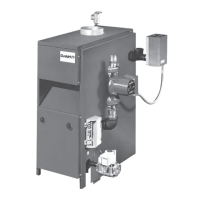
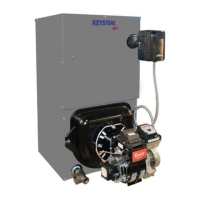
The provided manual describes the Dunkirk PWB Series Gas-Fired Hot Water Boilers, available in both Continuous Pilot (PVWB) and Electronic Intermittent Ignition (PWB) models. These boilers are designed for heating hot water in residential and commercial applications.
The Dunkirk PWB Series boilers are gas-fired appliances that heat water for hydronic heating systems. They are equipped with either a continuous pilot or an electronic intermittent ignition system to ignite the main burners. The heated water is then circulated through a piping system to radiation units (e.g., radiators, baseboards, convector radiators) to provide space heating. The system includes safety features such as a safety relief valve, rollout switch, and spill switch to ensure safe operation. A vent damper is integrated to improve efficiency by reducing standby losses when the burner is off.
The boilers are available in 2 to 9 sections, with varying input MBH, heating capacity MBH, and Net I=B=R Rating MBH.
Input MBH (1,000 Btuh):
Heating Capacity MBH (D.O.E. test procedure):
Net I=B=R Rating MBH (based on 1.15 piping and pickup allowance):
Dimensions (Inches):
Boiler Volume (Cu. Ft.):
Electrical Supply: Separate 120 volt circuit, 15 ampere, 14 gauge or heavier copper wire. Thermostat: 24 volt, heat anticipator set at .2 amps. Gas Pipe Sizes: Refer to tables for Natural Gas and Propane Gas pipe capacity based on length and BTU per hour input. Altitude Deration: For altitudes above 2,000 ft., input ratings are reduced by 4% for each 1,000 ft.


 To Next Page
 General