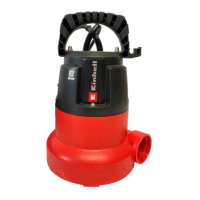
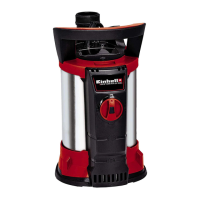
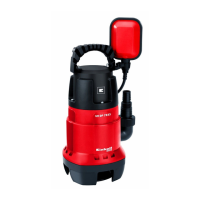
This document provides operating instructions for the Einhell RG-SP 750 LL submersible pump.
Function Description
The Einhell RG-SP 750 LL is a submersible pump designed for pumping water with a maximum temperature of 35 °C. It is suitable for various applications, such as moving water in the house or garden, and provides protection from flooding when installed in a shaft. The pump is not designed for continuous operation, such as a circulating pump in a pond, as this would significantly shorten its lifespan due to continuous loading. It is also explicitly stated that the equipment must not be used in swimming pools or paddling pools, or any other bodies of water where people or animals may be present during operation. The pump is designed for its prescribed purpose only, and any other use is considered misuse, with the user/operator being liable for any resulting damage or injuries.
The pump features an integrated floating switch, which allows for two operating modes: automatic and manual/shallow water. In automatic mode, the selector switch (A) is in the lower position (Fig. 4), activating the floating switch. The pump activates at approximately 12 cm water height and switches off when the water height reaches approximately 3 cm. In manual mode or for shallow water operation, the selector switch (A) is in the upper position (Fig. 5). This bypasses the integrated floating switch, allowing the pump to run continuously and pump water down to 4 mm. However, it is important to note that the water depth must be at least 15 mm before the equipment can be run in manual mode, and the pump must never run dry.
Important Technical Specifications
- Mains connection: 230V ~ 50 Hz
- Power rating: 750 W
- Max. pumping rate: 15,000 l/h
- Max. delivery head: 10 m
- Max. immersion depth: 5 m
- Max. water temperature: 35 °C
- Hose connection: 1 1/2" female thread
- Max. size of foreign bodies: Ø 5 mm
- Switching point height: ON: max. approx. 12 cm
- Switching point height: OFF: min. approx. 3 cm
- Min. suction height: 4 mm
The equipment requires a socket outlet with earthing contact, sufficiently fused (at least 6 A) and in good working order.
Usage Features
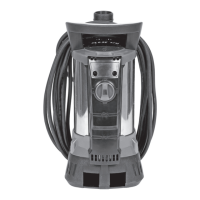
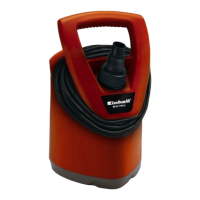
The pump is equipped with a carry handle (1) with cable rewind, a hose connection (2), a fastening nut (3), a pump housing (4), an intake cage (5), and a power cable (6).
Installation:
The pump can be installed either stationary with rigid tubing or stationary with a flexible hose line. It is crucial never to hang the equipment by the discharge line or the power cable; it must be hung by the provided carry handle or rest on the bottom of the shaft. To ensure proper operation, the bottom of the shaft must be kept free of sludge and dirt. Regular checks and trial start-ups are recommended to prevent sludge from drying out and hindering the pump's start-up. For optimal performance of the floating switch, the pump shaft should measure at least 40 x 40 x 50 cm to allow free movement.
Safety Precautions:
Before first use, it is essential to read and follow all operating instructions and safety information to prevent injuries and damage. In stagnant water bodies, garden ponds, swimming ponds, and their surrounding areas, the unit must only be used with an earth-leakage circuit breaker with an actuating rated current of up to 30 mA (according to VDE 0100 Part 702 and 738). The equipment is not designed for use by individuals with limited physical, sensory, or mental capacities, or those with no experience/knowledge, unless supervised or instructed by a responsible person. Children must always be supervised to ensure they do not play with the equipment.
Prior to operation, a specialist should check the earthing, protective multiple earthing, and residual-current operated circuit-breaker circuit to ensure compliance with safety regulations and correct functioning. Electrical plug-in connections must be protected from wet conditions, and in case of flooding risk, they should be placed in a safe area. The pump should not be used for aggressive liquids or abrasive substances, and it must be protected from frost and dry running. It should also be kept out of the reach of children.
Operation Checklist:
Before operating the pump, ensure it is set up securely, the discharge line is fitted correctly, the electrical connection is 230 V ~ 50 Hz, the electrical socket-outlet is in good working order, and no moisture or water can reach the power connection. Most importantly, ensure the equipment does not run dry.
Maintenance Features
General Maintenance:
Before any maintenance work, always unplug the power plug. For mobile applications, the equipment should be cleaned with clear water after every use. For stationary installations, it is recommended to check the floating switch for proper functioning every three months. A water jet can be used to remove any lint or fibrous particles from the housing. Sludge should be removed from the shaft bottom and shaft walls every three months, and clear water used to remove deposits from the floating switch.
Cleaning the Paddle Wheel:
If significant deposits accumulate in the housing, the bottom part of the equipment needs to be dismantled. First, disconnect the intake cage from the housing. Then, clean the paddle wheel with clear water. It is crucial not to put down or rest the equipment on the paddle wheel. Finally, reassemble in reverse order.
Replacement Parts:
There are no parts inside the equipment that require additional maintenance. When ordering replacement parts, provide the type of machine, article number, identification number, and the replacement part number. Further information and prices can be found on www.einhell.com.au.
Disposal and Recycling:
The packaging materials are raw materials that can be reused or returned to the raw material system. The unit and its accessories are made of various materials (metal, plastic) and defective components must be disposed of as special waste. Consult your dealer or local council for proper disposal.
Troubleshooting Guide:
The manual includes a troubleshooting guide to address common issues such as the equipment not starting (check power supply, raise floating switch position), not pumping (clean intake sieve, unkink hose), not cutting out (place equipment correctly on shaft bottom), insufficient pumping rate (clean intake sieve, clean equipment, replace wear parts), or switching off after brief running (unplug and clean equipment/shaft, ensure water temperature does not exceed 35 °C).


 To Next Page
 General