29
Owners Manual
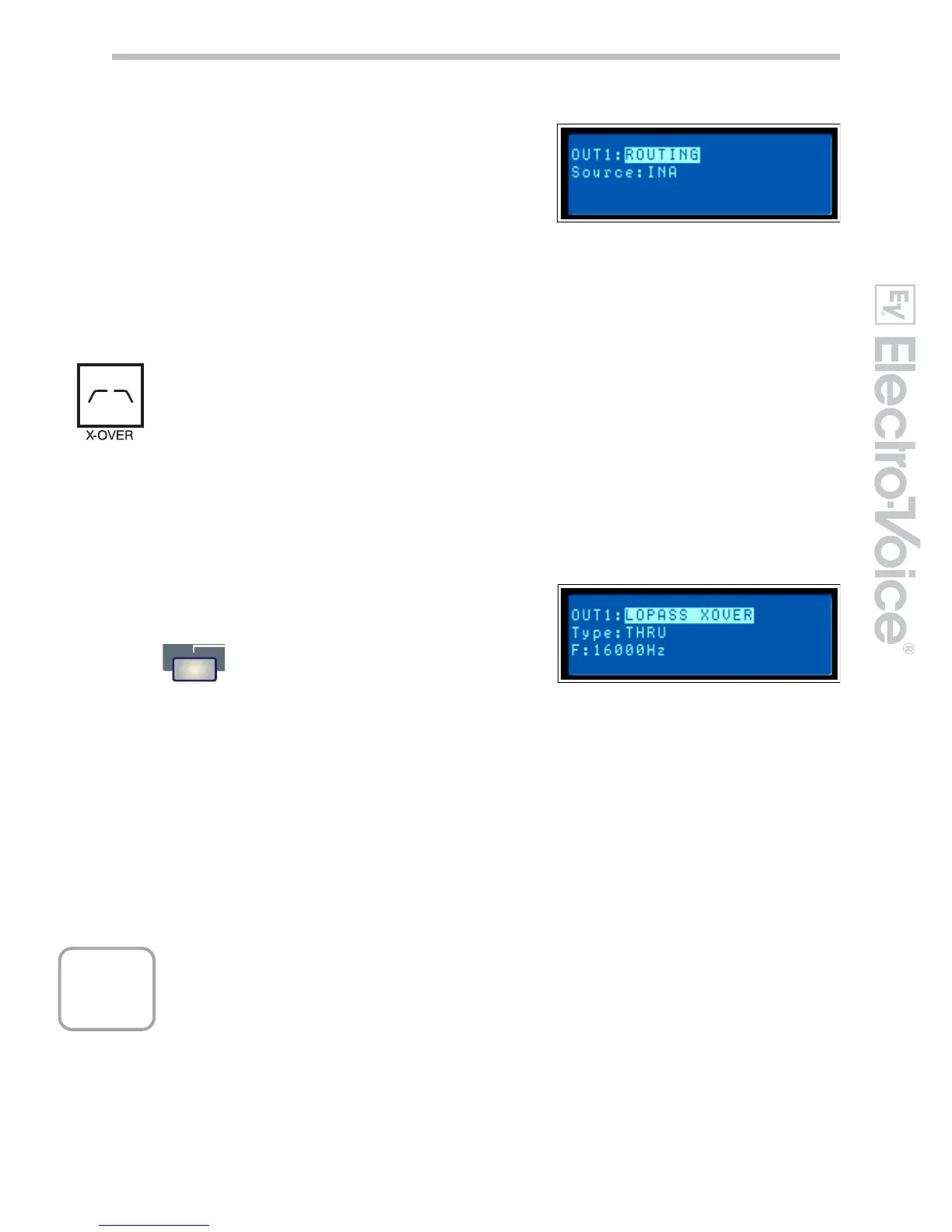
Routing
Input selections (In-A, In-B or In-A+B) can
be applied to any or all of DC-One’s six
outputs. Choose a desired output channel
from the output menu and press the Edit
button to scroll to the Routing window
using the Value up/down arrows.
Using the <SELECT> key to navigate to
the Source parameter, apply a desired input selection to a selected output
channel using the VALUE up/down keys to choose between inputs (In-A, In-B
or In-A+B).
Cross-Over (Output Channels)
The DC-One’s crossover is an advanced frequency division process that is
accomplished by applying a variety of high-pass and low-pass filters to a
predetermined set of crossover points.
Speaker systems are generally made up of several drivers that are dedicated
to a specific range of frequencies that result in the efficient reproduction of
the audio spectrum and a smooth sound. The DC-One crossover routes
frequencies to the appropriate drivers to accurately reproduce sound. The
crossover network can also be used to insure that low-frequency energy is not
accidently routed to the mid-range or tweeter drivers that may result in
potential damage.
Available DC-One crossover parameters are
Type and Frequency.
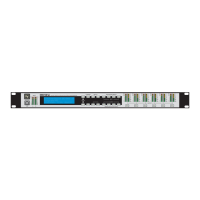
To access the Crossover screen,
press the X-Over button found on
the output processing menu.
Subsequent button presses will
toggle the display between OUT1 to OUT6. Use the <SELECT> button to
navigate between the Low Pass/parameters. Adjust the values of each
parameter using the up/down VALUE arrows.
The DC-One Crossover offers a variety of HiPass and LoPass filters depending
on the configuration output selected along with a variety of selectable filters
and frequency ranges that are adjustable using the up/down VALUE arrows.
Type
Type offers list of selectable slopes/response Q’s
· Thru
· 6dB
· 12dB/ 0.5Q - 2.0Q
· Bessel: 12 dB, 18 dB or 24 dB
· Butterworth: 12dB, 18dB or 24 dB
· Linkwitz-Riley: 12dB or 24 dB
X-Over
For detailed
EQ plot im-
ages please
see page 45





 To Next Page