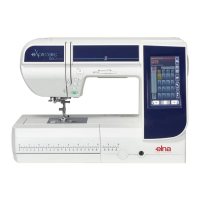
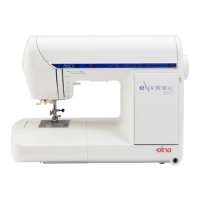
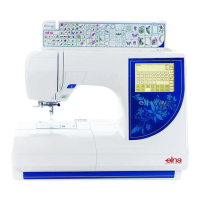
This document is a service manual for the "ec 30" model, providing comprehensive information for its maintenance, adjustment, and repair.
Function Description:
The "ec 30" is a sewing machine designed for various sewing tasks. It features a range of stitch patterns, including zigzag and triple stitch, and incorporates mechanisms for precise thread handling and fabric feeding. The machine is equipped with electronic components that control its operations, including a driving motor, feed motor, and zigzag motor, all managed by printed circuit boards. It also includes a self-diagnostic test mode to identify and troubleshoot issues.
Important Technical Specifications:
- Presser Bar Height: The distance between the bottom of the presser foot in the up position and the needle plate should be 6.0 mm.
- Needle Drop Position: The clearance between the needle drop position and the edge of the needle should be 0.2 mm or more for both sides when the stitch width is set to "5.0" (zigzag stitch).
- Hook Timing: The ascending travel of the needle bar from its lower position to the point where the tip of the rotary hook meets the right side of the needle should be 1.4 to 2.0 mm (for zigzag stitch with width "5.0").
- Needle Bar Height: The standard distance between the upper edge of the needle eye and the upper surface of the hook race should be 3.0 to 3.6 mm when the hook point meets the right side of the needle in its ascending travel from the right lowest position of the maximum width zigzag stitch.
- Clearance between Needle and Tip of Rotary Hook: The clearance should be -0.10 to +0.05 mm.
- Feed Dog Height: The highest position of the feed dog should be 0.80 to 0.95 mm from the surface of the needle plate.
- Backlash between Hook Gear and Lower Shaft Gear: The rotary play of the hook point should be 0.8 mm or less when it is between the span of the feed dog teeth.
- Top Tension: The top tension should be between 75 to 90 gf when pulling polyester sewing thread #50 (white) with the tension dial set at "4" and the presser foot lowered.
- Stretch Stitch Feed Balance: For the triple stitch pattern #05, the total stitch length from the 3rd piece to the 13th piece should be within the range of 25 to 27 mm.
- Motor Belt Tension: The belt should deflect 7 to 9 mm when applying 300 grams-force of load to the middle of the belt.
Usage Features:
The manual outlines various operational aspects, including:
- Stitch Selection: Users can select different stitch patterns, such as zigzag stitch and triple stitch, and adjust stitch width.
- Power Control: The machine is turned on/off via a power switch.
- Handwheel Operation: The handwheel is used to manually control needle movement and hook timing during adjustments.
- Presser Foot and Feed Dog Control: The presser foot lifter and feed dog position (up/down) can be adjusted.
- Bobbin Winder: The bobbin winder spindle can be moved to the right for bobbin winding.
- Speed Control: A speed control lever is available for adjusting sewing speed.
- Needle Threader: The machine includes a needle threader plate for easier threading.
- Self-Diagnostic Mode: A dedicated self-diagnostic mode allows users to check the functionality of various components, including LED displays, buzzer, lamp, buttons, bobbin winder switch, presser foot lifter switch, upper shaft positioning sensor, zigzag motor, feed motor, foot control, slide volume, and DC motor. This mode provides specific LED displays and buzzer sounds to indicate correct or defective conditions.
Maintenance Features:
The service manual provides detailed instructions for:
- Changing External Parts: Procedures for removing and attaching the face cover, bed cover, front cover, and rear cover.
- Mechanical Adjustments: Step-by-step guides for adjusting critical mechanical components:
- Presser bar height
- Needle drop position
- Hook timing
- Needle bar height
- Clearance between needle and tip of the rotary hook
- Feed dog height
- Backlash between hook gear and lower shaft gear
- Top tension
- Stretch stitch feed balance
- Replacement and adjustment of the needle threader plate
- Replacing Electronic Components: Instructions for replacing key electronic parts:
- Printed circuit board A
- Printed circuit board L
- Driving motor (DC motor)
- Switching regulator unit
- Troubleshooting Guide ("WHAT TO DO WHEN"): A comprehensive table listing common problems (e.g., skipping stitches, fabric not moving, breaking threads, needle breaks, noisy operation, deformation pattern), their causes, and how to fix them, with references to specific adjustment pages in the manual.
- Self-Diagnostic Test: A detailed procedure to enter and interpret the self-diagnostic mode, which helps identify defective components and suggests remedies (e.g., replacing specific circuit boards or motors).
- Displaying Program Version: Instructions to access and display the machine's program version.
- Connector Handling: Emphasizes the importance of grasping the connector, not the cord, when disconnecting electronic components to prevent damage.
- Lubrication: Mentions oiling all moving parts as a remedy for noisy operation due to insufficient oil.

 Need help?
 General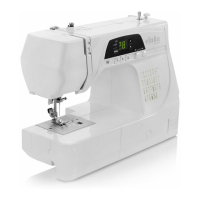

 To Next Page