EasyManua.ls Logo

Emerson Bettis RTS - User Manual

Emerson Bettis RTS
26 pages
Print Icon
To Next Page IconTo Next Page
Loading...
Bettis RTS
Connectivity with PROFINET
Installation, Operation and Maintenance Manual
FCIM-20054-EN Rev. 0
September 2023

Other manuals for Emerson Bettis RTS

Question and Answer IconNeed help?

Do you have a question about the Emerson Bettis RTS and is the answer not in the manual?

Summary

Hazard Warnings

Safety and Cautionary Notices

Summarizes WARNING, CAUTION, and NOTE notices for personal safety and equipment protection.

Section 1: General

PROFINET Interface Overview

Introduces the PROFINET bus system interface for Bettis RTS electric actuators as a hardware option.

Section 2: Topology

PROFINET Network Topologies

Details supported network structures like line, tree, star, and mixed forms for PROFINET.

Section 3: Technical Data

Bettis RTS PROFINET Specifications

Lists key technical data including data capacity, cycle time, baud rate, and transport layer.

Section 4: Limitations

Unsupported PROFINET Features

Outlines limitations and unsupported features for the PROFINET interface.

Section 5: Connection

Standard Connection Design

Explains the M12 connector setup for standard PROFINET fieldbus connections.

Explosion Proof Connection Design

Details wiring via screw terminals and shielding clamps for explosion-proof units.

Section 6: Exchange Cycling Data

PROFINET Cyclic Data States

Explains IOPS (Provider State) and IOCS (Consumer State) for data validity and handling.

Section 7: Settings

PROFINET Control Unit Parameters

Lists additional parameters for configuration when the PROFINET option is enabled.

Section 8: Description of Input and Output Data

Input Data from Master to Slave

Covers position assignment, commands, and set points for data transfer from master to slave.

Extended Registers and Commands

Details extended registers for executing commands and reading/writing values.

Output Data from Slave to Master

Describes actual position, status, torque, and speed data transmitted from slave to master.

Extended Message Status

Explains message status bits for transaction execution, errors, and busy states.

Summary

Hazard Warnings

Safety and Cautionary Notices

Summarizes WARNING, CAUTION, and NOTE notices for personal safety and equipment protection.

Section 1: General

PROFINET Interface Overview

Introduces the PROFINET bus system interface for Bettis RTS electric actuators as a hardware option.

Section 2: Topology

PROFINET Network Topologies

Details supported network structures like line, tree, star, and mixed forms for PROFINET.

Section 3: Technical Data

Bettis RTS PROFINET Specifications

Lists key technical data including data capacity, cycle time, baud rate, and transport layer.

Section 4: Limitations

Unsupported PROFINET Features

Outlines limitations and unsupported features for the PROFINET interface.

Section 5: Connection

Standard Connection Design

Explains the M12 connector setup for standard PROFINET fieldbus connections.

Explosion Proof Connection Design

Details wiring via screw terminals and shielding clamps for explosion-proof units.

Section 6: Exchange Cycling Data

PROFINET Cyclic Data States

Explains IOPS (Provider State) and IOCS (Consumer State) for data validity and handling.

Section 7: Settings

PROFINET Control Unit Parameters

Lists additional parameters for configuration when the PROFINET option is enabled.

Section 8: Description of Input and Output Data

Input Data from Master to Slave

Covers position assignment, commands, and set points for data transfer from master to slave.

Extended Registers and Commands

Details extended registers for executing commands and reading/writing values.

Output Data from Slave to Master

Describes actual position, status, torque, and speed data transmitted from slave to master.

Extended Message Status

Explains message status bits for transaction execution, errors, and busy states.

Overview

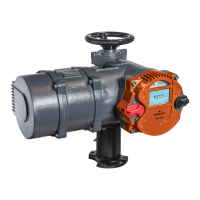
The Bettis RTS is an electric actuator designed for connectivity with PROFINET bus systems, an IEEE 802 Ethernet-based fieldbus system. This PROFINET interface is a hardware option that must be specified when ordering the actuator.

Function Description

The Bettis RTS actuator, when equipped with the PROFINET interface, integrates into a PROFINET IO network, utilizing a cyclic process data image for communication. Both the PROFINET IO Controller and Device maintain an image of input and output data, which is updated periodically via Ethernet frames. These frames contain I/O data and associated data status, configured at intervals by an engineering tool. The system operates on a Provider Consumer model, where an I/O data consumer exists for every I/O data provider, and both communicate their current state through various frames. These states include the IO Provider State (IOPS), indicating whether the associated data is valid (good) or invalid (bad), and the IO Consumer State (IOCS), which the consumer returns to the provider to indicate if the data has been handled. Each submodule within the PROFINET IO system exchanges its I/O data and two I/O data states with the IO-Controller.

The actuator supports various commands and data exchanges over the PROFINET network. Set points for position can be written and read, and commands such as OPEN, CLOSE, STOP, EMERGENCY OPEN/CLOSE, BLOCK, POSITIONER OFF, and WATCHDOG can be issued. Latched Open/Close commands, locking functions, and fail-safe triggers are also supported. Additionally, the system allows for intermediate position commands and PVST (Process Value Status) start.

Extended registers enable the execution of further commands and the reading of various information. This involves specifying a register number and, if applicable, a value to be written or read. The system also provides output data from the slave (actuator) to the master (controller), including actual position, status information, actual torque, actual speed, and external actual value (for PID-controller option).

Status information includes:

  • Status 2: Provides digital output and input states, phase sequence error, FC error (power supply unit/frequency converter), and fail-safe unit readiness. Parameters can be set to define alternative output functions for Status 2.
  • Status 3: Reports error numbers such as motor temperature warnings/cut-outs, phase sequence errors, power supply/frequency converter errors, fail-safe unit errors, and fault position/torque sensor errors. Parameters can be set to define alternative output functions for Status 3.
  • Status 4: Displays bus channel activity (A, B, or both) and PVST status (not activated/available, active, successful, or error). Parameters can be set to define alternative output functions for Status 4.
  • Extended Message Status: Indicates the state of read or write commands, including Idle, Pending, Done, Error, and Busy.
  • Extended Message Status – Current Register: Shows the currently accessed extended register number.
  • Extended Message Status – Current Register Value: Displays the current value of the currently accessed extended register.

Important Technical Specifications

  • Maximum number of total cyclic input data: 1440 bytes (including IOPS and IOCS)
  • Maximum number of total cyclic output data: 1440 bytes (including IOPS and IOCS)
  • Topology recognition: LLDP, SNMP V1, Physical Device Record Objects
  • Minimum cycle time (MinDeviceInterval): 1 ms
  • Baud rate: 100 Mbit/s
  • Data transport layer: Ethernet II, IEEE 802.3, MAUType 16
  • Minimum RDHT (SystemRedundancy only): 200 ms
  • PROFINET Interface: Utilizes 4-pin, D-coded, M12 connectors for standard design, ensuring a high degree of protection (IEC 61076-2-101). Explosion-proof designs use screw terminals with an additional frame and M20x1.5 threaded holes for cable earthing.
  • Cable types: Standard patch cables (twisted pair, S/UTP, AWG26, Cat5e) are recommended.
  • Data Formats:
    • Set point: 16-bit (lower 10 bits for 0-1023 range, 0-100% function).
    • Command: 16-bit (bit field).
    • Command 2: 16-bit (bit field).
    • Set Point – Revolution Speed: 16-bit (lower 8 bits for 0-100% value and direction).
    • Extended Registers – Commands: 16-bit (bits for execute, write, read operations).
    • Extended Register – Register Number: 16-bit (0 to 65535).
    • Extended Register – Register Value: 16-bit (0 to 65535).
    • Actual Position: 16-bit (lower 10 bits for 0-1023 range, 0-100% function).
    • Status: 16-bit (bit field).
    • Actual Torque: 16-bit (lower 8 bits for 0-100% value and direction).
    • Actual Speed: 16-bit (lower 8 bits for 0-100% value and direction).
    • External Actual Value: 16-bit (lower 10 bits for 0-1023 range, for PID-controller option).
    • Status 2, 3, 4: 16-bit (bit field or error number).
    • Extended Message Status: 16-bit (bit field).
    • Extended Message Status – Current Register: 16-bit (0 to 65535).
    • Extended Message Status – Current Register Value: 16-bit (0 to 65535).

Usage Features

  • Network Topologies: The two ports on the PROFINET board allow for line, tree, star, ring (if supported by master), and mixed network topologies.
  • Configuration: Parameters such as IP address, net mask, gateway, and watchdog time can be configured via the control unit. The watchdog time monitors a toggle bit from the master; failure to toggle within the set time results in a bus watchdog fault.
  • Setpoint Source: The set point can be specified via PROFINET, by an analogue signal, or a combination of both, with automatic switching to analogue value in case of a bus error.
  • Byte Order: The control unit can swap low and high bytes (P15.5) in registry values, and the transmission mode (big endian/little endian) must be adjusted for correct analog value transmission.
  • Actuator Identification: The MAC address is displayed in the Status Area S5 for unambiguous identification in the network.

Maintenance Features

  • Shielding Connection: For both standard and explosion-proof designs, the cable shield must be connected to the actuator housing via the connector housing or shielding connection clamp. This is crucial to prevent potential differences between devices in the PROFINET network, which could lead to transient currents over the cable shield.
  • Parameter Changes: After changing critical parameters (P15.1 to P15.3), the PROFINET protocol stack is restarted to apply the changes.
  • Error Reporting: The system provides detailed status information (Status 2, 3, and 4) to help diagnose issues related to digital I/O, power supply, motor temperature, phase sequence, fail-safe unit, and sensor faults. Extended message status also indicates transaction errors.

Emerson Bettis RTS Specifications

General IconGeneral
BrandEmerson
ModelBettis RTS
CategoryRecording Equipment
LanguageEnglish

Related product manuals