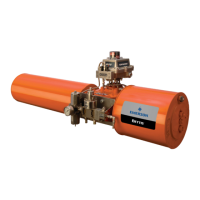
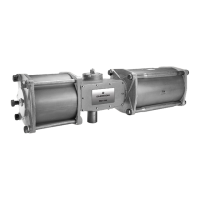
The Biffi Morin Series A, B, C, and S Scotch Yoke Actuators are designed for "ON-OFF" or modulating control of any quarter-turn ball, butterfly, rotary plug, or damper style valve application.
Technical Specifications:
- Supply Pressure: 40-160 psig (2.75 - 11 barg), as indicated on the product nameplate.
- Supply Medium: Any pneumatic fluid compatible with the materials of construction.
- Temperature Rating:
- Standard Range: -20 °F to +210 °F (-28 °C to +99 °C)
- Optional Range: -65 °F to +300 °F (-54 °C to +149 °C)
- Angular Rotation: 90 degrees ± 8 degrees.
Installation:
The actuator can be mounted parallel or perpendicular to the pipeline and in any convenient position, including vertical, horizontal, or upside down.
- Bolt the mounting bracket to the actuator hand tight, but do not fully tighten yet.
- Install the coupling on the valve. Ensure that rotary stops on the valve are removed or adjusted to allow the actuator stops to perform the stopping function.
- Install the actuator and bracket to the valve, keeping all fastener connections hand tight. If possible, stroke the valve and actuator to a half-open position (45°) and physically shift the actuator back and forth until the coupling and all fasteners are relaxed. Then, tighten all bolts and nuts. This procedure ensures accurate alignment of the valve stem to the actuator output shaft and prolongs valve stem seal life. Lift the actuator at a balance point near the center housing; do not lift the weight of the valve.
- Cycle the valve/actuator assembly and observe for smooth operation.
- Adjust travel stops for perfect alignment in both open and closed positions.
- For tubing connections, some models use two pistons for added power. Spring-return (single-acting) dual cylinder designs require one "jumper" to make the supply port common on both pistons. Double-acting (air-to-air) dual cylinder designs require two "jumpers."
Caution: Use correct length mounting bolts. Mounting bolts used in the actuator mounting pad must not extend more than two threads above the back of the mounting pad to avoid interfering with the actuator rotary mechanism.
Jackscrew Override:
The jackscrew option is intended for infrequent or emergency on-site operation of the automated valve.
Operating Instructions:
- Disengage the power supply and vent air from the actuator.
- Operate the handwheel to drive the actuator into the desired position. The valve position can be verified by checking the actuator position indicator. For models 006 through 270, the jackscrew must be returned to the fully retracted position before the actuator can resume normal operation. Back the jackscrew out until it stops. Air will leak from the jackscrew unless it is fully retracted against its internal seal.
Actuator Stroke Adjustment (Models 006 through 270):
The jackscrew has a built-in actuator stroke adjustment.
- Retract the jackscrew override completely by rotating counter-clockwise.
- Loosen the lock nut and turn the brass adjusting screw to the desired position. The handwheel will rotate with the adjusting screw. Never make stroke adjustments by turning the handwheel only.
- Tighten the lock nut.
Actuator Stroke Adjustment (Models 370, 575 and 740):
- Retract the jackscrew override completely by rotating counter-clockwise.
- Loosen the stroke adjusting screw and lock nut.
- Using the handwheel, turn the jackscrew to adjust the actuator to the desired position.
- Screw the adjusting screw until it stops and tighten the lock nut.
Manual Handpump Hydraulic Override:
- Hydraulic Fluid Level: The fluid level in the handpump reservoir changes when the actuator is operated. The fluid level is high when the hydraulic cylinder piston rod is retracted and low when extended. Measure the fluid level in the low position using a dipstick and maintain it 1 inch (25.4 mm) above the pump base. Operate the actuator open and closed to verify the low position. Tighten the fill port plug securely.
Caution: Do not exceed this fluid level, or fluid may squirt out of the relief valve.
- Remote Mounting: The handpump is normally installed on the actuator with the fill port on top. If installed on a valve in a pipeline, the fill port must remain on top regardless of the valve's angle. The handpump can be remotely mounted on an adjacent structure, ideally close to and above the actuator. If located below the actuator, both speed control valves must be completely closed before removing the reservoir fill plug to check the fluid level. This prevents hydraulic fluid from draining out of the actuator. Reset both speed controls after the fill plug is reinstalled.
- Handpump Specifications:
- Maximum reservoir fill volume = 75 in³ (1.23 dm³)
- Pump relief pressure = 1500 psi (103 bar)
- Pump volume/stroke = 0.66 in³ (0.01 dm³)
- Handle length = 24 in. (610 mm)
- Operation: Maintain fluid level with ISO-22 hydraulic fluid (e.g., Chevron "Hydraulic Oil AW"). The selector control valve is set in the center position for remote operation. Select left or right positions for manual open or manual close as shown on the pump label. Store and lock the handle to keep the pump plunger closed. Do not remotely operate the actuator with the handle on the plunger.
Integral Proximity Switch Mounting (Only with Prox Prep Factory Ordered Option):
- Remove plastic plugs from proximity ports on the back of the actuator housing.
- Insert the switch and turn clockwise until it touches the ferrous activator on the yoke, then back off approximately 1/16 in. (1.6 mm).
- Test the switch by stroking the actuator and verifying make and break of the switch.
- Repeat the procedure for the second switch if required.
Spring Conversion to Change Operating Pressure:
All spring packs, except the 40 psi (2.8 bar) pack (which uses only an outer spring), consist of an inner and outer spring. Various spring packages are available upon request from the factory.
Caution: Before attempting spring conversions, ensure the spring is in the "failed" or extended position. Remove any accessory equipment that might cause the spring to be cocked (e.g., declutchable override, jackscrew override).
- Procedure (Models S003 and B-006 only):
- Back off the adjustable travel stop on the end of the actuator opposite the spring end to allow maximum spring extension.
- Remove tie rod bolts (41). Back off piston bolt (33) until the spring is fully relaxed and piston (25) is free.
- Remove the 80 psi (5.5 bar) spring package and replace it with the desired spring package.
- Reassemble the piston, cylinder, endcap, and tie rods, following the tie rod tightening sequence. Do not overtighten bolts. Refer to the Assembly Torque Requirements Chart.
- Procedure (All models except S-003 and B-006):
- Alternately and uniformly remove bolts (51) from hollow tie rods. Back off each bolt approximately 1/4 in. (6.4 mm), following the tie rod sequence. Repeat until the spring(s) is/are totally relaxed and the endcap is free.
- Remove the 80 psi (5.5 bar) spring package and replace it with the desired spring package.
- Reassemble the endcap with bolts (51), using the reverse procedure from step B, ensuring the tie rod tightening sequence is followed. Ensure each hollow tie rod slides into the counterbore in the endcap. Do not overtighten bolts. Refer to the Assembly Torque Requirement Chart.
- Remove the nameplate from the actuator and stamp or etch the correct spring pressure rating accordingly.
Failure Mode Change - Spring-Return:
- Models 003-100 (Symmetric Yoke Actuators Only): Conversion from "fail close" to "fail open" is achieved by flipping the actuator over (left to right). The top and bottom of the center housing have identical mounting flanges and output shaft dimensions. Remove the vinyl pointer and indicator plate and mount them on the opposite side of the actuator.
- Models 023-7114 (Canted and Symmetric Yoke Actuators, Except Noted Above): Conversion requires removal of the spring cylinder assembly and reinstallation on the other side of the housing. It is recommended that fail-open and fail-closed actuators be ordered from the factory.
Maintenance:
Actuators are factory lubricated and generally do not require periodic lubrication or maintenance in service. They should be visually inspected periodically for corrosion damage and promptly repaired. Actuators should be operated at least annually to ensure proper operation.
Important Safeguards:
- Risk of Injury: To reduce the risk of injury, read the entire Installation, Operation and Maintenance Manual before installing, operating, or servicing this actuator.
- Inspect the actuator regularly for signs of corrosion and repair immediately.
- Always remove pressure and disconnect power supply before servicing the actuator.
- Keep hands and feet clear of an actuator that is in service.
- Do not disassemble the actuator without reviewing the disassembly procedure in this manual first. This is particularly important to ensure proper procedure is followed to avoid injury from internal spring power.
- Before attempting to remove an actuator from the equipment it is assembled to, always ensure that springs are in the "failed" or extended position. Remove any accessory equipment that may cause the spring to be cocked. If there is any doubt that the actuator is in the "failed" position, remove the air pressure from the actuator and install a long threaded bolt (a bolt that exceeds the length of the cylinder) in place of both travel stops. Once the actuator has been removed from the equipment, the long bolts must be removed first before the actuator can be disassembled.
- Repair or replace a damaged actuator immediately.
- Inspect the vent valves on models 1480 – 2380 during regular maintenance periods. The valves should allow leaking fluids to escape but prevent contaminates from the surrounding atmosphere from entering the actuator. Fluid leaking from the lower valve indicates a valve stem seal leak. Fluid leaking from the upper valve indicates a leaking cylinder seal. If leakage is observed from either valve, disassemble and repair the source immediately. Never replace the vent valves with plugs.
- Operate the actuators within the pressure and temperature ranges specified on the nameplate. Otherwise, the actuator life may be reduced or serious safety hazards may develop.
Additional Safety Instructions for Actuators used in a Potentially Explosive Atmosphere under ATEX 2014/34/EU:
- Marking: ATEX 2014/34/EU, Ex II 2G Ex h IIC T4 Gb.
- Selection: Ensure the equipment is marked with the correct equipment group, category, and type of atmosphere for the application, and that safety instructions are followed for each item of equipment. In particular, all items included in an actuator package, including valve, actuator, and all accessories, should be CE marked to ATEX in the appropriate and/or requested category.
- Installation:
- The installer must only use tooling appropriate to the working area.
- Installation must be carried out at ambient temperature.
- During installation, ensure that no metallic shocks/impacts are made to the equipment or the adjacent piping.
- Ensure that the equipment is suitably earthed (grounded) through the pipe or individually.
- The installer should thoroughly follow the operating and safety instructions provided for each individual item of equipment.
- When the valve is to handle hot fluids or fluids where exothermic reactions may take place, the end user must take all the necessary measures to ensure that the hot surfaces of the valve cannot provide a source of ignition to the surrounding gas, vapour, mist, or dust atmosphere.
- Before putting into use or during operation with a dangerous fluid, ensure that no release of the fluid to the atmosphere can take place.
- Maintenance:
- The operator shall ensure that maintenance and testing activities are carried out by competent personnel.
- The operator must ensure that only personnel qualified to work in a potentially hazardous area are allowed to carry out maintenance appropriate to the category of the equipment in use.
- The end user must ensure that only tooling appropriate to the working area is used.
- All equipment must only be fitted with manufacturer’s original spare parts.
Additional Safety Instructions for Actuators used in Emergency Shut-down Service or IEC 61508 Safety Integrity Level (SIL) Compliant Installations:
- The actuator will move a valve to the designated safe position per the actuator design within the specified safety time.
- The actuator has met the systematic requirements for SIL-3.
- The actuator is a Type A device with a hardware fault tolerance (HFT) = 0.
- If the automated partial valve stroke test (PVST) diagnostics is used, the diagnostics time is the PVST test interval.
- Customer is required to confirm the actuator is operated within the listed temperature limitations shown on page 1.
- Customers may voluntarily register their actuator by contacting Biffi actuator sales department.
- Actuators should be inspected for proper functioning and signs of deterioration every 100,000 cycles or annually (whichever comes first) under normal operating conditions. Inspect more frequently under severe operating conditions; defects should be repaired promptly.
- Normal operating conditions are: Air Quality within ANSI/ISA-7.0.01 standards; operating temperature and pressures consistent with the actuator nameplate and catalog limits; environment free from excessive particulates; operating environment consistent with the actuator materials of construction. Under these conditions, actuator life can exceed a million cycles.
- The recommended minimum operating interval is six months, and a partial stroke is acceptable to confirm that the installation is functioning.
- When an actuator has been repaired or any maintenance is performed, check the actuator for proper function (proof testing). Any failures affecting functional safety should be reported to the Pelham facility.
- IEC 61508 (SIL) installations should consult the Emerson factory to obtain the assessment and FMEDA report, which include failure data, PFDAVG, and other associated statistical data to establish or satisfy SIL level or requirements. This information is available in report MOR 12|04-064 R001 V1 R1 FMEDA.
- Proof testing of the actuator shall be performed on the interval determined per IEC 61508 / IEC 61511 requirements. A suggested proof test is included in report MOR 12|04-064 R001 V1 R1 FMEDA. No special tools are needed. The report includes the achieved proof test coverage.
- Service and maintenance on actuators shall only be performed by personnel trained in Safety Integrity Systems (SIS) operations and in the repair and maintenance procedure for Biffi actuators.

 Need help?
 General




 To Next Page