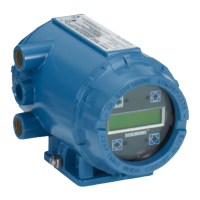
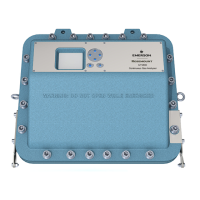
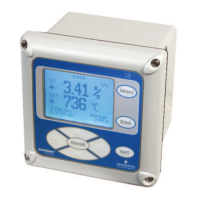
The 6888Xi Advanced Electronics is a sophisticated instrument designed to control zirconium oxide probes for measuring oxygen, primarily the O2 remaining from combustion processes. It offers a comprehensive suite of functions for installation, operation, and maintenance, ensuring accurate and reliable O2 measurement in various industrial applications.
Function Description:
The 6888Xi electronics performs several key functions:
- Heater Control: It receives a type K thermocouple input from an O2 probe and regulates power to the probe's heater to maintain a precise temperature setpoint of 736°C (1357°F).
- Signal Conditioning: The device processes the raw millivolt signal from the O2 sensing cell, linearizing and amplifying it to provide a linear 4-20 mA output signal. This signal can be used for recording or as an input to a Distributed Control System (DCS) for process control.
- Calibration: The 6888Xi facilitates calibration by introducing bottled gases of known O2 values (typically 0.4% O2 and 8% O2, balance nitrogen) into the probe. It automatically adjusts the 4-20 mA output signal to match the calibration gas values. With optional Single Probe Sequencers (SPS) or Intelligent Multiprobe Test Gas Sequencers (IMPS), the 6888Xi can also automatically switch calibration gases on and off.
- Diagnostics: The unit provides multiple alarms and diagnostic displays to assist technicians in identifying and resolving instrument problems. These diagnostics help pinpoint where an issue may reside within the system.
Important Technical Specifications:
- Measurement:
- Net O2 Range: 0 to 50% O2 (user scalable), or -2 to 50% O2 (user scalable with stoichiometer).
- Lowest Detectable Limit: 0.01% O2.
- Signal Stability: ±0.03% O2.
- Accuracy in Reducing Conditions: ±10% of reading or 0.1% O2.
- System Response in Reducing Conditions: T90 in 120 seconds (oxidizing to reducing), T90 in 30 seconds (reducing to oxidizing).
- Ambient Temperature Effect on Xi 4-20 mA Signal: Less than 0.0025% O2 per degree Celsius.
- Environmental:
- Enclosure Type: 4X/IP66, Polycarbonate Material.
- Ambient Temperature Limits: -20°C to 50°C (-4°F to 122°F) for the electronics, and -20°C to 70°C (-4°F to 158°F) as measured by electronics.
- LCD Display Ambient Temperature Limits: -20°C to 55°C (-4°F to 131°F).
- Installation:
- Mounting: Panel, wall, or pipe.
- Reference Air: 2 scfh (1 L/min), clean, dry, instrument-quality air (20.95% O2), regulated to 5 psi (34 kPa).
- Calibration: Semi-automatic or automatic.
- Traditional Architecture Cable: 200 ft (61 m) maximum length.
- Transmitter Electrical Power: 12 - 24 VDC (loop-powered from control room or 6888Xi).
- Electrical Power for 6888Xi: 120/240VAC ±10%, 50/60 Hz.
- Power Consumption: 12 VA maximum (without Traditional Architecture), 1020 VA maximum (with Traditional Architecture, 120V Probes).
- Alarm Relay Outputs: Two Form-C relays, 2 Amperes, 30 VDC.
- Optional Loss of Flame Input: Internally powered input to remove heater power, actuated via dry contact output from user’s flame scanner.
Usage Features:
The 6888Xi offers a local display/keypad for setup, calibration, and O2 display, along with advanced features accessible via the keypad or a HART Field Communicator (Model 375/475) or Asset Management Solutions (AMS) software.
- Probe Configuration: Allows detailed setup of probe parameters.
- Fully Automatic Calibration: Enables automated calibration sequences, especially when integrated with SPS or IMPS units.
- Failure Diagnostics: Provides detailed information on various alarms and fault conditions, aiding in troubleshooting.
- Flame Safety Interface: (Single probe version only) Disconnects heater power upon loss of process flame or heater over-temperature.
- Extended Temperature Operation: Allows operation above the standard 700°C (1292°F) temperature, with configurable heater setpoints (736°C or 550°C) and high-temperature alarms (750°C to 850°C). The heater can be configured to remain off if the process temperature falls below the setpoint, reducing ignition sources.
- Stoichiometer Feature: Indicates oxygen deficiency in reducing conditions (0% O2), allowing for lower range limits (-1% or -2% O2) in DCS trends. Requires an acid-resistant stoichiometer cell.
- Programmable Reference: Enhances accuracy at or near ambient O2 levels (20.95% O2) by allowing the use of a bottled reference gas of low O2 value (e.g., 0.4% O2).
- Plugged Diffuser Diagnostics: Detects when the diffusion element is plugging off by measuring the "return to process" time during calibration purge cycles. This feature helps prevent calibration errors caused by excessive pressurization and minimizes calibration gas usage and time. It can be configured for "Rate," "Proximity," or "Rate & Prox" detection modes.
- Password Protection: Secures configuration changes with a 4-numeric character password, preventing unauthorized access.
- D/A Trim: Calibrates the 4-20 mA output signal to a precision mA measurement device.
Maintenance Features:
- Maintenance Intervals: The maintenance schedule is variable, depending on the process environment. Calibration checks are generally recommended quarterly.
- Calibration Recommended Alarm: The 6888Xi provides a diagnostic alarm when calibration is recommended, ensuring timely recalibration and maintaining accuracy.
- Calibration Log: Stores current and up to 10 previous calibration records, including slope, constant, cell impedance, and time since calibration, aiding in tracking probe performance.
- Reset Calibration: Allows resetting the current calibration to the previous one, useful if a calibration was acknowledged in error or contained invalid values.
- Replacement Parts: Detailed procedures are provided for replacing various components, including the I/O Board, AC Relay Board, Power Supply Board, Front Panel, and DR Board.
- Software Upgrades: Enhanced software features can be activated for new I/O boards or for existing configurations, ensuring the device remains up-to-date with the latest functionalities.
- Troubleshooting: Comprehensive troubleshooting guides are available to diagnose and correct various fault indications, including grounding issues, electrical noise, electrostatic discharge, and specific alarm conditions related to probe and system health.

 Need help?
 General



 To Next Page