Need help?
Do you have a question about the Energate FZ100 and is the answer not in the manual?
Details regarding Energate's product patents and intellectual property rights.
Lists registered and unregistered trademarks of Energate Inc. and other companies.
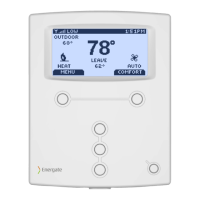
Covers navigation, home screens, and mode changes for the Foundation thermostat.
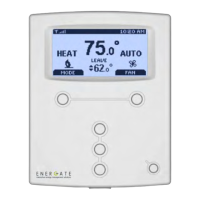
Explains navigation, home screen display, and control button functions for the Z100 Pioneer thermostat.
Instructions on how to safely remove the battery tab from the thermostat housing during initial setup.
Guidance on proper thermostat placement, wallplate installation, and wiring connections.
Details on installing the outdoor sensor in a shaded location for accurate temperature readings.
Procedure for cleaning the thermostat using a damp cloth with isopropyl alcohol, with caution for LCD.
Step-by-step instructions for safely removing the front housing of the Pioneer Z100 thermostat from its backplate.
Method for securely attaching the Foundation thermostat to its mounting bracket by snapping it into place.
Instructions on how to detach the Foundation thermostat from its mounting bracket using the snap-fit tab.
Diagram and terminal connections for wiring a Foundation thermostat to a conventional HVAC system.
Diagram and terminal connections for wiring a Foundation thermostat to a heat pump system.
Wiring diagram and terminal assignments for a Z100 Pioneer thermostat on conventional systems.
Wiring diagram and terminal assignments for a Z100 Pioneer thermostat on heat pump systems.
Guides on setting parameters for conventional HVAC systems like equipment type, stages, and fan settings.
Configuration options for heat pump systems, including reversing valve, type, stages, and balance points.
Details on equipment wiring and settings for a furnace and air conditioner setup.
Wiring and configuration for a furnace system without an air conditioner, including stages and fan control.
Wiring and configuration for an air conditioner system without a furnace, specifying cool stages and heat stages.
Wiring and settings for single-stage heat pumps without auxiliary heating, including reversing valve.
Wiring and settings for two-stage heat pumps without auxiliary heating, detailing stages and reversing valve.
Wiring and settings for single-stage heat pumps with auxiliary heating, including balance points.
Wiring and settings for two-stage heat pumps with auxiliary heating, covering multiple configuration parameters.
Solutions for installing thermostats when a common wire is unavailable, using auxiliary switches or spare wires.
Step-by-step guide for installing the AS20 Auxiliary Switch to enable common wire functionality in HVAC systems.
Instructions for installing an AS20 Auxiliary Switch with dual-transformer HVAC systems, covering wiring and connections.
Guidance on integrating Energate thermostats with typical zone control systems, emphasizing one thermostat per zone.
Using an Energate wall plate to cover existing wall openings when mounting the thermostat for a cleaner finish.
Details on recommended sensors and connection procedures for obtaining outdoor temperature readings.
How to connect an air filter sensor to the thermostat to receive alerts for filter replacement or cleaning.
Connecting a heat pump fault sensor to the thermostat's FAULT terminal to alert of issues and disable heat pump operation.
Information on the ZIP Connect device for enabling communication with utilities via the Internet.
Details on the optional Meter Data Collector for gathering and transmitting electricity consumption data to the thermostat.
Installation guide for the pager module, allowing remote communication with electricity providers via a FLEX pager radio network.
Information on the Wi-Fi module for wireless, two-way communication with utilities through a Wi-Fi network.
Procedure for testing heating, cooling, and fan functions on conventional systems using temporary hold.
Procedure for testing heating, cooling, and auxiliary heat functions on heat pump systems using temporary hold.
Enabling thermostat communication with ZigBee gateways like ZIP Connect or meters for utility data.
Steps to provision a gateway device using the Load Management System (LMS) for utility communication.
Associating the thermostat's MAC address with a ZigBee gateway via the utility website for successful connection.
Steps to pair the Foundation thermostat with the Meter Data Collector for receiving electricity consumption data.
Process to provision the pager module for utility network communication, requiring verification code and testing.
Obtaining thermostat MAC address and verification code for pager module provisioning process.
Associating a pager module with a home configuration using the Load Management System (LMS).
Verifying communication by sending a text message to the thermostat via the pager module.
Steps to diagnose issues when the thermostat doesn't power up or outputs don't energize, covering wiring and voltage checks.
Steps to resolve issues when provisioning ZIP Connect or other gateways fails, checking status and codes.
Common issues and solutions related to the ZIP Connect device, including power, internet connectivity, and indicator lights.
Resolving issues when the Meter Data Collector fails to pair or establish a link, focusing on sensor placement and alignment.
Diagnosing hardware issues with the Meter Data Collector based on status indicator lights and battery conditions.
Steps to troubleshoot issues with pager module installation and network provisioning, checking menu options and signal bars.
Steps to troubleshoot Wi-Fi module installation, connection, and error messages, including network setup and link info.
Procedure for requesting permission to return defective equipment, including required information for Technical Support.
Unsupported configuration: heat pumps with more than one auxiliary heating stage are not fully supported.
Unsupported configuration: individual thermostats do not support multiple zones; use zone controllers.
Unsupported proprietary communication protocols used by some HVAC equipment manufacturers.
Unsupported systems: Energate thermostats only support 24-volt HVAC systems, not line voltage.
Answers to common questions regarding thermostat installation, wiring, and initial setup issues.
Compatibility of Energate thermostats with hydronic systems, noting optimization for forced air.
Supported communication protocols for Energate thermostats, including ZigBee, pager, and Wi-Fi.
Answers to common questions about thermostat operation, schedules, and feature behavior.
Explaining why thermostats run HVAC equipment more often for precise temperature control and reduced cycling.
Troubleshooting incorrect time display on the thermostat, related to communication status with utility or manual settings.
Explanation of how thermostat schedules are structured with start times, target temperatures, and setpoints.
Understanding the thermostat's anticipation time feature that turns on equipment early to reach target temperature.
Meaning of the blue LED indicating adjusted setpoints due to energy or price conservation events.
Interpreting the yellow, orange, and red LEDs related to increasing energy prices and conservation levels.
Steps to temporarily override voluntary or mandatory energy events by adjusting the temperature.
Methods to permanently opt-out of or ignore energy and price conservation events via thermostat settings.
 General
| Type | Smart Thermostat |
|---|---|
| Connectivity | Zigbee |
| Programmability | 7-day programmable |
| Display | LCD |
| Demand Response Support | Yes |
| Remote Access | Via compatible smart home hub |


 To Next Page