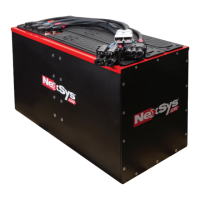
The EnerSys NexSys TPPL Battery is a lead-acid, valve-regulated battery designed for small traction applications, utilizing Thin Plate Pure Lead (TPPL) technology with a carbon additive in its active material formulation. This owner's manual provides critical information for the safe handling and proper use of these batteries, including global system specifications, safety measures, commissioning guidelines, and recommended maintenance.
Function Description:
The NexSys TPPL Battery serves as a power source for electrical industrial trucks. Unlike conventional vented lead-acid batteries, it features immobilized electrolyte and a valve system to regulate internal gas pressure, preventing oxygen ingress and allowing the escape of excess charging gases. This design eliminates the need for watering, making it a maintenance-free solution. The battery is designed to deliver reliable power, with its performance and lifespan optimized under specific operating and charging conditions. It can be used in various industrial truck applications, provided that all safety and operational guidelines are strictly followed.
Important Technical Specifications:
- Nominal Capacity (C5/C6): As specified on the type plate.
- Nominal Voltage: As specified on the type plate.
- Discharge Current: C5/5h or C6/6h.
- Rated Temperature: 30°C.
- Optimal Operating Temperature: Between 5°C (41°F) and 30°C (86°F) for operation, charging, and storage to achieve optimal battery life.
- Acceptable Ambient Operating Temperature Range for Discharge: Between -29°C (-20°F) and 45°C (113°F).
- Acceptable Ambient Charging Temperature Range: Between 0°C (32°F) and 45°C (113°F).
- Discharge Depth of Discharge (DOD): Discharges should ideally be 60% DOD or lower to maximize battery life. Deep discharges (over 60% DOD) are not recommended.
- Load Cut-off Settings:
- 50% DOD at an average loaded voltage of 1.98 volts per cell.
- 60% DOD at an average loaded voltage of 1.96 volts per cell (for average loads with currents in the range of 14 to 18).
- Charging Rate: Must be maintained between 0.18C6 and 0.40C6 for 2-volt cells, and 0.18C6 and 0.70C6 for 12-volt blocs, depending on the battery and charger type.
- Insulation Resistance: Must not be below 50 Ω per volt of nominal voltage. For batteries up to 20V nominal voltage, the minimum value is 1000 Ω.
- Maximum Inspection-Free Storage Time: 18 months if stored at or below 20°C (68°F) with no electronic devices connected. An OCV check is recommended after 12 months, and a refresh charge if OCV is less than 2.10 volts per cell. For storage above 30°C (86°F), OCV should be checked every six months.
- Terminal Torque (Standard Terminal):
- M6 Female: 6.8 Nm (60 lbf in) for 12NXS26 to 12NXS120 models.
- M6 Female: 9.0 Nm (80 lbf in) for 12NXS61, 12NXS85, 12NXS137, 12NXS157 models.
- 3/8-16" Female: 6.8 Nm (60 lbf in) for 12NXS86 model.
- M8 Female: 9.0 Nm (80 lbf in) for 12NXS166, 12NXS186 models.
- M10x1.5 Female: 25.0 Nm (222 lbf in) for All 2-Volt Cells.
- Terminal Torque (Terminal Adapter - SAE): 6.8 Nm (60 lbf in) for 12NXS26 to 12NXS120 and 12NXS86 models.
- Terminal Torque (Terminal Adapter - M6 Front Terminal): 9.0 Nm (80 lbf in) for 12NXS137, 12NXS157 models.
Usage Features:
- Maintenance-Free Design: The immobilized electrolyte and valve-regulated system eliminate the need for watering, simplifying maintenance.
- Opportunity Charging: NexSys TPPL batteries can be opportunity charged as often as needed without damaging the batteries, thanks to their specific charging profile.
- Flexible Installation: Batteries can be installed in any direction except inverted.
- Safety Features: The design minimizes gas emission rates, but adequate ventilation must always be provided in battery compartments.
- Over-Discharge Protection (Optional): Some batteries may be fitted with a Protection from Over-Discharge (POD) device, which provides visual and audible warnings when the maximum discharge level is reached, prompting immediate recharging.
- System Compatibility: Designed to be charged using EnerSys-approved chargers with appropriate NexSys TPPL battery charging profiles. Use of non-approved chargers or profiles will void the warranty.
- Initial Capacity: The battery reaches its full capacity after approximately 3 charging and discharging cycles.
- Connectivity: Electrical connections (plugs) should only be made or broken when the battery is in an open circuit condition (not charging or discharging).
- Multi-Unit Connection: When assembling multiple NexSys TPPL battery units into strings, flexible cable connections of adequate length must be used to prevent stress on terminals. Only batteries with the same state of discharge should be connected together.
Maintenance Features:
- No Watering Required: The immobilized electrolyte means no water additions are ever needed.
- Valve Integrity: Cell or bloc valves should never be removed. In case of accidental damage, contact an EnerSys representative for replacement.
- Cleanliness: The battery and its compartment should always be kept clean and dry. Any liquid in the battery tray must be extracted and disposed of properly, and insulation damage repaired to prevent corrosion.
- Daily Checks:
- Recharge the battery after every discharge.
- Check the condition of plugs and cables, ensuring all insulation covers are in place and in good condition.
- Weekly Checks:
- Allow up to 6 hours for a full charge at least once per week.
- Visually inspect for signs of dirt and mechanical damage to all component parts, especially charging plugs and cables.
- Quarterly Checks (End of Charge):
- Measure and record the voltage of the complete battery.
- Measure and record the voltages of individual cells or blocs.
- Contact an EnerSys representative if significant changes or differences are observed.
- If run time is insufficient, check compatibility with battery capacity, consistent charging, and charger settings.
- Annually Checks:
- Check the torque loading of bolts/screws on bloc-type products.
- Test the insulation resistance of the battery, ensuring it meets the specified minimum values.
- Storage Maintenance:
- Store fully charged in a cool, dry place, ideally below 20°C (68°F) but no lower than 5°C (41°F).
- For vehicle inactivity exceeding 48 hours, remove the ignition key and switch off auxiliary equipment.
- For decommissioning for one month or longer, professionally disconnect all electronic devices (e.g., Wi-iQ, POD device) by an EnerSys service representative.
- Conduct an Open Circuit Voltage (OCV) check after 12 months of storage and recharge if OCV is less than 2.10 volts per cell. For storage above 30°C (86°F), OCV should be checked every six months.
- A new battery can be stored for up to two years without performance degradation, provided OCV checks are conducted every 12 months and refresh charges are administered as needed.
- Disposal: End-of-life NexSys TPPL batteries must be recycled in compliance with local and national laws by a licensed or certified lead battery recycler. They must be packaged and transported according to prevailing regulations.
Safety Precautions:
- Always follow operating instructions and keep them near the battery.
- Only skilled personnel should work on batteries.
- Wear protective glasses and safety clothing.
- Adhere to current accident prevention rules (e.g., IEC 62485-3, EN 50110-1).
- No smoking; avoid naked flames, glowing embers, or sparks near the battery to prevent explosion.
- Avoid sparks from cables, electrical apparatus, and electrostatic discharges.
- In case of acid splashes, immediately wash with clean water and consult a doctor. Wash acid-contaminated clothing.
- Prevent short circuits by not using non-insulated tools, placing metal objects on the battery, or wearing rings, wristwatches, or clothing with metal parts that could contact terminals.
- Electrolyte is highly corrosive; if cell containers are damaged, the immobilized electrolyte is corrosive.
- Batteries are heavy; ensure secure installation and use suitable handling equipment.
- Lifting hooks must not damage cells, connectors, or cables.
- Do not place batteries in direct sunlight without protection.
- Store discharged batteries in a frost-free zone to prevent freezing.
- Be aware of dangerous electrical voltage; metal parts of the battery are always live.
- Do not use oil, organic solvents, alcohol, detergents, strong acids, strong alkalis, petroleum-based solvents, or ammonia solutions to clean the battery, as these can cause permanent damage and void the warranty.
- Ignoring instructions or using non-original parts will void the warranty. All failures, malfunctions, and fault codes must be reported to EnerSys service immediately.

 Need help?
 General



 To Next Page

