18
authentication encrypts the challenge text and sends it back to the access point. If the
challenge text is encrypted correctly, the access point allows the requesting device to
authenticate. It is recommended to select Auto if you are not sure which authentication
typeisused.
¾ KeyLength:Selecta64‐bitor128‐bitWEPkeylengthfromthedrop‐downlist.
¾ Key Type:Selectakeytypefromthe drop‐down list.128‐bitencryptionrequiresalonger
keythan64‐bitencryption.Keysaredefined byenteringinastring inHEX(hexadecimal‐
usingcharacters0‐9,A‐F)orASCII(AmericanStandardCodeforInformationInterchange‐
alphanumericcharacters)format.ASCIIformatisprovidedsoyoucanenterastringthatis
easiertoremember.
¾ DefaultKey:Youmaychooseoneofyour4differentWEPkeysfrombelow.
¾ EncryptionKey1‐4:YoumayenterfourdifferentWEPkeys.
¾ Enable 802.1x Authenti cation: Place a check in this box if you would like to use RADIUS
authentication. This option works with a RADIUS Server to authenticate wireless clients.
Wireless clients should have established the necessary credentials before attempting to
authenticate to the Server through this Gateway. Furthermore, it may be necessary to
configuretheRADIUSServertoallowthisGatewaytoauthenticateusers.Youwillthenbe
requiredtospecifytheRADIUSServer’sIPaddress,port,andpassword.
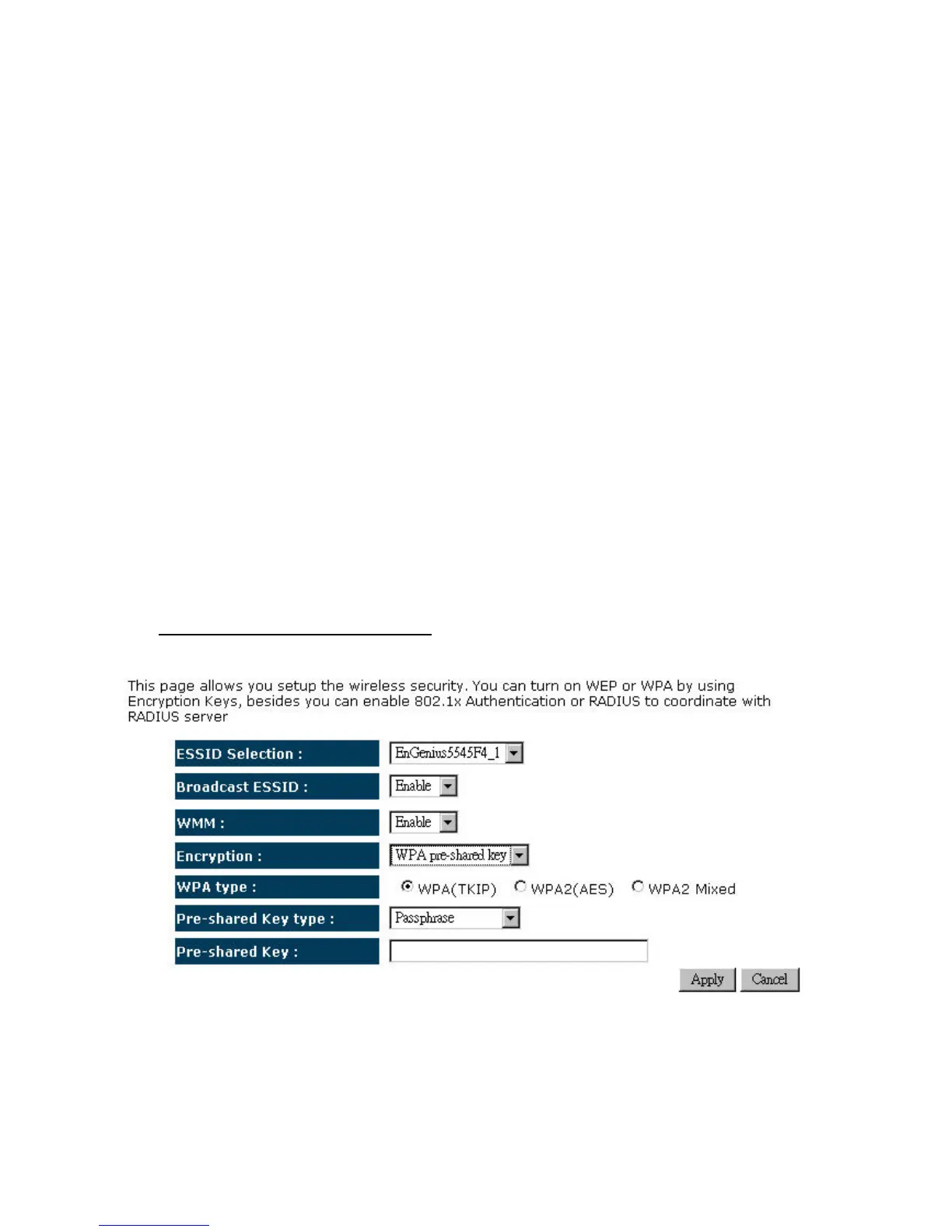
¾ Encryption:WPApre‐sharedkey
¾ ESSID Selection: As this device supports multiple SSIDs, it is possible to configure a
differentsecuritymodeforeachSSID(profile).SelectanSSIDfromthedrop‐downlist.
¾ Broadcast SSID: Select Enable or Disable from the drop‐down list. This is the SSID
broadcast feature. When
this option is set to Enable, your wireless network name is


 To Next Page