+1.800.343.5319 or +1.843.881.6560 envexp.com Environmental Express • 6
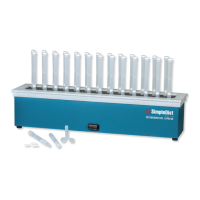
SimpleDist® Micro Heating Block: Operation & Instruction Manual Distillation Methods
Total Cyanide Distillation with the SimpleDist® Micro Heating Block
1.0 Scope and Application
1.1 This method follows US EPA method number 335.4 titled Determination of Total
Cyanide by Semi-Automated Colorimetry. It is applicable for the determination of
total cyanide in drinking, ground, surface, and saline waters, domestic and industrial
wastes, and soils.
1.2 The standard range is typically 5 to 500 µg/L. Lower detection limits can be achieved
by using a longer path length ow cell in the analysis step when using an automated
continuous ow analyzer.
2.0 Summary of Method
2.1 The cyanide as HCN is released from metal-cyanide complexes by means of an acidic
manual reux-distillation whereby the HCN gas that is formed is separated from the
sample matrix and absorbed in a dilute solution of sodium hydroxide. The distillate
can be analyzed for cyanide by semi-automated colorimetry, manual colorimetry,
titrimetric, or ion-selective electrode.
2.2 Reduced volume versions of this method that use the same reagents and molar ratios
as in the original method are acceptable provided they meet the quality control and
performance requirements stated in the method.
3.0 Interferences
There are several known interferences with this method. A few of these are:
Aldehydes Thiocyanates
Nitrate-nitrite Thiosulfates
Chlorine Suldes
Some of these interferences are reduced or eliminated by the distillation process. The addition
of magnesium chloride, which acts as a catalyst, will promote the breakdown of refractory
iron-cyanide complexes.
For all other pretreatment procedures refer to the US EPA method number 335.4 and/or
SW846 9010C.
4.0 Chemicals Required: Distillation Only
4.1 Sodium hydroxide solution (0.95 M) - Add approximately 500 mL of reagent water to a
1000 mL volumetric ask. Add 38 g sodium hydroxide (NaOH) pellets and stir to mix.
Caution: This reaction is exothermic and may release fumes. Allow the solution to cool
to ambient temperature and ll to the 1000 mL mark with reagent water.
4.2 Sulfuric acid (H
2
SO
4
), 36N (Concentrated)
4.3 Magnesium chloride hexahydrate (MgCl
2
•6H
2
O)


 To Next Page