+1.800.343.5319 or +1.843.881.6560 envexp.com Environmental Express • 12
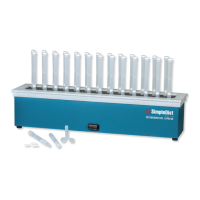
SimpleDist® Micro Heating Block: Operation & Instruction Manual Distillation Methods
Total Phenol Distillation with the SimpleDist® Micro Heating Block
1.0 Scope and Application
1.1 This method follows US EPA Method 420.4 and SW-846 method 9065. These methods
are applicable to the determination of phenol in drinking, ground, surface, and saline
waters, domestic and industrial wastes, and soils.
1.2 The standard applicable range is 10 to 500 µg/L total phenols. Higher concentrations
can be determined by sample dilution.
2.0 Summary of Method
2.1 A sample is pH adjusted to about 4 with sodium hydroxide or sulfuric acid to prevent
interference from sulfur compounds. It is then distilled and analyzed colorimetrically.
2.2 Reduced volume versions of this method that use the same reagents and molar ratios
are acceptable provided they meet the quality control and performance requirements
stated in the method.
2.3 Limited performance-based method modications may be acceptable provided they
are fully documented and meet or exceed method requirements.
3.0 Interferences
3.1 Sulfur compounds can interfere with the process. These compounds are removed by
adjusting the pH of the sample to about 4 prior to distillation.
3.2 Oxidizing agents can partially or fully oxidize phenolic compounds. These are tested
for at sampling and removed via appropriate measures.
3.3 Sample color and turbidity are removed via the distillation step. Some sample color
may persist after the initial distillation. These samples may be distilled again to
remove additional color. If the color persists, it must be corrected for via appropriate
instrumental methods.
4.0 Chemicals Required: Distillation Only
4.1 Phenol-free reagent water
4.2 1 M Sodium Hydroxide (NaOH) - Add approximately 70 mL of reagent water to a
100 mL volumetric ask. Stir and dissolve 4.0 g NaOH and allow the solution to cool.
Bring up to the mark with reagent water.
4.3 10% Sulfuric acid (H
2
SO
4
) - Add approximately 70 mL of reagent water to a 100 mL
volumetric ask. Stir and dissolve 10 mL concentrated sulfuric acid and allow the
solution to cool. Bring up to the mark with reagent water.
Note: The toxicity for each of the reagents used in this procedure is not fully documented.
Treat each chemical as a potential health hazard and limit exposure. Exercise good laboratory
technique with an emphasis on safety.


 To Next Page