28
EE33 Humidity / Temperature Sensor for High Humidity and Chemical Applications
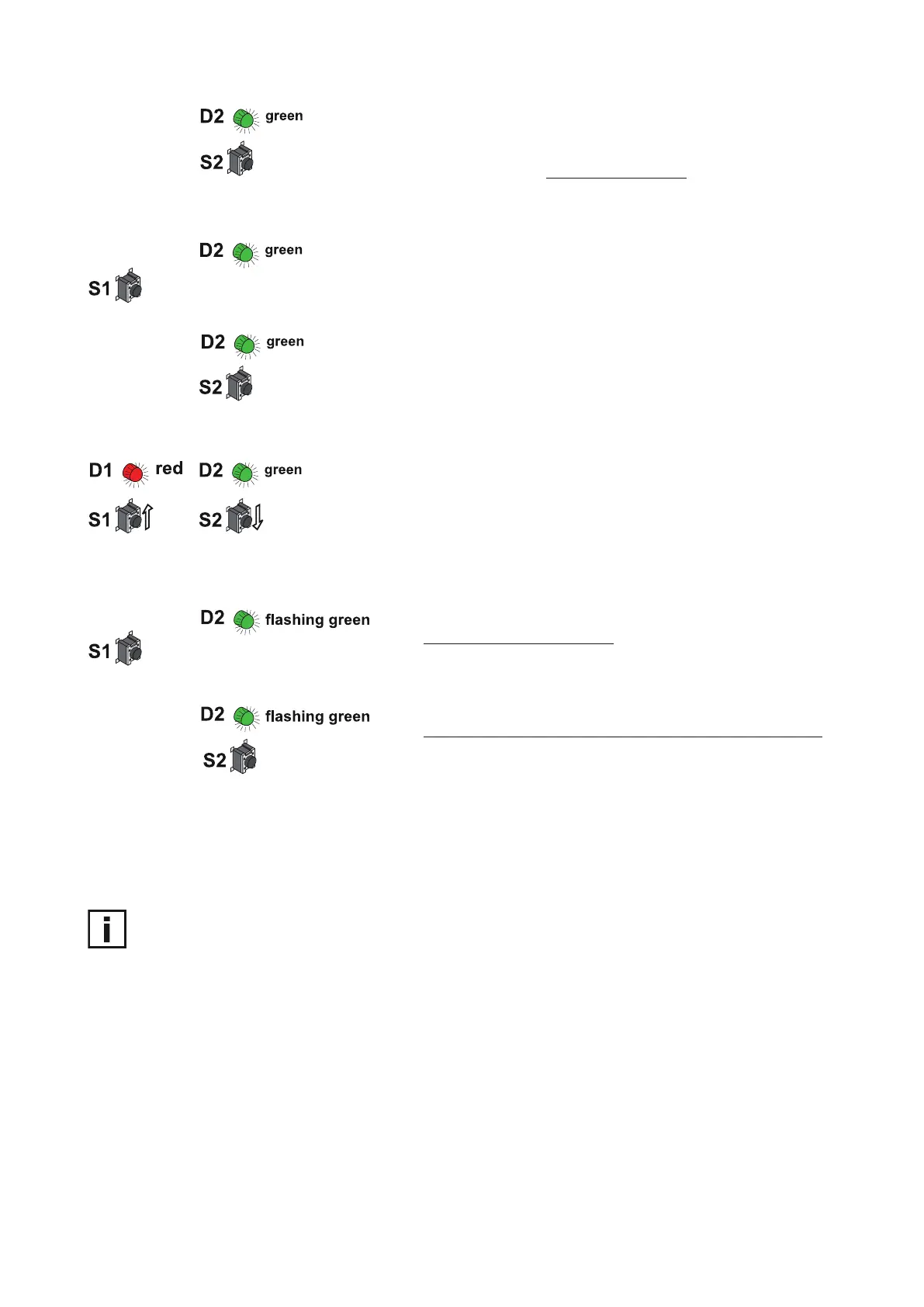
1. Insert the sensor probe into the reference humidity
(calibration point) and stabilise for at least 20 minutes.
2. BUTTON S2: Pressing the button for 5 seconds starts the
procedure for the calibration mode RH. The calibration mode is
indicated by the lit LED "D2" on the circuit board.
3. BUTTON S1: Pressing the button for 5 seconds starts the
procedure. The calibration mode is indicated by the lit LED "D2"
and the symbol "CALIB HIGH" will appear on the optional LC
display (CP ≥ 50% RH).
or
BUTTON S2: Pressing the button for 5 seconds starts the
procedure. The calibration mode is indicated by the lit LED "D2"
and the symbol "CALIB LOW" will appear on the optional LCD
(CP < 50% RH).
4. BUTTON S1 (up) and S2 (down): Pressing one of the two
buttons will adjust the measuring value in steps of 0.1% up or
down to the reference value. The actual measuring value is
indicated on the display or can be measured with the analogue
output.
5. BUTTON S1 (store): Pressing the button for 5 seconds
stores the calibration value and the procedure is ended. LED
"D2" flashes to indicate exiting of the calibration mode and the
symbol "CALIB LOW" or "CALIB HIGH" will disappear from the
optional LC display.
BUTTON S2 (cancel): Pressing the button for 5 seconds the
calibration procedure will be ended without storing the
calibration values. LED "D2" flashes to indicate exiting of the
calibration mode and the symbol "CALIB LOW" or "CALIB
HIGH" will disappear from the optional LC display.
“CALIB HIGH”
“CALIB LOW”
9.4 1-point Temperature Calibration
When the working range is limited to a certain more narrow range, a calibration at one temperature
point is absolutely sufficient.
In accordance with the working range, either the high or low calibration point should be selected. (CP
≥ or < 45 °C / 113 °F)
This calibration causes an extra inaccuracy for the rest of the working range.


 To Next Page