Operation
Operation
9 10
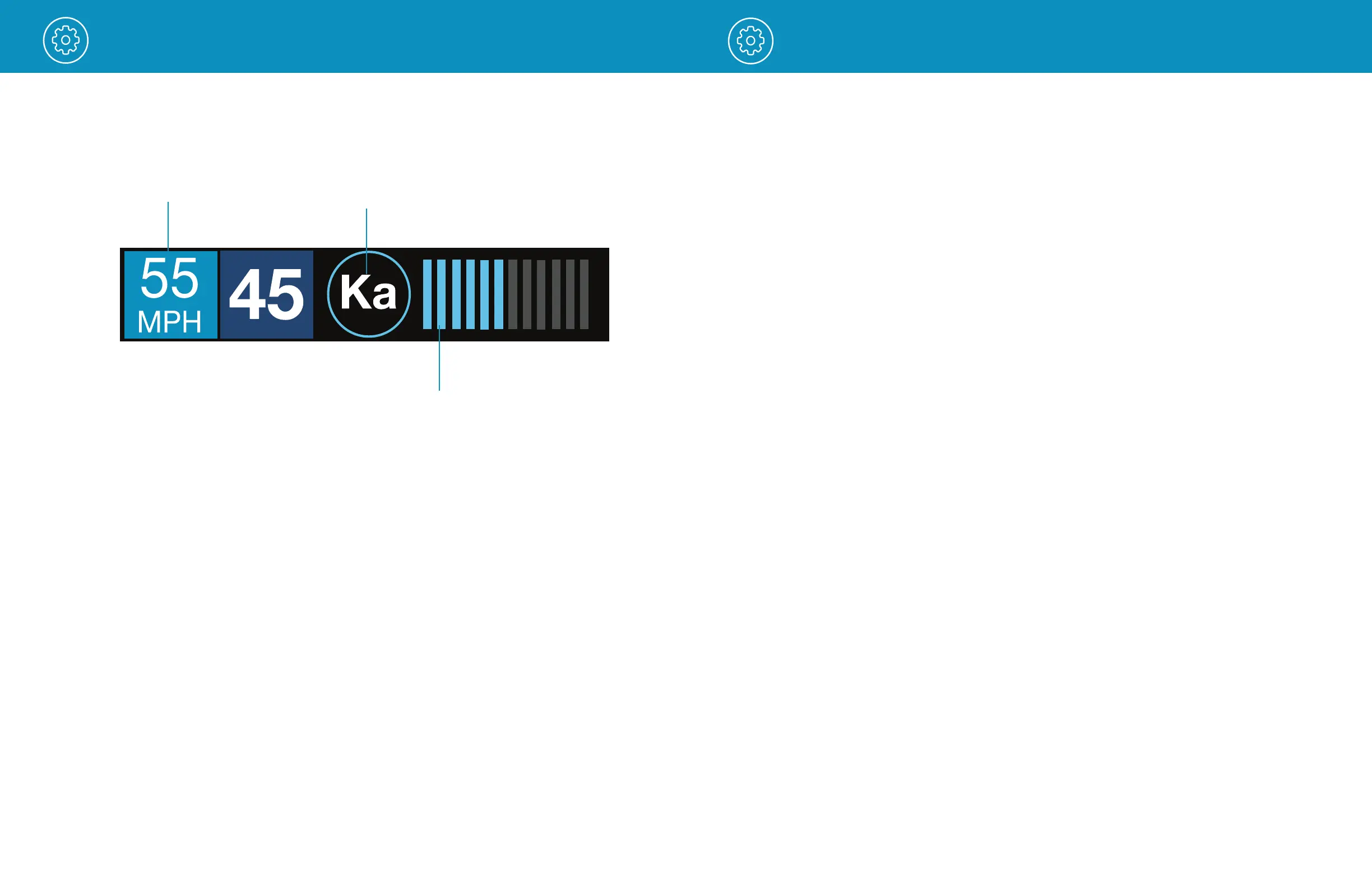
• Signal Band Indicator
Displays the radar band of the alert:
- X Band (commonly false alerts).
-
K band (used by police radar and
false alerts)
- Ka band (almost always police radar)
- Laser (almost always police)
• Signal Strength Meters
Displays the signal strength, or how close, the
alert is. The more alert bars displayed, the
stronger the signal strength. The left meter is
front signal strength. The right meter is rear
signal strength.
• OSP/Speed Limit Indicator
Over Speed alert setting, can be adjusted in
the Programming menu. Bluetooth icon will
appear here when paired to phone. Speed
limit data will appear here when connected to
the Drive Smarter app via Bluetooth
®
.
• Signal Counter
Displays the number of alerts being detected.
• Speed
Displays the current speed. When Speed
Display is o, displays the vehicle voltage.
DISPLAY AND MENU
OSP/Speed Limit
Signal Band Indicator
Signal Counter
How Radar Works
Trac radar, which consists of microwaves, travels in straight lines and is easily reected by objects
such as cars, trucks, even guardrails and overpasses. Radar works by directing its microwave beam
down the road. As your vehicle travels into range, the microwave beam bounces o your car, and the
radar antenna looks for the reections.
Using the Doppler Principle, the radar equipment then calculates your speed by comparing the
frequency of the reection of your car to the original frequency of the beam sent out.
Trac radar has limitations, the most signicant of these being that it typically can monitor only one
target at a time. If there is more than one vehicle within range, it is up to the radar operator to decide
which target is producing the strongest reection. Since the strength of the reection is aected by
both the size of the vehicle and its proximity to the antenna, it is dicult for the radar operator to
determine if the signal is from a sports car nearby or a semi-truck several hundred feet away.
Radar range also depends on the power of the radar equipment itself. The strength of the radar unit’s beam
diminishes with distance. The farther the radar has to travel, the less energy it has for speed detection.
Because intrusion alarms and motion sensors often operate on the same frequency as X, and K-band
radar, your detector will occasionally receive non-police radar signals. These transmitters generally
produce much weaker readings than will a true radar encounter. As you become familiar with the
sources of these pseudo alarms in your daily driving, they will serve as conrmation that your device’s
radar detection abilities are fully operational
.
How Laser (Lidar) Works
Laser speed detection is actually light detection and ranging (LIDAR). Laser guns project a beam of
invisible infrared light. The signal is a series of very short infrared light energy pulses that move in a
straight line, reecting o your car and returning to the gun. Laser uses these light pulses to measure
the distance to a vehicle. Speed is then calculated by measuring how quickly these pulses are
reected, given the known speed of light.
Laser is a newer technology whose use is not as widespread as conventional radar; therefore, you
may not encounter it on a daily basis. And unlike radar detection, laser is not prone to false alarms.
Because laser transmits a much narrower beam than does radar, it is much more accurate in its ability
to distinguish between targets and is also more dicult to detect. As a result, even the briefest laser
alert should be taken seriously.
There are limitations to laser, however. Laser is much more sensitive to weather conditions than radar,
and a laser gun’s range will be decreased by anything aecting visibility, such as rain, fog or smoke. A
laser gun cannot operate through glass, and it must be stationary to get an accurate reading. Because
laser must have a clear line of sight and is subject to cosine error (an inaccuracy that increases as the
angle between the gun and the vehicle increases), police typically use laser equipment parallel to the
road or from an overpass. Laser can be used day or night.
TSR Signal Ranking Software
Your radar detector includes an optional boost in anti-falsing software to eliminate excessive alerts
from erroneous K-band sources. One example of this is trac ow monitoring systems. These
systems, which are becoming more widely used in several countries, generate K-band signals to
measure the ow of trac on a given road. Unfortunately most detectors see this as a real threat and
will alert you to it unnecessarily. Our proprietary TSR software, intelligently sorts, ranks and rejects this
type of false alarm automatically. The result is ultimate protection without excessive false alarms.
UNDERSTANDING YOUR DETECTOR


 To Next Page
 Loading...