7
Duty cycle.
The Formula used to determine duty cycle is:
Run me
x 100 = Duty cycle
Run me + rest me
Working example 1: (Low duty cycle)
Run me: 17 seconds.
Rest me: 20 seconds.
17 ÷ 37 x 100 = 45.94
Thus the duty cycle in example 1 is said to be 45.94%
Working example 2: (High duty cycle)
Run me: 17 seconds.
Rest me: 1 second.
17 ÷ 18 x 100 = 94.44
Thus the duty cycle in example 2 is said to be 94.44%
The above examples do not factor in resistance and gate mass. These two elements contribute greatly to the amount of heat generated in your gate
automaon system.
Below are the maximum allowed duty cycles based on the gate mass and rolling resistance for the ET motor models. These are calculated to conform
to the standards set out in the SANS 60335-95-1:2011 safety code.
Duty cycle capabilies guideline of the ET Drive series motor models:
Model Gate Mass Starng Resistance Rolling Resistance Max Duty Cycle
Drive 1000 -
ACDC opon
≤ 1000 kg ≤ 40 kgf ≤ 30 kgf 98%
Drive 1000 -
Baery dependent opon.
≤ 1000 kg ≤ 40 kgf ≤ 30 kgf 25%
Where to posion the gate motor.
Liquid ingress:
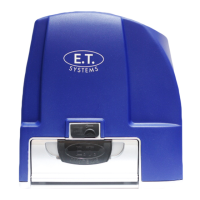
The ET Drive series motor models all carry an ingress protecon rang of IPX4. This means they are protected from splashing water. They are not
water ght as there are sensive electronic and electrical circuits that require uninhibited airow to remain cool and dry.
When deciding on an installaon posion, be aware of water collecon points around and near the desired mounng posion of the motor unit. If
the water does not ow away quick enough, it can seep into the system and cause expensive and possibly hazardous damage. Always install the unit
higher than the highest level, any water owing past the motor unit can reach.
Physical protecon:
Whenever possible, always install the gate motor on the opposite side of the gate’s guide/emergency post, to the driveway itself. This way it is out of
the path of the motor vehicles as they pass through the entrance/exit.


 To Next Page