etac.com
5
EN
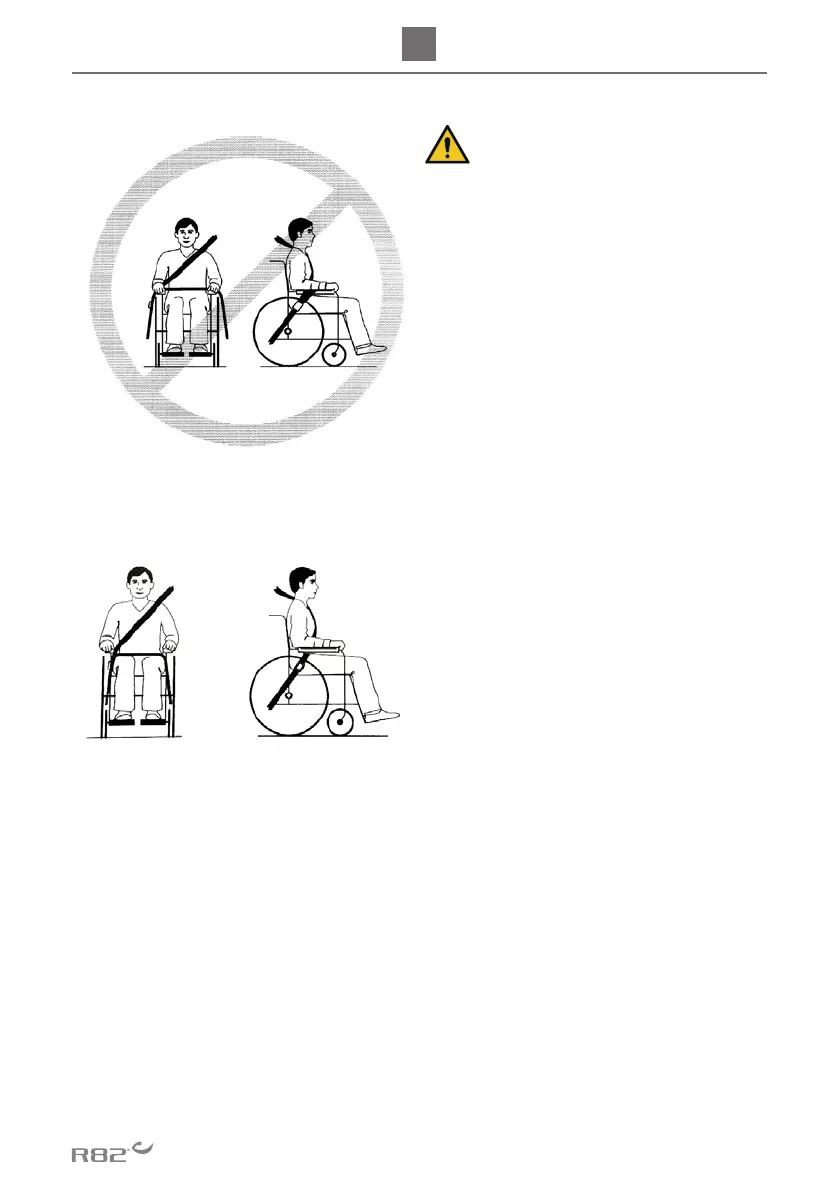
Figure 4
Shoulder belt restraints should t over the
shoulders, similar to the illustration provided in
gure 5.
Figure 5
An updated table covering congurations for
seats and frames, max. load/user weight in
transportation can be found in the overview
“frame_and_seat_combinations.pdf” at:
www.etac.com/support/support-center/
support-documents/
Check the user manual or assembly instructions
for the product, for information about:
• the minimum weight limit
• the securement points
• maximum load for the seat or frame (can also
be found on the product label on the product).
The wheelchair’s size and turning radius will
affect its ease of access to and maneuverability
in motor vehicles.
Small wheelchairs and/or wheelchairs with a
shorter turning radius will generally provide
greater ease of access and maneuverability.
03 - Warnings
The product is approved according to ISO 7176-
19:2022 furthermore the product complies to
ISO 16840-4:2009 if the product is a seat.
The wheelchair has been dynamically tested
in a forward facing orientation with the
anthropomorphic test device restrained by both
pelvic and shoulder belts (e.g. a shoulder belt
as part of a three-point belt restraint).
Pelvic and shoulder belt restraints should be
used to reduce the possibility of head and chest
impacts with vehicle components.
Loose parts and trays must be removed from
the wheelchair and secured separately in the
vehicle. Other auxiliary wheelchair equipment
should be either secured to the wheelchair or
removed from the wheelchair and secured in the
vehicle during travel, so that it does not break
free and cause injury to vehicle occupants in
the event of a collision.
The product should be inspected by the dealer
before reuse following involvement in any type
of vehicle collision. Alterations or substitutions
should not be made to the wheelchair
securement points or to structural and frame
parts or components without consulting the
wheelchair manufacturer. The approval is not
valid on ‘custom made’ chairs.
Care should be taken when applying the
occupant restraint to position the seatbelt
buckle so that the release button will not be
contacted by wheelchair components during a
crash.
Postural supports should not be relied on for
occupant restraint in a moving vehicle, unless
they are labelled as being in accordance
with the requirements specied in ISO 7176-
19:2022.



 To Next Page