36 | Operation
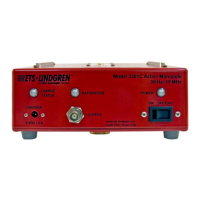
State of LED Indicates
Green The batteries are charged. You may disconnect the
AC adapter from the Model 3301C.
Red Fault condition.
If this occurs, disconnect the AC adapter from the
Model 3301C, and then re-connect the AC adapter;
CHARGE STATUS should now display a steady blue light.
If the red light persists, contact ETS-Lindgren
Customer Service.
CHARGER CONNECTOR
The charger connector is used to recharge the Nickel Metal Hydride (NiMH)
batteries. To charge the Model 3301C, set the power switch to OFF/CHG and
plug in the AC adapter. The charging circuit will not charge the batteries when
the Model 3301C is on. For more information, see Charging the Batteries on
page 42.
SATURATION LED
The saturation LED indicates that the amplitude of the signal has reached the
limits of the internal amplifier, after which the output signal will be distorted. The
saturation indicator will blink red and the unit will beep when the Model 3301C is
in saturation. Do not take readings when the unit is in saturation.
If saturation occurs, apply internal attenuation by changing the
DIP switch settings. See DIP Switches on page 38 for more
information.
Impulsive-type signals may put the Model 3301C into a non-linear region without
triggering the saturation circuit. When dealing with impulsive-type signals, strictly
observe the 63 dBu V/m/MHz limit. If a signal exceeds this limit, apply internal
attenuation.
The unit output capability is the limiting factor in handling impulsive-type signals.
Once the internal attenuators are engaged, most higher-impulsive signals may
be measured. For example, with the 30 dB attenuator engaged, a
93 dBuV/m/MHz signal may be measured.


 To Next Page