Manual EKS Electronic-Key Adapter USB
2094485-05-07/19 Subject to technical modifications Page 29/34
When the control system detects the character string DLE ETX BCC, it ends reception. The control system
compares the block check character BCC with the longitudinal parity calculated internally. If the block check
character is correct and no other reception errors have occurred, the control system sends the control character
DLE. If the BCC is erroneous, the control character NAK is sent to the peripheral device. A retry is then
awaited. If it is not possible to receive the block correctly after a total of six attempts (3964R protocol
specification) or the retry is not started by the peripheral device within the block waiting time of 4 s, the control
system interrupts the reception.
If transfer errors occur during reception (lost characters, frame errors, parity errors), the control system
continues to receive data until the connection is terminated and then sends the control character NAK to the
peripheral device. Then a retry in the form described above is awaited.
8.3.1.5 Summary of the most important points
DLE duplication:
For the control system to be able to differentiate between the control character DLE and a randomly
occurring 10
hex
value in the message core, a 10
hex
value in the message core must be sent twice. In this
way it is achieved that the data are interpreted by the receiving end as user data and not as control
characters for connection termination.
The BCC Block Check Character:
At the end of each data block, a block check character is sent to assure data integrity. The block check
character BCC is the even longitudinal parity (XOR operator on all data bytes) of a block sent or received.
The block check character is formed starting with the first byte of the message core after the connection is
set up and ends after the characters DLE and ETX during connection termination.
Retries on errors:
If an error occurs for any reason during data transfer, a total of six attempts are made to transfer the data
correctly.
8.4 Commands for writing and reading an Electronic-Key read/write
Write and read processes are always initiated by the PC using a “command message.”
The Electronic-Key-System then sends a reply message to the PC.
PC/control system Electronic-Key-System
Command message
→
-Key read/write with 116 bytes freely programmable, the memory is organized in 4-
byte blocks. This means the start address for writing must be given in the range byte number 0 to byte
number 112, always in 4
-byte steps (byte number 0, 4, 8 ... 112). Also, a multiple of 4-byte-sized blocks
must always be written (4, 8, 12 ... 116 bytes)!
However, during reading it is possible to access the memory byte
-by-byte without the above-mentioned
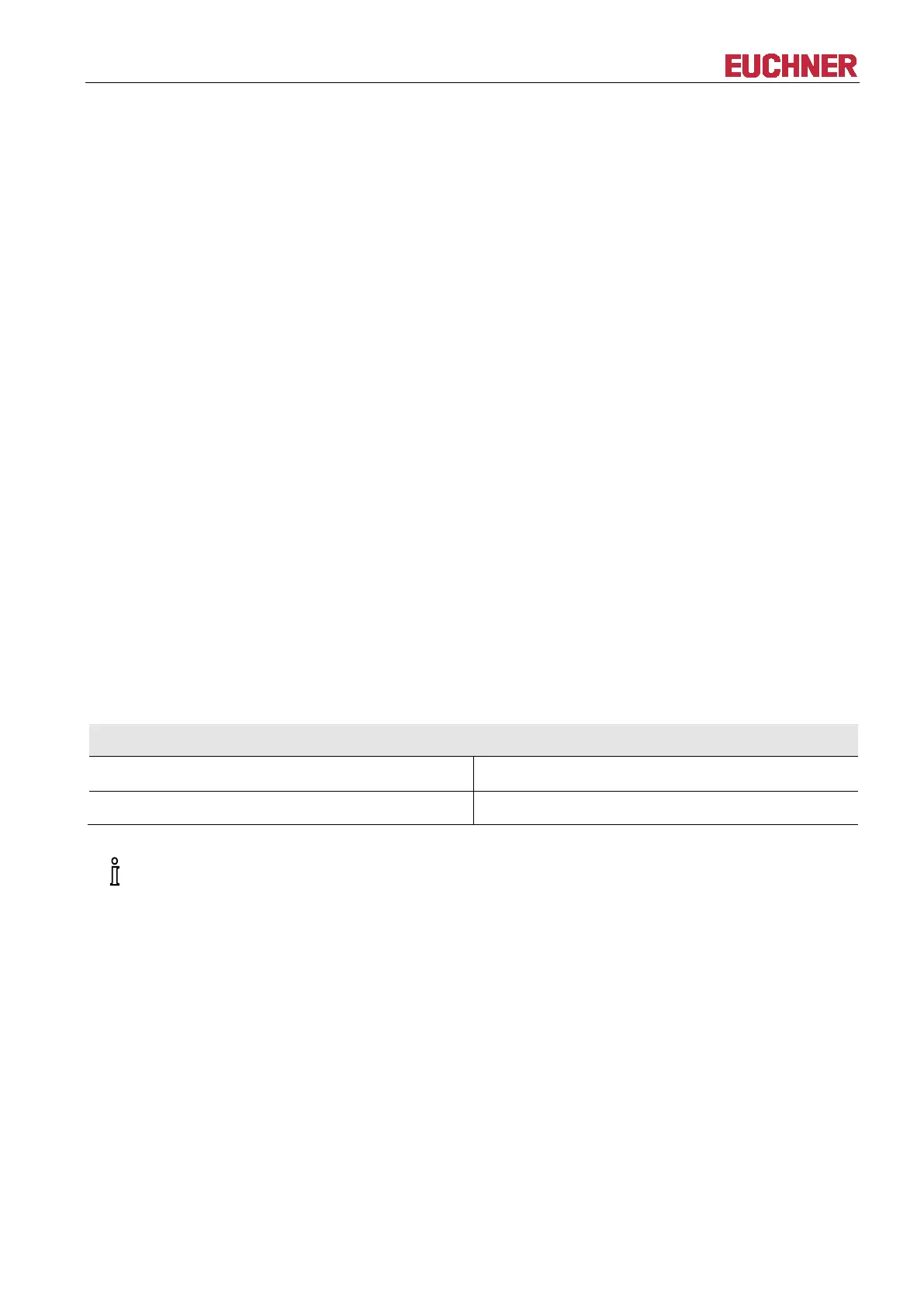
-Key read/write also has a unique 8-byte serial number that is permanently written to the
memory during the Electronic
-
Key production process. The serial number therefore cannot be changed.
The serial number is used for secure distinction of
every single Electronic-Key. It is necessary that all 8
bytes are completely evaluated for secure distinction. The serial number is appended to the freely
programmable memory. The serial number can be read by entering the start address byte number 116
and
the number of bytes 8.


 To Next Page