EasyManua.ls Logo

Euhomy CFJ-30 - User Manual

Euhomy CFJ-30
20 pages
Print Icon
To Next Page IconTo Next Page
Loading...
Emailsupport@euhomy.com
Facebook@Euhomy.Official
SKU
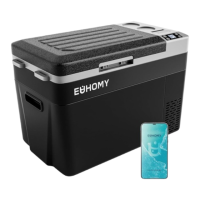
Car Refrigerator
CFJ-30/CFJ-30B
Instruction Manual
Question and Answer IconNeed help?

Do you have a question about the Euhomy CFJ-30 and is the answer not in the manual?

Overview

This document is an instruction manual for the Euhomy Car Refrigerator, models CFJ-30 and CFJ-30B. It provides comprehensive information on the product's functions, operation, technical specifications, and maintenance.

Function Description

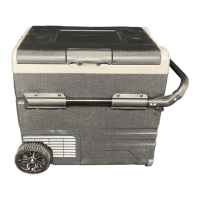
The Euhomy Car Refrigerator is designed to provide portable cooling and freezing capabilities for various applications, particularly in vehicles. It can be powered by DC 12V/24V from a car's cigarette lighter, or by AC 100-240V using an AC adapter. Some models (CFJ-30B) also support a detachable battery and solar charging, offering enhanced portability and off-grid use. The refrigerator features a built-in Eco electronic control module that monitors the car battery's voltage to prevent draining and ensure the car can start. It offers two operating modes: MAX for rapid cooling and ECO for energy-saving operation. The device includes a control panel for adjusting temperature, selecting operating modes, and setting battery protection levels. A removable divider allows for organized storage within the compartment.

Important Technical Specifications

  • SKU: CFJ-30, CFJ-30B
  • Input Voltage: DC12V/24V, AC100-240V
  • Temperature Control Range: -7°F to 50°F
  • Cryogen: R134a
  • Rated Power: 45W ± 20%
  • Rated Current: 5A/2.5A
  • Battery (CFJ-30B only): Detachable, purchased separately
  • Net Weight:
    • CFJ-30: 26.5 pounds
    • CFJ-30B: 28.9 pounds
  • Product Size (LWH): 23.1 * 12.6 * 16.2 inches
  • Packing Size (LWH): 24.4 * 14.6 * 18.7 inches
  • Battery Protection Voltage Reference (Factory Default: H):
    • 12V System:
      • H (High): 11.3V off / 12.5V on
      • M (Medium): 10.1V off / 11.4V on
      • L (Low): 9.6V off / 10.9V on
    • 24V System:
      • H (High): 24.6V off / 26V on
      • M (Medium): 22.3V off / 23.7V on
      • L (Low): 21.3V off / 22.7V on

Usage Features

Connecting Power: The refrigerator can be connected to a car's cigarette lighter using the provided DC power cord. For home use, an AC adapter (included in the standard packing list) is required. The device supports 12V/24V DC power directly. To start the refrigerator, the power button must be long-pressed for 3 seconds.

Control Panel Operation: The control panel features a power button, settings button, temperature increase button, temperature decrease button, and a temperature display.

  • Power Button: Turns the fridge on/off.
  • Settings Button: Selects between MAX (quick cooling) and ECO (energy-saving) modes.
  • Temperature Adjustment: Increases or decreases the set temperature by 1 degree per press, or quickly by pressing and holding.
  • Temperature Scale Selection: Pressing the temperature increase and decrease buttons simultaneously for 3 seconds switches between Fahrenheit (°F) and Celsius (°C).

Battery Protection Setting: The refrigerator has three battery protection levels: H (High), M (Medium), and L (Low). The factory default is H. To change the setting, press the settings button for 3 seconds, then press it again to cycle through H, L, and M. The selected level will flash for 3 seconds before saving. This feature prevents excessive battery drain, ensuring the car can start.

Detachable Battery and Solar Charging (CFJ-30B): For models with a detachable battery, the battery is installed in a dedicated slot. The battery can be charged via the fridge's 12V/24V power connection (cigarette lighter or AC/DC adapter) even when the fridge is off. Solar panels (output range 12–18V) can also be connected to charge the battery, but the solar panel does not directly power the fridge. It is recommended to set the battery protection level to "L" when using the battery to avoid "E1" (low charge) errors. The battery should not be charged in temperatures higher than 109°F.

Removable Partition: A partition can be inserted into the middle of the compartment to organize items. This partition does not affect the device's function or temperature display.

Applications: The car refrigerator is suitable for various uses:

  • Maintaining Temperature: Keeps items at a set temperature, especially useful with a battery for extended periods.
  • Storing Frozen Items: Ideal for ice cream, requiring the lowest temperature setting and constant power.
  • Preventing Deterioration: Keeps bottled water from overheating and fresh/frozen foods (including seafood) safe during long trips.
  • Preserving Beverages: Maintains the freshness of tea leaves and keeps red wine at its ideal storage temperature (50°F-64°F).
  • Fruit Preservation: Keeps fruits fresh for extended periods, unlike leaving them in a hot car.
  • Protecting Valuables: Prevents damage to items sensitive to high temperatures, such as sunglasses (coating peeling) and cosmetics (melting/spoiling).
  • Convenience: Features closed-loop hooks on one side for hanging bags or small tools, freeing hands.

Maintenance Features

Cleaning: Before first use, clean the refrigerator inside and out with a damp cloth. Regular cleaning of the inner compartment is recommended to prevent bacteria and odors and ensure food safety.

Storage: When the refrigerator will not be used for a long time, disconnect the power supply and keep it dry.

Troubleshooting and Solutions: The manual provides a comprehensive list of common problems, their causes, and solutions:

  • Refrigerator does not work: Check power connection, plug, power button, cooling ventilation, and fuse.
  • Poor cooling performance: Check if the lid is closed properly, door seal for damage, ventilation around the fridge, and temperature settings.
  • Abnormal noise: Ensure the refrigerator is on a flat surface, check for vibrations in surrounding objects, and ensure internal parts are secure.
  • Refrigerator condensation: Normal if humidity exceeds 75%.

Error Codes: The device displays error codes to indicate specific issues:

  • E1 (Low input voltage):
    • Cause 1: Power cord inserted before car started. Solution: Connect after car starts.
    • Cause 2: Adapter input voltage too low. Solution: Adjust battery protection to M or L, or replace adapter.
  • E2 (Fan fault): Solution: Replace the fan.
  • E3 (Input voltage fault due to compressor starting and stopping frequently):
    • In car: Shut down for 5 minutes, then restart. If persistent, refer to E1 solutions.
    • Via adapter: Adjust battery protection to M or L. If persistent, replace adapter.
  • E4 (Low rotational speed of compressor): Solution: Adjust input voltage and restart.
  • E5 (Overheating of controller chip): Solution: Power off for 5 minutes, check for poor ventilation around the compressor.
  • E6 (Temperature sensor wire disconnected): No solution provided in the manual, implies professional service.

Safety Notice:

  • Ensure proper voltage connection as specified on the product label.
  • Do not pour liquids directly into the refrigerator.
  • Do not modify the refrigerator independently, as it may be hazardous.
  • Do not expose the refrigerator to rain or other water sources.

Euhomy CFJ-30 Specifications

General IconGeneral
BrandEuhomy
ModelCFJ-30
CategoryRefrigerator
LanguageEnglish

Related product manuals